
CTOLITY 400W Portable Solar Panel
4.4Editor score
23% conversion efficiency
40V portable power output
IP65 waterproof construction
Adjustable kickstand design
Our 400w Solar Panel guide compares ten top models for output, portability, compatibility, weather resistance, installation, and suitability for every use.
A 400w Solar Panel is a substantial energy source for portable power stations, RVs, off-grid systems, and emergency reserves. Choosing well means looking beyond headline wattage to consider cell technology, output voltage, connector compatibility, portability, weather resistance, and the way each panel is intended to be installed.
We compared ten real options across foldable and rigid formats, using their stated electrical specifications, physical features, compatibility details, customer ratings, and support information. The list includes portable panels, paired 200W modules, bifacial designs, and higher-total-output alternatives relevant to the search keyword.
Each pick highlights the panel configuration that makes it most useful, while the reviews also identify important limitations involving voltage, shading, connectors, weather exposure, or system design. Product listings and prices can change, so confirm current specifications, power-station limits, and installation requirements before purchasing.
4.4Editor score

4.6Editor score

4.8Editor score
This comparison organizes all ten panels by format, rated output, efficiency, and intended installation, making it easier to distinguish a convenient portable charger from a permanently mounted solar system.
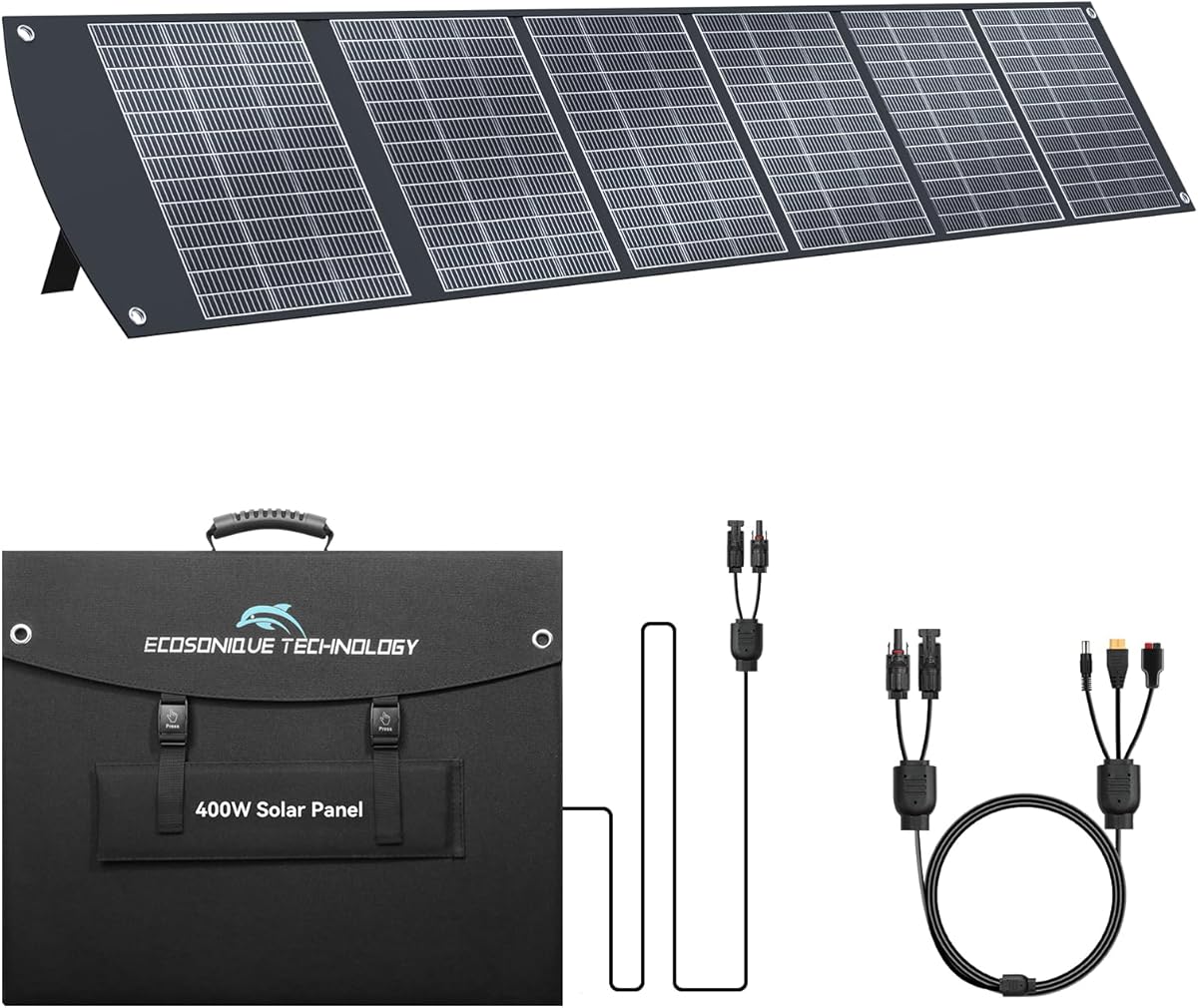




The CTOLITY 400W Portable Solar Panel combines a conventional 400W rating with a stated 23% conversion efficiency, earning it a 4.4 customer rating. Its most appealing combination is straightforward power-station charging, environmental protection, and a foldable format that suits campsites, RVs, boating, hiking, and emergency preparation without requiring a permanent rooftop installation.
We may earn a commission when you buy through this link, at no additional cost to you.
The panel is described as compatible with 40V portable power stations, including models from Jackery and EcoFlow. An auto-reboot feature is intended to resume charging when sunlight returns, while intelligent protection covers over-current, over-voltage, and short-circuit conditions. The adjustable kickstand helps users orient the cells more directly toward sunlight, making the panel practical for temporary setups where mounting equipment would be inconvenient.
Its Oxford cloth and PET lamination are rated IP65 for water resistance, while the sealed construction is also described as dust resistant. These features do not mean the panel can remain fully exposed in every weather condition, and users should still follow the manufacturer’s handling guidance. The 400W label is also a maximum output under favorable conditions rather than a guaranteed charging rate in clouds, shade, heat, or imperfect positioning.
This is a strong choice for someone who wants a capable foldable charger without moving into a permanently installed system. Check the power station’s input voltage, connector, and maximum solar-input rating before use. If those requirements align, the CTOLITY panel offers a balanced mix of efficiency, portability, protection, and straightforward deployment.
With a stated 23% conversion efficiency and 400W maximum output, this panel is designed to replenish compatible power stations efficiently. Actual charging time varies with sunlight, temperature, power-station acceptance limits, and the devices drawing power while the battery charges.
The auto-restart function reduces the need to intervene when clouds or changing light interrupt charging. Water-resistant Oxford cloth, PET lamination, and electronic protection add useful durability for camping and travel, although the panel should be stored dry when conditions demand it.
We may earn a commission when you buy through this link, at no additional cost to you.
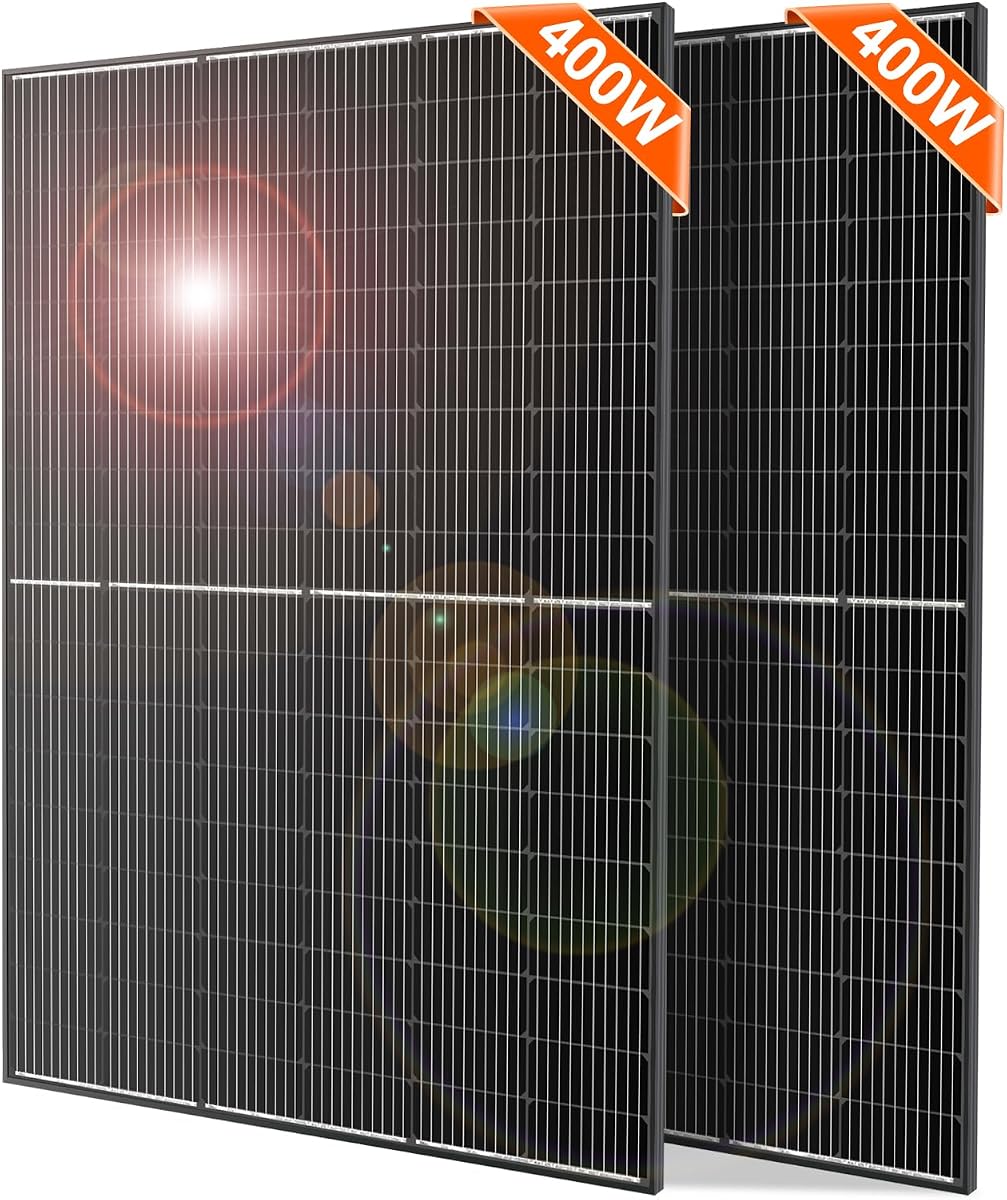
The DOKIO listing is a two-panel package rather than a single 400W module, delivering a combined 800W under standard test conditions. Its 4.1 rating reflects a more installation-oriented design, with tempered glass, aluminum frames, sealed junction boxes, and MC4 wiring. It is aimed at buyers creating a backyard, RV, marine, or off-grid array rather than carrying one panel to a campsite.
We may earn a commission when you buy through this link, at no additional cost to you.
Each panel is rated at 400W and uses 31V nominal output. The supplied information identifies compatibility with AGM, gel, and LiFePO4 batteries through PWM or MPPT controllers. It also explains that 12V parallel wiring is the default approach, while series operation requires suitable controllers. That distinction matters because a controller rated only for the combined current or voltage may limit performance or create safety problems.
A major practical advantage is the reduced connection count compared with an equivalent group of smaller 100W panels. Each panel includes approximately 9.84 feet of MC4 lead, helping panels reach a combiner or controller without immediately adding extension cables. Fewer joints can make the installation tidier and reduce potential connection points, but cable routing still needs protection from foot traffic, sharp edges, and moisture.
Choose this option if you want substantial permanent array output and already have, or plan to add, a properly sized controller and inverter. The two-panel format is less convenient to transport than a foldable charger. Verify charge-controller capacity, battery-bank voltage, fusing, grounding, and local installation requirements before connecting the system.
Using two substantial modules instead of many smaller ones can reduce the number of splitters, adapters, and parallel connections. The result is generally easier to organize and maintain, provided the charge controller and electrical design match the array.
Tempered glass, an aluminum frame, and sealed junction boxes suit a permanent outdoor installation. The buyer must still select weather-resistant cable routing, appropriate disconnects, and a controller that safely manages the array’s electrical characteristics.
We may earn a commission when you buy through this link, at no additional cost to you.
The Greenmagic Portable 400 Watt Solar Panel has a 4.6 rating and a 400W maximum output, making it one of the strongest all-around portable entries in this guide. Its stated 21.5–23.5% conversion range, 39V operating voltage, and support for series or parallel wiring make it suitable for common portable power stations and expandable solar setups.
We may earn a commission when you buy through this link, at no additional cost to you.
Compatibility is a major strength. The built-in MC4 cable is described as suitable for generators from Jackery, Goal Zero, EcoFlow, Bluetti, Anker, and other brands. Four built-in kickstands provide multiple ground angles, while four edge loops allow mounting from an RV or other support. These details make the panel more flexible than a model intended only for flat placement on a campsite.
The panel folds to approximately 32.09 by 31.30 by 1.97 inches and weighs 21.5 pounds, giving it a briefcase-like form that is still substantial to carry. Its laminated surface, 840D Oxford cloth, and IP65 rating protect against splashes, dust, moisture, and scratches. Importantly, the product information states that the junction box is not waterproof and advises against leaving the panel under rain or soaking it.
This is our Editor's Choice because it balances output, broad power-station compatibility, flexible positioning, and manageable packing. It suits campers, RV travelers, and homeowners who want one panel to serve several generator brands. Confirm the exact connector and input-voltage limits of your power station, and plan to protect the panel during heavy rain.
The built-in MC4 connection and stated support for major generator brands reduce setup friction. Compatibility still depends on voltage, connector type, and each power station’s maximum solar-input allowance, all of which should be confirmed.
Four independently adjustable kickstands and multiple hanging loops make it easier to optimize the panel on uneven ground or beside an RV. Small changes in angle can improve output, but avoid placing the surface where shadows fall across multiple cells.
We may earn a commission when you buy through this link, at no additional cost to you.
This 40V MC4 Foldable Solar Charger combines a 400W rating with a stated 23.5% conversion efficiency and a 4.4 customer rating. Its semi-flexible, six-fold construction is clearly aimed at travelers who need meaningful charging capacity but want a panel that occupies less space than a rigid module.
We may earn a commission when you buy through this link, at no additional cost to you.
When folded, the panel measures approximately 26 by 22 by 3 inches and weighs 20.3 pounds. High-grade Oxford fabric and CPC lamination are described as tear-resistant, dustproof, and waterproof. The product information also states a temperature tolerance from minus 4°F to 158°F, making it intended for varied seasonal environments, provided the panel and connected equipment remain properly managed.
The included 3-meter MC4 cable and shorter adapter lead supports power stations from EcoFlow, Jackery, Bluetti, Anker, and other brands. A six-angle kickstand helps optimize sun exposure, while auto-restart technology resumes charging after an interruption. Smart protection is also listed, along with a 12-month defect warranty and round-the-clock support through email or chat.
This is a compelling option for RV and camping users who value a compact package and a long included cable. The advertised 80% charging claim depends on ideal conditions and should not be treated as a guaranteed result for every power station. Check its maximum input rating, verify the adapter, and position the panel where it will not be shaded by trees, vehicles, or a tent.
The folded dimensions make the unit easier to fit into a vehicle than many rigid 400W panels. Its listed weight remains meaningful, so users should consider the lifting and setup effort required at an exposed campsite.
Auto-restart support is useful when thin clouds, passing shadows, or temporary power changes interrupt the input. A stable controller and a power station that supports solar reconnection remain important for dependable operation.
We may earn a commission when you buy through this link, at no additional cost to you.
The Callsun N-Type 400W Bifacial System pairs two 200W modules and has the highest customer rating in the group at 4.8. It combines advanced N-type monocrystalline cells, 16BB busbars, bifacial construction, and a dual-module parallel design, making it the most technically specialized 400W option for an installer seeking long-term outdoor performance.
We may earn a commission when you buy through this link, at no additional cost to you.
The two panels can be connected in series to produce 400W, 47.48V at the maximum-power point, and 54.62V open-circuit voltage. That operating profile is appropriate for many portable power stations with 60V-class solar-input limits, but it is not automatically suitable for every 12V or 24V battery system. The system voltage must be managed through a suitable controller, and the power station must accept the panel’s input range.
Its bifacial backsheet can capture light from the front, rear, and reflected surroundings, potentially increasing energy collection. The benefit depends on installation: rear exposure, reflective surfaces, and adequate clearance matter. The dual-module parallel construction also improves partial-shade performance because one independently operating section can continue producing when another is shaded.
Each panel measures 51.3 by 30.3 by 1.4 inches and weighs 23.8 pounds. A tempered-glass surface, corrosion-resistant aluminum frame, and IP68 junction box support durable outdoor use. A low temperature coefficient of minus 0.30% per K also helps in hot climates. This is our premium recommendation for buyers with compatible high-voltage inputs who value efficiency, shade tolerance, bifacial capability, and a stated 25-year performance commitment.
Dividing each panel into independently operating sections reduces the impact of a localized shadow. This feature is especially useful near trees, buildings, roof equipment, or other obstructions that can interrupt a conventional panel.
The transparent backsheet allows the rear side to contribute under suitable light conditions. Installation height, spacing, and reflective ground can influence the additional yield, so the advertised benefit should not be treated as guaranteed in every setting.
We may earn a commission when you buy through this link, at no additional cost to you.
This two-module 400W bifacial system uses N-Type Grade A+ cells and 18BB full-welding busbar technology. Its stated efficiency reaches 25% EL tested, while the 4.0 customer rating is the lowest in this comparison. It is primarily a rigid-panel solution for people building a permanent or semi-permanent solar array.
We may earn a commission when you buy through this link, at no additional cost to you.
A polyurethane-filled junction box is rated IP68 for water and dust resistance, and the aluminum alloy frame is designed to resist corrosion. The listing also cites resistance to 2,400 Pa wind pressure and 5,400 Pa snow loads. These specifications make the modules relevant to rooftops, RVs, vans, boats, and off-grid installations, although actual performance depends on mounting quality and local conditions.
The MC4 interface supports straightforward plug-and-play connections, and the supplied 11 AWG oxygen-free copper wire is rated to handle currents up to 25 amps. Reverse-current blocking technology is included to improve nighttime safety and system efficiency. A UV-resistant outer sheath adds protection for long cable runs exposed to sunlight and moisture.
This system makes sense for buyers who want advanced cells and robust weather sealing without paying for the Callsun package’s more elaborate anti-shading layout. Check the individual panel voltage, open-circuit voltage, and combined current before selecting a controller or battery architecture. Also consider whether two rigid 200W modules can be mounted where you need them.
N-Type cells and densely welded busbars support efficient output and long service life. The stated 25% EL-tested efficiency is useful for space-conscious installations where every available mounting area matters.
The filled junction box, corrosion-resistant frame, and protected wiring system target common outdoor failure points. Proper mounting and cable strain relief remain necessary to preserve those protections.
We may earn a commission when you buy through this link, at no additional cost to you.
The Renogy 400W N-Type panel has a 4.6 rating and focuses on efficient fixed installation rather than portable deployment. Its 16BB N-Type cells deliver a stated 25% efficiency, and the product is described as 7.5% smaller and 11.7% lighter than the preceding version while retaining the same 400W output.
We may earn a commission when you buy through this link, at no additional cost to you.
That dimensional improvement makes the panel a noteworthy option for Class B vans and other constrained spaces. It supports 12V and 24V battery systems, including lithium, AGM, and deep-cycle batteries. The low temperature coefficient helps maintain output in hot climates, while the 24V design is described as reducing current loss and improving system efficiency.
Long-term reliability is another central selling point. The listed degradation is no more than 1% in the first year and no more than 0.4% annually, with a stated 25-year, 80% output performance level. These are meaningful differentiators for permanently installed RV, van, or off-grid systems where replacing panels is inconvenient.
Choose this model for a compact, efficient fixed array with a trusted-looking long-term specification set. It is less convenient for campers who expect to fold and carry a panel, and the listed information does not suggest that a portable folding case is included. Buyers still need appropriate racking, wiring, fusing, and a controller sized for the installation.
The smaller dimensions relative to the predecessor are especially relevant for Class B vans. A compact footprint can make an unobstructed roof location more realistic, provided the panel does not compete with vents, antennas, or roof access.
The stated first-year and annual degradation limits make the panel easier to plan around for a permanent installation. Real output still varies with temperature, shade, orientation, and system losses, so appropriate sizing assumptions remain important.
We may earn a commission when you buy through this link, at no additional cost to you.
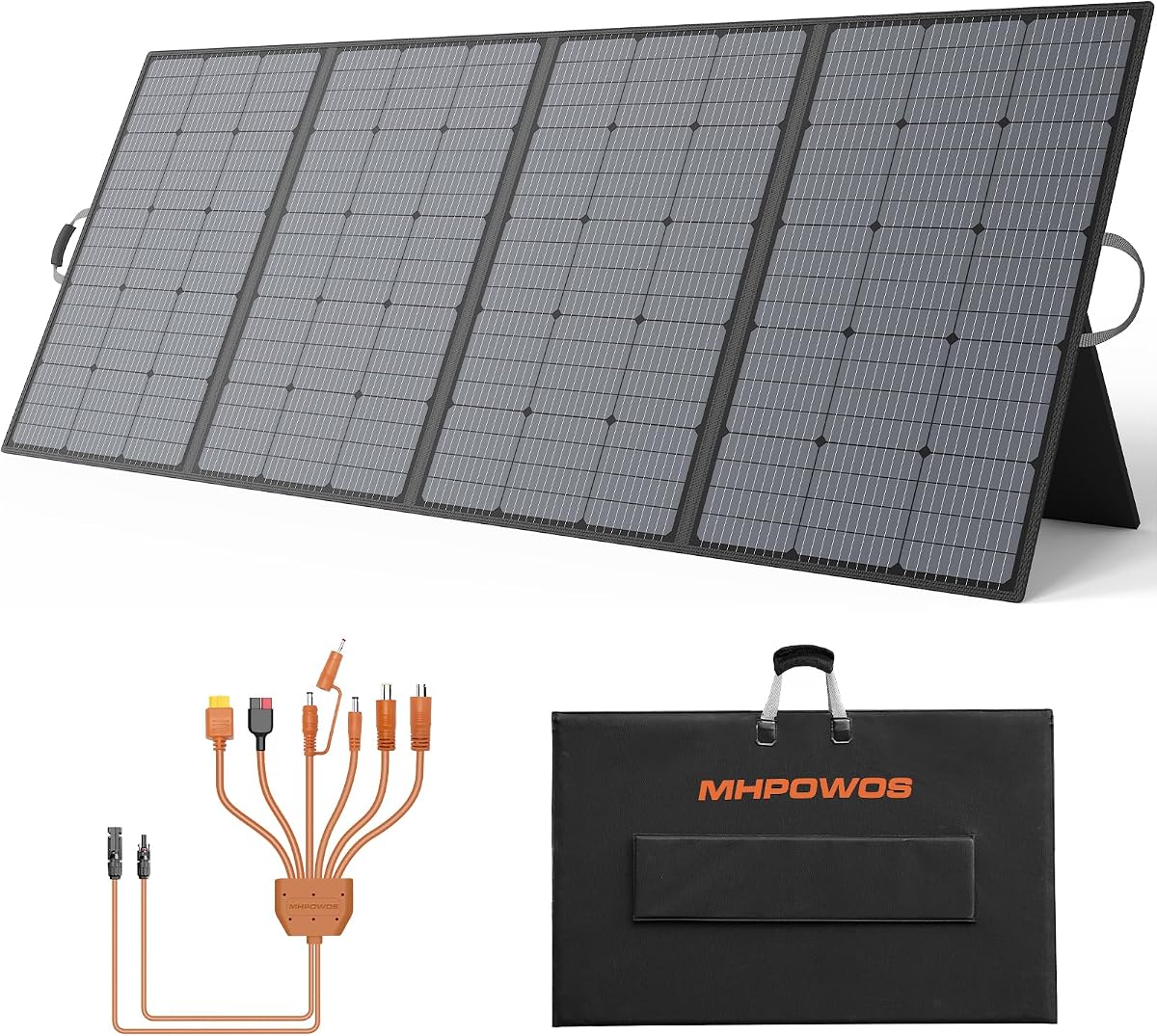
The MHPOWOS 400W Foldable Panel is designed around convenience and broad charging compatibility. It carries a 4.1 rating, claims 23.5% conversion efficiency from A+ monocrystalline cells, and includes connections for Anderson, XT60, DC7909, DC5521, DC8020, DC5525, and DC35135 interfaces.
We may earn a commission when you buy through this link, at no additional cost to you.
That range of adapters can simplify linking the panel to many portable power stations, though buyers should still verify voltage, polarity, and each station’s accepted solar input. The panel’s four built-in kickstands make it easy to position on a flat surface, while adjustable devices allow the angle to be refined toward the strongest available sunlight. A zippered pouch supports organized storage.
The panel is described as IP67 waterproof and dustproof, giving it useful protection for fishing trips, camping, RV travel, and other outdoor activities. Its 400W maximum output can still be limited by the connected power station, and the seller explicitly warns that some models accept less input than the panel can produce. That limit is a feature of the receiving device rather than a defect in the panel.
This is a useful pick for buyers who own an older or less common power-station connection and do not want to source a separate adapter. Its 4.1 rating is respectable but not among the strongest in the group. Check the power station’s manual, confirm the correct cable, and avoid placing the panel in a location where prolonged rain or pooling could overwhelm the enclosure.
The included range of adapters is especially helpful for households or campers using more than one power station. Using the specified adapter and observing polarity is essential for safe operation.
Four kickstands provide a stable base, and the adjustable design lets users refine the sun angle. Periodic repositioning may be necessary as the sun moves or when nearby objects cast changing shadows.
We may earn a commission when you buy through this link, at no additional cost to you.
The E-POWO 400W Foldable Panel combines a stated 23.5% efficiency with a rugged ETFE surface and a 4.3 customer rating. It is built for outdoor users who need multiple connection options, flexible positioning, and a panel that can be mounted on an RV, tent, or other support.
We may earn a commission when you buy through this link, at no additional cost to you.
A seven-in-one cable supports Anderson, XT60, DC7909, DC5521, DC8020, DC5525, and DC35135 connections, allowing the panel to work with many popular power stations. The package also includes a user guide and accessory pouch. Its IP67 protection comes from ETFE lamination and waterproof Oxford fabric, supported by a fiberglass structure intended to provide corrosion resistance and thermal stability.
The folded dimensions are approximately 37.76 by 24.96 by 1.3 inches, while the listed weight is 15.57 kilograms. That weight is substantial for a portable panel, so buyers should consider whether the vehicle can carry it and whether one person can manage setup. The support system offers three angle settings—40, 50, and 60 degrees—and reinforced grommets expand the available mounting methods.
An 18-month warranty and stated support response commitment add reassurance, and the seller says cloud cover or obstacles may reduce charging efficiency. This is a good option for users who prioritize rugged materials and connector breadth over a lighter carry weight. Verify the output voltage and adapter for your specific generator, and position the panel to minimize partial shading.
ETFE lamination gives the active surface resistance to dust, weather, and prolonged outdoor exposure. The IP67 rating and reinforced fiberglass structure support durability, while careful storage remains important when the panel is not in use.
Three defined support angles make it easier to tune the panel toward direct sun, and reinforced grommets permit RV or tent mounting. The best configuration depends on available space, wind exposure, and the location of nearby shadows.
We may earn a commission when you buy through this link, at no additional cost to you.
The JJN package includes two 425W bifacial N-Type modules with a combined 850W rating and a 4.6 customer rating. It is the highest-output product in this guide, making it most relevant to buyers who want the largest permanent array rather than a single portable 400W charger.
We may earn a commission when you buy through this link, at no additional cost to you.
The transparent backsheet allows electricity generation from both sides of each module. The listing states up to a 25% efficiency increase compared with conventional panels, although actual bifacial yield depends on rear exposure, installation spacing, reflective surroundings, and system design. N-Type 16BB cells are also designed for strong performance and reduced impact from partial shading compared with older 9BB and 10BB layouts.
A black corrosion-resistant aluminum frame is rated for 2,400 Pa wind pressure and 5,400 Pa snow loads. The junction box has IP65 protection, while the connectors are rated IP68. Pre-drilled mounting holes simplify installation on residential rooftops, off-grid structures, RVs, and boats. UL 61730 listing adds a recognized safety certification to the electrical design.
This package makes sense for a homeowner, installer, or serious off-grid user who can safely support, wire, and control two modules. It exceeds the requested 400W class and may require a more capable charge controller, inverter, and disconnects. The stated transferable 30-year output warranty is another strong reason to consider it for a permanent installation.
Two 425W modules provide substantially more collection capacity than a single 400W portable panel. This makes the package attractive for larger battery banks, rooftop systems, and installations designed to serve substantial daily energy loads.
UL 61730 listing, sealed connectors, corrosion-resistant framing, and pre-drilled mounting holes support a professional-style installation. The product listing states that it includes the panels only, so the buyer must plan the remaining balance-of-system components.
We may earn a commission when you buy through this link, at no additional cost to you.
The right 400W panel depends on where it will be used, how it will be connected, and whether portability or permanent output matters more. Review the electrical limits and mounting conditions before focusing on efficiency or included accessories.
A panel’s wattage alone does not establish compatibility. Check the maximum-power voltage, open-circuit voltage, operating current, connector type, and polarity against the power station or charge controller. A 39V or 40V portable panel may suit a particular generator while remaining unsafe for a controller limited to a lower voltage. Likewise, a 400W system made from two 200W modules may be wired in series or parallel, producing very different voltage and current characteristics.
Foldable, semi-flexible panels are designed to move between campsites, vehicles, and temporary RV positions. Rigid modules generally offer a more permanent installation and may be better suited to rooftop or off-grid arrays. Weight, packed dimensions, handle placement, and setup speed should influence the decision. A 400W panel may be manageable as a briefcase-style fold, but its weight can still make one-person setup difficult.
Conversion efficiency describes how effectively a panel converts incident sunlight into electrical power, but real output is influenced by temperature, orientation, shading, wiring, and controller behavior. A figure between 21.5% and 25.6% may indicate advanced cell technology, yet the difference matters less than using the panel under direct, unobstructed sunlight with correct electrical configuration. Compare efficiency with thermal characteristics and shading behavior rather than treating it as the only performance measure.
Water-resistance ratings provide useful guidance, but their meaning depends on the tested component. Some listings specify a waterproof panel while explicitly noting that the junction box is not waterproof. IP65 is suitable for dust and splash exposure, while IP67 or IP68 indicates stronger protection against moisture. Regardless of rating, inspect seals, cable entries, and connectors after severe weather and store foldable panels dry when folded.
Even a small shadow can reduce output across conventional cells because cells are electrically connected in series. Panels with half-cut, multi-busbar, or independently operating sections can continue producing when part of the surface is shaded. The Callsun pair explicitly uses a dual-module parallel design, while the JJN modules use 16BB cells. Positioning remains the first line of defense, but suitable cell architecture provides valuable backup near trees, buildings, and roof fixtures.
A solar panel does not directly regulate charging in most professionally designed systems. A charge controller should be selected for the array’s voltage, open-circuit voltage, and current. The product descriptions mention PWM, MPPT, 12V, 24V, lithium, AGM, gel, and LiFePO4 configurations, but compatibility is system-specific. A controller and battery bank designed for another architecture can reduce output or create unsafe operating conditions.
Bifacial panels collect light on the front and can also generate from the rear through a transparent backsheet. The potential gain depends on how much rear light reaches the module and whether the surroundings reflect solar energy. Suitable installations may include elevated rooftop mounting, open ground, or carefully selected reflective surfaces. A bifacial rating should be treated as a site-dependent opportunity rather than a guaranteed addition to nominal output.
The included cable, adapter set, stand, and controller connection can materially affect setup. MC4 leads with long reach reduce the need for extensions, while multiple barrel-style adapters can help connect different power stations. Also review the stated warranty, support channels, and output commitments, but do not confuse a product warranty with a guaranteed energy yield. Documentation, compatible accessories, and accessible support are often more useful than a long list of optional features.
Before deployment, read the instructions for both the panel and the connected power station or controller. Confirm voltage, current, connector, polarity, and maximum solar-input limits. Charge the power station separately when possible, place the panel in direct sunlight, and connect the appropriate cable without exposed contacts. Avoid operating the electrical system in wet connectors or standing water, even when the panel itself carries a water-resistance rating.
Position the panel with its active surface facing the sun and away from shadows. Use the kickstands on level ground, mount it to an RV or tent where appropriate, and adjust the angle as the sun moves. For a rigid array, use the supplied mounting holes and compatible hardware, maintain ventilation behind the modules, and provide cable strain relief. Never modify a plug, connector, or grounding arrangement to force a fit.
After use, disconnect the cable, inspect the surface and seams, and wipe away dirt, salt, or mud with a soft cloth. Fold portable panels along their intended sections, remove trapped moisture, and store them in a dry, ventilated place. Rigid modules can be cleaned with an appropriate nonabrasive method, but avoid powerful water jets, harsh chemicals, and contact with sharp metal objects. Have damaged panels, cables, or connectors assessed before returning the system to service.
No. A 400W solar panel must also match the power station’s input voltage, current range, connector, and maximum accepted solar power. A station with a lower input limit may charge more slowly even under excellent sunlight. Check the station manual and compare it with the panel’s electrical specifications before connecting the two devices.
The 400W rating normally represents output under standardized laboratory conditions, commonly called standard test conditions. Real output varies with sunlight intensity, panel temperature, angle, partial shading, cable losses, and controller behavior. A connected power station may also accept less input than the panel can produce, especially when its battery is nearly full or it is powering other devices.
It can be, provided the panel’s voltage and connector match the RV’s solar controller and battery architecture. Foldable models are convenient for temporary use, while rigid modules are often better for permanent roof or side mounting. Consider roof space, weight, wind exposure, shading, cable routing, and whether the RV is driven with the panel deployed.
Yes, but series and parallel connections produce different electrical characteristics. Parallel wiring helps maintain voltage while increasing current, while series wiring raises voltage and keeps current lower. The correct configuration depends on the charge controller, battery bank, and power station, and a controller rated for the combined array is essential.
Water-resistance ratings do not mean every product can remain exposed indefinitely. Some listings explicitly state that the junction box is not waterproof, and prolonged rain can still collect at cable connections. Follow the manufacturer’s instructions, keep connectors dry and elevated, and store the panel dry whenever possible.
No. Bifacial output depends on light reaching the rear face, the reflective properties of the surroundings, mounting clearance, and the system design. Elevated installations and light-colored reflective surfaces can improve rear-side collection, while obstructed or ground-mounted configurations may see a smaller benefit.
A foldable panel with a voltage and connector accepted by the power station is usually the most convenient. Look for a stated efficiency around the mid-20% range, weather protection, automatic charging resumption, and an adjustable support. Also verify whether the station can accept the panel’s full maximum power, since many include a lower solar-input limit.
Follow the panel’s specific guidance. Even weather-rated equipment can be vulnerable when connectors are wet or water pools around a fold seam. If conditions are severe, disconnect the system safely, move the panel to a protected location if practical, and dry the connection area before reuse.
The CTOLITY foldable panel is a practical budget-oriented choice for compatible 40V power stations, while the Greenmagic model stands out through broad generator compatibility, multiple supports, and a strong customer rating. For a more advanced fixed installation, the Callsun 400W bifacial system combines high-efficiency N-Type cells with a particularly useful partial-shading design and long-term performance commitment.
Prioritize electrical compatibility before any other feature. Confirm panel voltage, open-circuit voltage, current, connector, and the receiving device’s input limit, then decide whether portability or permanent mounting is more important. Direct sunlight, clean connectors, correct wiring, and an appropriately sized controller will contribute more to real-world results than a small difference in stated conversion efficiency.
Product listings, availability, promotions, and prices can change, so check current details and manufacturer instructions at the time of purchase. This guide is an informed comparison based on the supplied specifications and ratings rather than a claim of personal testing, and it should be combined with your specific power-system requirements.