
iSunergy Battery Equalizer
4.5Editor score
Supports 7V to 18V batteries
Wide lead-acid lithium compatibility
Modular parallel installation
Our 12V 24V 48V Battery Equilizer Balancer guide compares balancing range, current, protections, displays, and battery compatibility to help you choose
A battery equalizer helps keep individual cells or batteries within a multi-battery bank at similar voltage levels, reducing uneven charging and discharge. The right unit depends on bank architecture, battery chemistry, balancing current, protection features, and whether you need visibility through an LED or LCD display.
We compared all ten products using their stated voltage ranges, supported battery types, equalization current, automatic balancing behavior, connection method, protection functions, displays, and intended applications. The list covers dedicated 24V and 48V units as well as modular designs for 12V batteries and larger series-parallel systems.
Each review explains who the balancer suits, what makes it useful, and where its limitations may matter. Ratings and specifications reflect the supplied product information, while availability and prices can change, so readers should confirm the latest listing details before purchasing.
4.5Editor score

4.3Editor score

4.1Editor score
The table below compares the ten shortlisted balancers by bank coverage, balancing power, battery support, and monitoring features, making it easier to match a product to a specific 12V, 24V, 36V, or 48V battery arrangement.




The LiTime 48V Battery Balancer is a four-port active equalizer designed for 24V, 36V, and 48V battery banks, with a stated maximum working current of 10A. Its 4.3 rating reflects a broadly capable design that combines automatic balancing, low-power standby behavior, and a generous range of supported battery chemistries.
We may earn a commission when you buy through this link, at no additional cost to you.
Automatic operation is one of its strongest features. The unit begins balancing when it detects a difference between connected batteries and continues until the difference falls below 10mV. Once the batteries are closely matched, it enters standby and draws less than 5mA from the bank. Reverse polarity and high-temperature protection add practical safeguards for permanent installations in RVs, boats, trolling-motor systems, off-grid projects, and energy-storage setups.
The trade-off is that it has no display, so users must assess battery balance through another meter or monitoring system. Its four-port design also centers on a bank made from 12V batteries rather than a collection of individually lower-voltage cells. Despite those points, the combination of 10A current, automatic behavior, chemistry flexibility, and a maximum bank voltage of 48V makes this a strong general-purpose selection.
This is a particularly good fit for owners of a larger 12V-based RV, marine, solar, or off-grid bank who want balancing to continue without regular manual intervention. It is less suited to someone who needs an integrated display or a product explicitly designed for very low-voltage lithium cells. For those priorities, the LiTime remains a well-rounded option with automatic operation and meaningful charging current.
Once the connected batteries are within 10mV, the equalizer shifts into a low-draw standby state. This makes continuous installation practical, particularly in stationary solar or off-grid systems where unattended balancing is valuable.
The stated compatibility includes LiFePO4, lithium-ion, lead-acid, GEL, SLA, and flooded lead-acid batteries rated from 3V to 20V. The four connections also allow use with 24V, 36V, and 48V arrangements built from 12V units.
We may earn a commission when you buy through this link, at no additional cost to you.
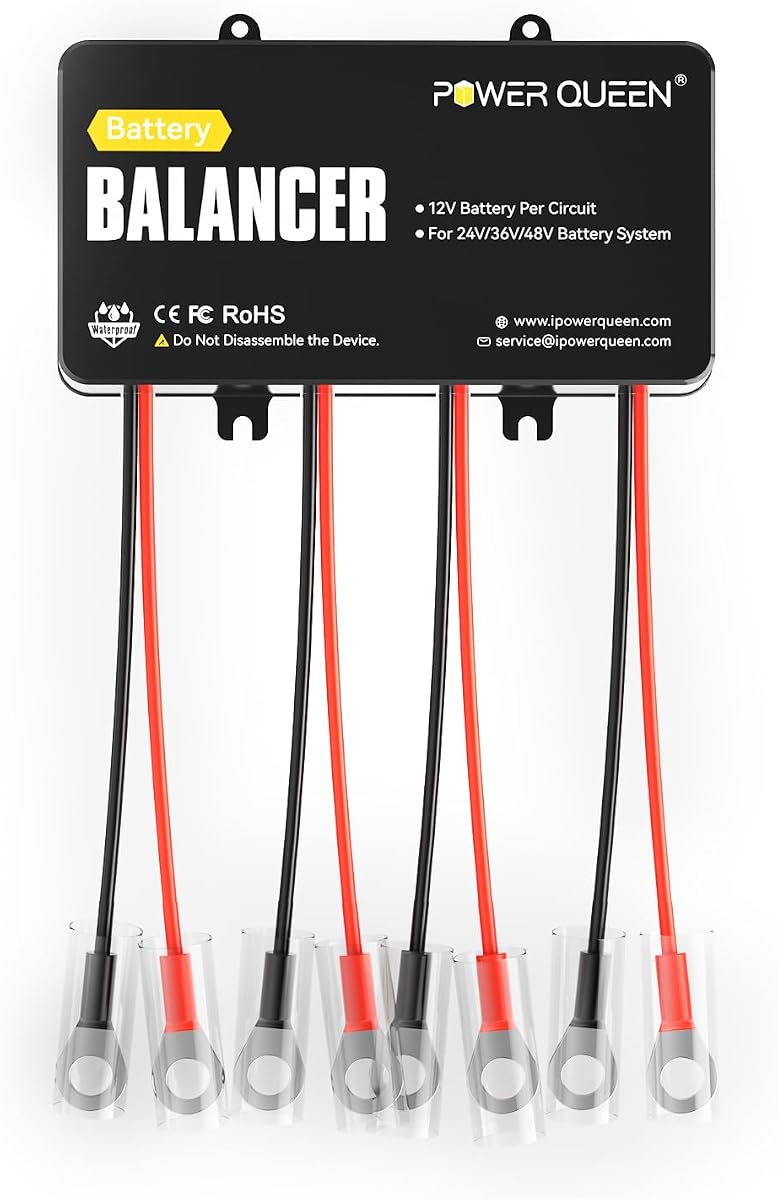
The Power Queen 48V (4 x 12V) Battery Balancer is a four-port equalizer for 24V, 36V, and 48V systems. With a 4.3 rating, it stands out for automatic balancing, compatibility with several lead-acid and lithium chemistries, and a standby mode that draws approximately 5mA.
We may earn a commission when you buy through this link, at no additional cost to you.
The unit activates when voltage differences exceed 10mV and is intended to remain connected for long-term balancing. Reverse polarity protection helps reduce the consequences of accidental wiring errors, while high-temperature protection guards against overheating. Its battery support includes LiFePO4, lithium-ion, and lead-acid types such as GEL, SLA, and flooded lead-acid, with individual battery ratings from 3V to 20V.
Its main limitation is the absence of a display, which makes external measurement more important during setup and troubleshooting. The instruction to connect series-parallel systems in parallel first and then in series also deserves attention because incorrect architecture can undermine the intended balancing arrangement. Within that proper configuration, however, it offers a useful combination of automatic control and long-term standby efficiency.
The balancer is a good option for RV, boat, trolling-motor, and off-grid installations using four 12V batteries. It is especially attractive to users who prefer a product that can remain connected without manually switching it on and off. Buyers who need visual voltage confirmation should consider an LED-equipped alternative, while installers comfortable with bank-level monitoring may find this model sufficient.
The equalizer can stay connected and intervene whenever its 10mV trigger is exceeded. That makes it suitable for banks that naturally develop imbalance because of age, load sharing, or differences in individual battery performance.
Support for lithium and common lead-acid formats gives installers flexibility when a storage bank includes mixed battery types. Matching batteries within each bank remains important, however, because equalization cannot correct incompatible cell chemistries.
We may earn a commission when you buy through this link, at no additional cost to you.
The Victron Energy Battery Balancer is a focused solution for equalizing the state of charge between two series-connected 12V batteries or parallel strings of series-connected batteries. Its 4.2 rating reflects a simple, established approach with up to 1A of balancing current rather than the higher current offered by several newer competitors.
We may earn a commission when you buy through this link, at no additional cost to you.
The balancer begins operating when the charge voltage in a 24V system rises above 27V. It then compares the voltages across the two series-connected batteries and draws current from the higher-voltage battery or parallel group, creating a charge-current differential that helps the batteries converge toward the same state of charge. Several balancers can be installed in parallel, and three units are specified for balancing a 48V bank.
The comparatively low current makes this device less aggressive than a 5A or 10A model, and there is no built-in display for monitoring. Its supplied information also focuses on 12V batteries rather than advertising a broad set of lithium chemistries. On the other hand, the restrained specification and clear operating principle may appeal to installers who want a simple unit for a known battery configuration.
This is most appropriate for a 24V system made from two 12V batteries, particularly when a modest balancing current is sufficient. For 48V installations, the buyer must plan for multiple units rather than assuming one balancer covers the entire bank. It is a practical pick for users who value a narrowly defined balancing function and already know their system requires a dedicated 12V battery equalizer.
The stated 27V activation point means the balancer is designed to operate during an appropriate charging condition in a 24V lead-acid system. This focused trigger supports predictable integration into a conventional battery bank.
The stated scaling model uses three balancers for a 48V bank. This modular approach can be useful for larger systems, though it requires more wiring, mounting, and attention to correct parallel operation.
We may earn a commission when you buy through this link, at no additional cost to you.
The iSunergy Battery Equalizer is a modular two-battery balancing device with the highest rating in this roundup at 4.5. It supports individual batteries from 7V to 18V and is suitable for lead-acid, lithium-ion, lithium iron phosphate, nickel-cadmium, and nickel-hydrogen batteries.
We may earn a commission when you buy through this link, at no additional cost to you.
Its defining advantage is flexibility. Any number of batteries can be connected in series or parallel, while multiple equalizers can be installed in parallel to scale the system. Each module corresponds to two batteries and uses a rail-style buckle intended for installation in a distribution box. The stated application list includes autos, boats, golf carts, motorcycles, solar systems, trucks, RVs, and electric forklifts.
The limitation is that one unit does not balance an entire four-battery 48V bank by itself; multiple modules are needed to cover the relevant battery pairs. The supplied information also does not highlight a display or a specific maximum compensation current. Users who value broad chemistry support and installation flexibility will find those omissions less significant than those needing real-time readings or a high-current balancing specification.
This equalizer is a strong choice for a modular battery project spanning one of several chemistries, particularly where distribution-box mounting is useful. It is less convenient for someone wanting a single plug-and-play 48V unit. Still, its 4.5 rating, wide application range, and straightforward pair-based architecture make it one of the most versatile selections in the guide.
Compatibility extends beyond ordinary lead-acid and lithium systems to nickel-cadmium and nickel-hydrogen batteries. That range gives the module a place in specialized fleet, industrial, or restoration projects where a limited-chemistry balancer would be unsuitable.
Because each equalizer handles a pair and multiple units may be connected in parallel, installers can scale balancing coverage. Larger banks require planning to ensure every relevant series pair receives the required balancing connection.
We may earn a commission when you buy through this link, at no additional cost to you.
The HC02 48V Battery Voltage Balancer is designed around a four-12V-battery arrangement and includes an LED display for voltage visibility. Its 3.7 rating is the lowest among the ten products, making it important to assess the available specifications rather than assuming feature count alone indicates overall suitability.
We may earn a commission when you buy through this link, at no additional cost to you.
By default, the unit can connect four 12V batteries whether they are arranged in series or parallel. For 96V or higher battery groups, multiple 48V equalizers can be connected in parallel. Reverse polarity protection and low-voltage disconnection provide the principal safety functions, while the LED display makes it easier to check operating voltage without relying entirely on a separate meter.
A key omission in the supplied specifications is the maximum equalization current. That figure is important when comparing balancing speed, battery capacity, and potential thermal demands. The 3.7 rating also warrants a more measured recommendation, particularly for buyers who place a high value on established performance records or extensive guidance. The broad stated use cases include autos, boats, golf carts, motorcycles, solar, trucks, RVs, and electric forklifts.
HC02 may suit installers who specifically want an LED-equipped, four-battery unit with direct low-voltage and reverse-polarity safeguards. It is less compelling for someone who needs a clearly stated high balancing current or a highly rated product. Confirming the current rating, battery chemistry guidance, and protection behavior in the current listing is advisable before integrating it into a critical storage system.
The LED display provides a practical advantage over balancers without integrated readouts. It can simplify routine checks and help identify whether a connected bank is operating as expected.
Paralleling multiple 48V modules allows the design to address 96V and higher groups. Installation must be planned carefully so that each module covers the intended battery sections without creating mismatched balancing paths.
We may earn a commission when you buy through this link, at no additional cost to you.
The Redodo 24V Battery Balancer is built for two 12V batteries connected in a 24V arrangement. Its 4.4 rating is among the strongest in the roundup, and the combination of a 10A maximum equalization current, an LED voltage display, and a stated 3V to 18V working range gives it a clear profile for medium and larger battery installations.
We may earn a commission when you buy through this link, at no additional cost to you.
The equalizer starts automatically when the connected series batteries develop a voltage difference. It can remain installed long term without disassembly, providing continuous state-of-charge balancing. Two 50cm cables with M8 OT terminals simplify connection to common battery hardware, while the LED display presents the voltage of the two battery strings. Supported chemistries include LiFePO4, GEL, SLA, and flooded lead-acid batteries.
Reverse connection protection and high-temperature protection provide useful safeguards, though the instructions warn against prolonged reverse polarity. Its main limitation is system scope: it is explicitly designed around 24V, or two 12V batteries, rather than a four-connection 48V unit. Buyers with a larger bank should not infer 48V compatibility from the product category alone; multiple modules or a different model may be more appropriate.
The Redodo is a good fit for a 24V RV, marine, trolling-motor, off-grid, AGV, or solar-storage bank where visibility and meaningful balancing current are priorities. The stated one-year warranty and professional support add reassurance, though the absence of a broad 48V specification means buyers should match it specifically to a two-battery layout.
A maximum equalization current of 10A provides substantially more balancing authority than the 1A and 5A options in the guide. That can be useful in high-capacity banks where a small difference needs to be corrected without taking too long.
The LED readout makes the unit easier to monitor during installation and routine checks. Supplied M8 OT terminal cables also reduce the need for improvised ring-terminal adapters on many common battery posts.
We may earn a commission when you buy through this link, at no additional cost to you.
The Power Queen 48V (4 x 12V) Battery Equalizer is a four-port device for 24V, 36V, and 48V banks. Its 4.1 rating places it behind several alternatives, but the automatic 10mV trigger, approximately 5mA standby draw, and support for both lithium and lead-acid batteries make it a relevant option for permanently installed systems.
We may earn a commission when you buy through this link, at no additional cost to you.
The unit is designed to remain connected and automatically begin balancing whenever the measured voltage difference exceeds 10mV. Reverse polarity and high-temperature protection are included, and the stated chemistry range covers LiFePO4, lithium-ion, and GEL, SLA, and flooded lead-acid batteries rated from 3V to 20V. Common uses include RVs, boats, trolling motors, and off-grid power systems.
Like other display-free balancers, it offers less immediate feedback during setup and troubleshooting. It also shares a very similar description and performance profile with another Power Queen model in the list, so buyers should compare the current listing, warranty information, and included accessories rather than relying on brand and headline voltage alone. The need to connect parallel groups first and then series arrangements remains essential.
This product fits an owner who wants automatic low-draw balancing across a 24V, 36V, or 48V bank and does not need an onboard display. It may be particularly practical for stationary storage where the balancer can remain connected and intervene as battery behavior changes. For users seeking explicit current figures, more prominent monitoring, or a clearly differentiated feature set, a different model may provide a more transparent fit.
The stated 5mA standby draw is small relative to the needs of most supported banks. Automatic standby behavior is therefore useful where the equalizer must remain connected but should not continuously consume meaningful power.
Four ports allow the same unit to serve several 12V-based bank arrangements. The specified series-parallel sequence reduces wiring ambiguity, but a correctly designed bank remains the foundation of effective balancing.
We may earn a commission when you buy through this link, at no additional cost to you.
The N x 12V Battery Balancer is a modular equalizer designed to balance two 12V batteries. Its 4.3 rating reflects a capable design with a maximum compensation current of 5A, automatic activation above a 10mV difference, and indicator lights that show operating status.
We may earn a commission when you buy through this link, at no additional cost to you.
The product supports a 24V system directly, while multiple 24V balancers can be connected in parallel for 48V or higher-voltage arrangements. Its stated chemistry coverage is extensive, including LiFePO4, lead-acid, lithium, GEL, SLA, nickel-cadmium, and nickel-hydrogen batteries. Reverse polarity protection and a low-voltage cutoff function provide two important layers of battery and equipment safeguard.
Because it balances a pair rather than a four-battery bank in one enclosure, a 48V installation needs more than one module. Indicator lights are useful for confirming status, but they are not a substitute for a numerical voltage display, especially during initial setup. The 5A current is also lower than the 10A maximum offered by the LiTime and Redodo units, so buyers should think about battery size and how quickly the system needs to converge.
This balancer is well suited to a compact 24V installation or a 48V bank assembled from multiple modules. It appeals to users who need broad chemistry support, straightforward automatic balancing, and visible status confirmation without a full LCD monitor. The architecture rewards careful planning because every relevant battery pair must receive the proper balancing connection.
Status lights provide quick confirmation that the module is active or idle. This is particularly helpful in a permanently mounted system where checking every connection with a handheld meter would be inconvenient.
The stated 5A maximum is suitable for many 12V-based systems and exceeds the output of the Victron model. It also requires appropriate cable and connection practices so the balancing path is not the weakest part of the installation.
We may earn a commission when you buy through this link, at no additional cost to you.
The HA01 Battery Equalizer is a two-battery module with an LED digital display and a stated compensation-current range of 0A to 5A. It holds a 4.3 rating and is intended to maintain voltage balance across series-connected 12V lead-acid or lithium batteries, including 24V, 36V, and 48V arrangements.
We may earn a commission when you buy through this link, at no additional cost to you.
Its strongest feature is the combination of monitoring and control. The digital display allows the installer to check product voltage, while the listed 0A to 5A range suggests useful flexibility in balancing output. A flame-retardant shell is also noted as a practical construction feature, and the product includes reverse polarity protection and low-voltage disconnection for safer long-term use.
The stated balancing trigger is 20mV, higher than the 10mV thresholds cited by several other products in the guide. That does not make it unsuitable, but it should be considered when determining how tightly matched the battery strings must remain. The device also handles only two batteries per module, so three units are needed to balance a four-battery 48V system.
HA01 is a good fit for users who want a numeric display, protection against reverse connection, and the option to operate through a broad 5A compensation range. Its listed applications include cars, boats, golf carts, motorcycles, solar systems, trucks, RVs, and electric forklifts. For a 48V project, installers should budget for the additional modules required to cover all battery pairs.
The integrated LED display removes much of the guesswork from initial setup. It also allows periodic verification without opening an electrical cabinet or relying on a separate meter for every reading.
The stated 20mV trigger determines when the unit begins compensating. Users who need extremely tight matching should understand this threshold and monitor how consistently the battery strings return to balance.
We may earn a commission when you buy through this link, at no additional cost to you.
The MAZAVA HX02 LCD Display Active Balancer combines a four-series 12V design with an integrated monitor. Its 4.1 rating is supported by a distinctive feature set: an LCD screen, a 7V to 18V working range for each battery, fine voltage-difference resolution, and an aluminum alloy shell intended to improve heat dissipation.
We may earn a commission when you buy through this link, at no additional cost to you.
The display is the standout element, giving users a way to monitor voltage information without relying on a separate instrument. Multi-module parallel support allows the architecture to expand beyond a single four-cell arrangement, while the aluminum housing is a sensible choice for a device that may operate continuously in a protected battery compartment. The title identifies support for 12V, 24V, 36V, and 48V arrangements and specifically names lead-acid batteries.
The supplied details do not state the maximum balancing current, so buyers cannot directly compare its correction strength with the 1A, 5A, or 10A products. Lithium compatibility is not emphasized in the provided description either. Those omissions matter in a bank that uses lithium chemistry, particularly if the buyer expects the same explicit multi-chemistry support offered by several alternatives.
MAZAVA is most attractive to someone who wants equalization and monitoring in one display-equipped unit, appreciates a metal housing, and uses a lead-acid system within the stated 4S arrangement. It is less compelling when a published current rating, broad lithium support, or a more highly rated product is the primary requirement. The integrated LCD and thermal-conscious shell nevertheless distinguish it from the basic modules.
Combining the balancing device with an LCD monitor reduces the need for a separate display in the enclosure. That is particularly useful in compact installations where panel space and additional wiring are limited.
The aluminum alloy shell is intended to dissipate heat more effectively than a basic enclosure. Thermal management remains important when a balancer operates automatically whenever the battery strings drift apart.
We may earn a commission when you buy through this link, at no additional cost to you.
Choosing a battery equalizer requires matching the device to the bank's voltage, battery chemistry, construction, and expected imbalance. The most important details are electrical coverage, connection architecture, balancing authority, protection, and whether the system needs an integrated display.
Start with the nominal voltage of the complete bank rather than only the rating of one battery. A two-12V series bank is 24V, three are 36V, and four are 48V. Some modules balance only one adjacent pair, while four-port units connect directly to a 24V, 36V, or 48V arrangement. Others are designed for batteries rated from 3V to 18V, allowing them to work with lower-voltage lithium cells within a larger series system.
The selected unit should explicitly support the chemistry already in the bank. Several products list LiFePO4, lithium-ion, GEL, SLA, AGM, and flooded lead-acid batteries, while the iSunergy option also identifies nickel-cadmium and nickel-hydrogen. The MAZAVA HX02 emphasizes lead-acid in its supplied description. Chemistry matters because charge behavior, resting voltage, and acceptable equalization practices differ substantially between lithium and lead-acid systems.
Maximum equalization current indicates how aggressively a unit can transfer charge from a higher-voltage battery to a lower-voltage battery. The guide includes options from 1A to 10A. A higher current can correct larger differences more quickly, but it also places greater demands on wiring, connections, cooling, and the balancer itself. Smaller-capacity banks may need less, while large or frequently uneven banks can benefit from a higher-rated unit, provided the installation is designed appropriately.
Some products have four ports and connect across four 12V batteries. Others use three wires to balance one pair, meaning several units are needed for a 48V bank. Modular designs can be less convenient but offer more precise control over which battery sections are balanced. For series-parallel systems, follow the specified wiring sequence, commonly connecting parallel groups first and then arranging those groups in series. Misunderstanding this step can leave some batteries outside the balancer's intended path.
Reverse polarity protection helps prevent damage when connection leads are accidentally reversed. High-temperature protection is valuable in enclosed compartments where heat can build up around power electronics. Low-voltage disconnection or cutoff can also prevent continued operation when the connected pack falls below a safe level. These safeguards do not replace correct installation, but they add an important second layer of defense in unattended RV, marine, solar, and off-grid systems.
An automatic equalizer reacts when the measured difference reaches its stated threshold and returns to standby once the batteries are sufficiently matched. Standby current matters in a permanently connected system: the LiTime and Power Queen designs are described as drawing approximately 5mA, while the Victron unit uses a charge-voltage trigger above 27V. Automatic control is especially convenient for banks exposed to variable loads, uneven battery aging, or changing charging conditions.
A display is not essential for balancing, but it can simplify installation and make maintenance more transparent. The Redodo uses an LED display, the HA01 offers a digital LED readout, and the MAZAVA combines an LCD with monitoring. The LiTime, Power Queen, Victron, and iSunergy options do not advertise integrated numeric displays. Decide whether you need visual confirmation at the enclosure or are comfortable measuring the bank with a separate multimeter or battery monitor.
Consider mounting space, ventilation, cable reach, and access to battery posts. The iSunergy module uses a rail-style buckle for distribution-box installation, the MAZAVA uses an aluminum alloy shell, and the Redodo includes 50cm cables with M8 OT terminals. Fixed systems should have secure connections, protected wiring, and enough clearance for heat dissipation. Vehicles, boats, forklifts, and off-grid installations may also face vibration, moisture, and changing ambient temperatures.
Begin by confirming that the battery bank is built from compatible batteries and that the balancer is designed for its series count. Plan the connections so the equalizer reaches every battery pair that needs balancing. For series-parallel banks, follow the product instructions regarding whether to connect parallel groups first and then place the groups in series. Disconnect power before changing any connection, and never rely on reverse-polarity protection as a substitute for correct wiring.
Connect the leads in the order specified by the manual. Common arrangements use a negative connection at the bank negative, a positive connection at the bank positive, and an intermediate or separate lead at the junction between the batteries being balanced. Because terminal conventions vary among four-port and three-wire designs, users should follow the product's diagram rather than assuming all models connect in the same way. Tighten terminals, protect exposed conductors, and confirm polarity before energizing the circuit.
After installation, check the displayed or externally measured voltages and allow the balancer to enter normal operation. Monitor for unexpected heat, unusual standby draw, or a persistent voltage difference. Keep the enclosure dry, clean, and ventilated, and inspect terminals and cables periodically for corrosion, looseness, or abrasion. If a battery is damaged, overheated, leaking, or persistently out of balance, investigate the battery bank and charger before relying on the equalizer to correct the problem.
An equalizer monitors voltage differences within a battery bank and transfers charge from a higher-voltage battery or string to a lower-voltage one. This helps the connected batteries converge toward a similar state of charge and reduces uneven charging or discharging. It is not a substitute for a properly sized charger, and it cannot repair physically damaged or badly aged cells.
That depends on the device architecture. A four-port equalizer may cover four 12V batteries in one bank, while many two-battery modules require one unit for each pair that needs balancing. A 48V bank made from four 12V batteries may therefore need either one four-port unit or several pair-based modules. Count the required balancing paths and follow the installation diagram for the selected product.
Only if the individual battery and the complete connection scheme fall within the balancer's published specifications. A 48V bank made from four 12V batteries is not the same as one 48V battery, and the balance of each 12V unit still needs attention. Do not connect a nominal 24V module across a 48V arrangement merely because the voltage label appears nearby; verify the supported series count, cell range, and trigger behavior.
No. Higher current can correct differences more quickly, but it also requires suitable wiring, secure connections, and adequate heat dissipation. A very high current may be unnecessary for a smaller bank or unsuitable for an installation with limited cable capacity. Compare the stated maximum with battery capacity, bank size, and installation constraints rather than selecting on the number alone.
It can support longer service life by reducing persistent imbalance between batteries that are repeatedly charged and discharged together. Its effect is limited when imbalance is caused by damaged cells, incorrect charger settings, extreme temperatures, or batteries that have aged beyond useful service. Equalization works best as one part of a system with matched batteries, proper charging, and routine inspection.
Several products in this guide are explicitly designed for long-term connection and automatically enter standby when their balancing threshold is reached. Their stated standby consumption is very small in some cases. Even so, users should follow the manufacturer's instructions, maintain ventilation, and check periodically for abnormal heat or current draw.
The balancer should explicitly list lithium iron phosphate compatibility, and its operating logic should be suitable for the way that chemistry is charged and balanced. Several products in the guide support LiFePO4, but others focus on lead-acid or provide broader chemistry claims. Do not assume a lead-acid balancer is appropriate simply because both systems use a nominal 12V label.
The cause may be an incorrect connection, an under-covered battery pair, a persistent difference between parallel strings, or a battery with abnormal internal resistance. Verify the wiring diagram, ensure every required section is connected, and compare each battery or string under the same operating conditions. If one unit remains noticeably different, test it and the charger separately because an equalizer cannot fully compensate for a weak or failing battery.
The LiTime 48V Battery Balancer is the strongest all-around recommendation for a 12V-based bank from 24V through 48V because it combines four-port coverage, a 10A maximum current, automatic balancing, and low standby draw. The iSunergy Battery Equalizer stands out for broad chemistry support and modular scalability, while the MAZAVA HX02 appeals to buyers who want an integrated LCD monitor and aluminum housing in a four-series design.
The right choice ultimately depends on the bank rather than on a universal winner. A two-battery 24V system may be best served by the Redodo or HA01, a smaller 24V installation may suit the Victron, and a high-voltage project may require several pair-based modules. Prioritize exact voltage coverage, chemistry support, required module count, current, protection, and trustworthy wiring guidance before considering a display or other secondary feature.
Product ratings, technical claims, availability, and prices can change, and the final listing should be checked for updated instructions and compatibility. Review the bank layout carefully, gather the correct terminals and cables, and use a battery monitor to establish the starting condition. Those steps will help ensure the selected equalizer is installed safely and actually addresses the imbalance it is designed to correct.