
Premium Wire Marker Book Numbered 1-45
4.8Editor score
450 numbered labels included
Matching terminal markers supplied
High-tack adhesive backing
Our guide compares electrical wire labels for organization, including numbered markers, printable sheets, reusable tags, colors, adhesion, and write-on
Electrical wire labels make dense panels, equipment racks, and cable bundles easier to understand at a glance. A good label should remain legible, stay attached, and clearly identify a conductor without interfering with nearby wiring. The right format depends on whether you need numbered panel markers, printable sheets, or reusable write-on tags.
This guide compares ten label products based on their stated construction, identification format, attachment method, writing or printing compatibility, color range, and intended applications. It includes adhesive marker books for electrical panels, color-coded sheets for large cable inventories, and reusable hook-and-loop options for cords that may be moved or replaced.
Each pick highlights a different way to organize wires, from pre-numbered vinyl markers to flexible sheets and reusable tags. Ratings and product details reflect the supplied information, while availability and pricing can change. Buyers should compare label dimensions, surface compatibility, and their own workflow before making a final selection.
4.8Editor score

4.7Editor score

4.4Editor score
The comparison below covers the leading formats, attachment methods, labeling capacities, and compatibility features across all ten products, helping readers identify the right option for panels, cables, electronics, and mixed electrical inventories.


The Klein Tools 56250 is a pre-numbered wire marker book built for the structured identification used around electrical panels and cable-management systems. It carries a 4.7 rating and offers numbers 1 through 48 on 0.25-by-1.5-inch labels. Its standout feature is a layout that places more pages of frequently used low numbers 1 through 24 in the book.
We may earn a commission when you buy through this link, at no additional cost to you.
The design is especially practical for users who want an established numbering system rather than a collection of blank write-on tags. Separate pages can be dedicated to odd or even markers, making it easier to dress both sides of a panel while keeping related numbers accessible. Perforated pages also detach in thirds, two-thirds, or full-page sections, which can reduce waste and speed up installation.
The labels use a vinyl-coated white cloth construction and offer strong tack for lasting adhesion, including on oily wires. Each label can be split for thin wire, adding flexibility where conductor diameter is limited. The trade-off is that users cannot create custom descriptions or color-coded categories because the markers are already numbered.
This book is a strong all-around choice for electricians, facilities teams, and advanced home users who value readable numbering, straightforward panel organization, and a compact marker format. It is especially suitable when a project benefits from a consistent numerical sequence across many conductors.
Overall, the Klein Tools 56250 balances installation convenience with durable construction and practical panel-specific features. It stands out as our Editor's Choice because it addresses real workflow needs rather than offering generic adhesive labels.
Preprinted numbers create a consistent visual language for identifying wires across a panel or larger installation. The emphasis on low numbers and separate odd or even pages helps users maintain order without assembling a custom numbering sequence from blank labels.
The vinyl-coated cloth and strong tack are intended for demanding conditions, including oily wires. Detachable sections and splittable labels add flexibility when working with different panel arrangements and conductor sizes.
We may earn a commission when you buy through this link, at no additional cost to you.
The Wrap-It Storage cable label set is a reusable write-on system for identifying cords, charging leads, network cables, speaker wires, and other frequently handled lines. It has a 4.6 rating and includes 30 medium-size labels in multiple colors. The hook-and-loop closure is the central feature, allowing each tag to wrap around a cable and open again without adhesive residue.
We may earn a commission when you buy through this link, at no additional cost to you.
Because the labels are not permanently bonded, they suit environments where equipment changes, cables are moved, or a temporary identification scheme is needed. The writing surface is designed to accept pen input, allowing users to add names, destinations, or short identifiers. A multi-color assortment also supports simple visual grouping without requiring a separate legend for every label.
The main compromise is that these tags are less compact than flat adhesive stickers or numbered marker strips. They are also not designed to create a standardized panel-number sequence. Buyers whose primary goal is permanent circuit documentation may find a sheet label or marker book more appropriate.
This set is best for offices, studios, home theaters, computer setups, and mobile equipment where the same cable may be relabeled repeatedly. It also appeals to users who dislike peeling adhesive from jackets or surfaces. For flexible, reusable identification rather than fixed panel records, the medium labels offer a straightforward solution.
The Wrap-It set is a convincing alternative for serviceable cable environments. Its color range, simple writing surface, and residue-free closure make it one of the more adaptable options in this guide.
The hook-and-loop design separates the identification layer from the cable jacket. This allows labels to be repositioned and reused while avoiding the residue that can remain after removing ordinary adhesive tags.
Multiple colors make it easier to separate cable groups at a glance. Users can write a short destination on each label and add a color to reinforce the same organization system.
We may earn a commission when you buy through this link, at no additional cost to you.
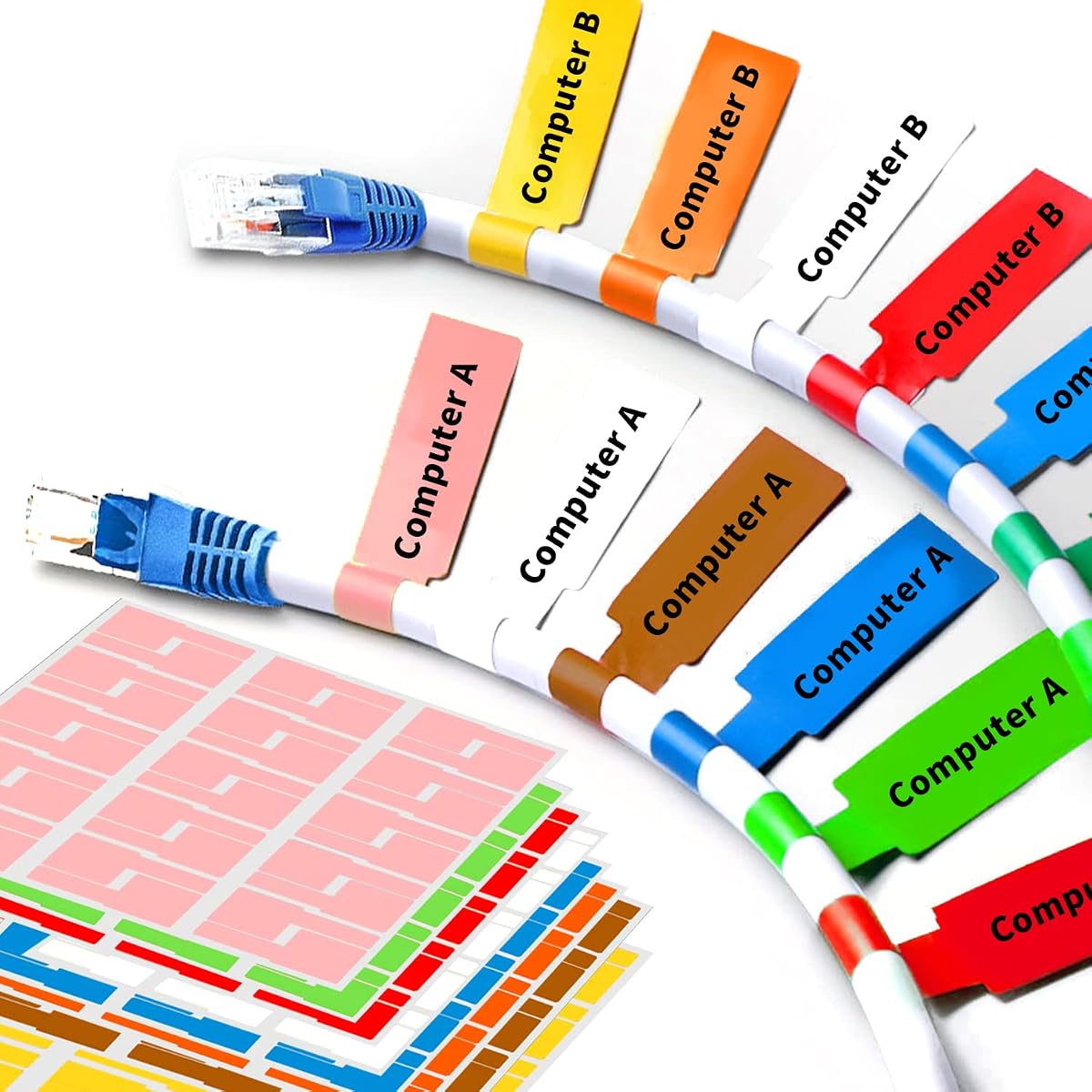
The JIQEZNL 300-piece set is a bulk labeling solution for computer, network, charging, audio, and general electrical cables. It has a 4.4 rating and distributes labels across ten bright colors, including red, orange, yellow, blue, light blue, purple, light purple, green, and white. The large capacity makes it useful when an entire room, rack, or device collection needs labels.
We may earn a commission when you buy through this link, at no additional cost to you.
These labels can be printed on standard A4 sheets with a laser printer or marked by hand. A template is included for laser-printer use, which helps buyers create a consistent series of names or identifiers. The flexible self-adhesive material is described as waterproof, oil proof, and tear resistant, supporting use across indoor and outdoor cable collections.
Compared with small marker books, this approach offers much greater labeling flexibility because each blank can carry custom text. The tradeoff is that color choices do not inherently communicate meaning; users must define their own system, such as one color for power, networking, audio, or room location. Printing also requires compatibility with A4 media and a laser printer rather than inkjet.
The set is well suited to IT departments, homeowners, renters, and anyone managing a large mixed cable inventory. It is less appropriate for someone seeking standardized circuit numbers in an electrical panel, but it is a strong budget choice for flexible, color-coded cable identification.
For sheer quantity and versatile use, the JIQEZNL set is difficult to overlook. It combines printing, handwriting, ten colors, and substantial environmental resistance in one economical package.
Each blank label can carry information entered by laser printer or written by hand. This flexibility supports short custom names, detailed descriptions, and repeatable systems that would be difficult with fixed-number markers.
With 300 labels in ten colors, the set can handle extensive cable collections without requiring frequent replenishment. Colors help separate groups, while written details provide the precise identification.
We may earn a commission when you buy through this link, at no additional cost to you.
Trilancer offers large reusable cable labels designed for cords, wires, power strips, charging cables, home theater systems, and other organized inventories. The product has a 4.6 rating and emphasizes a clean writing surface that resists ink bleeding. That detail matters for short, high-contrast identifiers that need to remain readable after normal handling.
We may earn a commission when you buy through this link, at no additional cost to you.
Its reusable hook-and-loop closure avoids the lint, dirt, and adhesive residue associated with one-time tape solutions. The tags are described as waterproof and designed to open and close through repeated use. This makes them useful for equipment that moves, is serviced regularly, or may be reorganized several times.
The trade-off is that the labels are large and function as wraps rather than compact adhesive markers. They may not fit neatly around very thin conductors, and they do not offer a preprinted numbering sequence. Users must supply their own text and organize any color system themselves.
Trilancer is a strong choice for home technology setups, offices, workshops, and entertainment systems where readable custom labels matter more than permanent panel coding. The reusable closure also makes it easier to update a label when a device or cable changes roles.
The combination of a non-bleeding writing surface, large format, and reusable attachment makes this a practical middle ground between flat stickers and rigid plastic tag systems.
The surface is designed to accept marker, pen, and ink-pen writing without blurring. Clear lettering is especially valuable when labels must be read quickly from several directions.
Hook-and-loop attachment allows repeated repositioning without leaving adhesive on the cable. It also reduces the need to replace a tag whenever a cable moves or its role changes.
We may earn a commission when you buy through this link, at no additional cost to you.
This 32-piece reusable label set combines colorful nylon tags with a smooth laminated writing area. It has a 4.7 rating and includes four labels in each of eight colors. The individual dimensions of 1.77 by 0.79 inches provide space for a bold destination, short equipment name, or basic cable function without making the tag excessively large.
We may earn a commission when you buy through this link, at no additional cost to you.
The tear-resistant nylon is described as wear resistant and suitable for repeated peeling and daily friction. A laminated coating supports marker use and helps bold text remain visible. The labels are also waterproof, making them useful for electronics, workshop cords, garden equipment, and other frequently handled items.
The principal limitation is the comparatively small count. Thirty-two labels are adequate for a focused cable setup, but they may not cover a large office, entertainment center, or multi-room inventory. Because the tags are reusable, that limitation can be reduced by rotating them among cables, although larger projects may still need more capacity.
The set is best for users who value a durable writing surface and compact dimensions over adhesive convenience. It can organize Ethernet, network, USB, speaker, charger, and circuit-breaker labels, while also working for ropes, tools, or small plants.
With a 4.7 rating, strong material specification, and a generous writing area, this set stands out as a colorful and durable option for moderate-scale organization.
The laminated surface is designed to accept bold marker text while resisting everyday wear. Its larger face makes short identifiers easier to read than on narrow flag-style labels.
These tags can also identify tools, ropes, or small plants. That versatility makes the set more useful in mixed households or workshops where several categories need compact visual tags.
We may earn a commission when you buy through this link, at no additional cost to you.
The 270-piece tear-resistant label set combines nine colors with A4 sheets sized for laser printing or handwriting. It has a 4.4 rating, and each label measures 3.3 by 1 inch. The nine sheets contain 30 labels apiece, providing a substantial inventory for computers, chargers, Ethernet lines, power cords, and general electrical wiring.
We may earn a commission when you buy through this link, at no additional cost to you.
Its stated durability includes resistance to color fading, tearing, water, oil, and high temperatures. The labels can be handwritten with a suitable marker or printed through a laser printer, giving users freedom to create custom circuit names, destinations, or detailed identifiers. The range of colors is useful for distinguishing groups at a glance.
Printer compatibility is an important limitation. Inkjet printers are not supported, so buyers without a laser printer may need to handwrite the labels. As with other self-adhesive sheets, these are less convenient when a cable must be relabeled repeatedly because removal and reuse are not the primary purpose.
This set is a good fit for contractors, facilities managers, technology installers, and homeowners who want flexible printed labels in manageable quantities. It also works for vehicle cables and other indoor or outdoor cable groups where stronger environmental resistance is useful.
Its strong combination of printability, nine colors, and tear-resistant construction makes it one of the most versatile bulk-sheet options in the guide.
The A4 format fits common laser-printing workflows and allows many labels to be prepared at once. Buyers can establish consistent naming patterns across several cable groups without writing every label individually.
Water, oil, high-temperature, and tear resistance support use in demanding cable environments. These properties help the labels retain their shape and appearance after handling.
We may earn a commission when you buy through this link, at no additional cost to you.
The Premium Wire Marker Book is a high-capacity numbered system designed primarily for electric-panel and cable-management work. It has a 4.8 rating, the highest in this selection, and provides 450 labels across ten pages with 45 markers per page. Numbers run from 1 through 45, creating a consistent sequence for identifying conductors.
We may earn a commission when you buy through this link, at no additional cost to you.
A standout feature is the inclusion of matching terminal markers. That added documentation layer can make it easier to connect the wire-side marker with the corresponding terminal designation. The high-tack rubber adhesive is designed to secure labels in high-stress environments, while the vinyl-coated cloth construction supports durable use.
The compact booklet is portable and straightforward to store in a tool bag or at a work area. Its trade-off is the same one that affects all pre-numbered systems: users cannot choose custom text or extend the numerical sequence beyond 45. A separate alphanumeric marker book may be needed for circuits with more than 45 positions or nonnumeric identifiers.
This product is well suited to electricians, installers, facilities teams, and serious DIY users who want a large, durable supply of standardized panel markers. The terminal-marker pairing adds practical coordination that many ordinary cable tags do not provide.
With its 4.8 rating, substantial 450-label capacity, and matching terminal markers, it earns the Best Premium designation for panel-focused organization.
Including a corresponding terminal marker for every wire marker creates a more complete identification system. Users can coordinate both ends of a connection without assembling separate labeling materials.
The rubber adhesive is intended to remain secure in high-stress environments. Combined with vinyl-coated cloth, it provides a durable option for structured panel documentation.
We may earn a commission when you buy through this link, at no additional cost to you.
The 300 Waterproof Cable Tags set provides ten A4 sheets with 30 labels per sheet. It has a 4.5 rating and offers 300 labels measuring 3.3 by 1 inch. The assortment includes red, orange, yellow, blue, green, light green, pink, rose red, and white, allowing labels to be matched to different cable jacket colors.
We may earn a commission when you buy through this link, at no additional cost to you.
These tags are made from paper described as waterproof, oil proof, and high-temperature resistant. They are also designed not to warp or tear during use. Users can write on them directly or print them with a laser printer, so the set supports both quick improvised notes and planned batches of custom labels.
The main constraint is that inkjet printers are not supported. Users should also plan a color legend because the colors provide differentiation but no inherent meaning. Although paper labels are useful for permanent documentation, they are not designed to be repeatedly removed and reused like hook-and-loop tags.
The set is appropriate for homes, offices, cars, computer power cords, charger leads, network cables, and Ethernet connections. It is particularly useful for users who want high-volume printable labels and a strong contrast against both light and dark cable jackets.
With 300 labels, ten colors, and stated resistance to several common sources of damage, this product is a solid choice for permanent, color-coded cable inventories.
Ten sheets and 300 total labels allow consistent batches to be prepared efficiently. Laser printing is especially useful for recurring names, numbering conventions, and room or device destinations.
The broad color assortment makes it easier to select a contrasting label for light or dark cable jackets. This visual contrast can improve recognition from a distance.
We may earn a commission when you buy through this link, at no additional cost to you.
The Klein Tools 56253 is an alphanumeric marker book that expands identification beyond a simple number sequence. It has a 4.7 rating and contains labels for A through Z, numbers 0 through 15, plus the plus, minus, and forward-slash symbols. That range supports custom circuit codes, panel references, and compact combinations that a numbered-only book cannot provide.
We may earn a commission when you buy through this link, at no additional cost to you.
The markers measure 0.2 by 1.5 inches and use easy-to-read black printing. Each page is perforated so that a third, two-thirds, or full page can be detached, allowing users to carry only the characters needed for a specific task. Labels can also be split for thin wire, improving their usefulness in compact panels.
A strong-tack backing is designed for lasting adhesion on oily wires, an important consideration in electrical environments. The limitation is that the numeric range stops at 15, so projects with more numeric positions may need multiple books or another marker format. There is also no color coding in this set.
This book is ideal for users who need letters and symbols, such as technicians documenting control wiring, equipment interconnections, or panel references. It is a more expressive alternative to fixed sequential numbering while preserving the familiar perforated marker-book design.
The combination of broad character coverage, easy-to-read print, and durable adhesion makes the Klein Tools 56253 a particularly flexible choice for structured electrical labeling.
Letters and symbols make it possible to build descriptive or hierarchical codes rather than relying only on consecutive numbers. The included plus, minus, and slash symbols support more specialized reference systems.
Perforated pages can be detached in multiple increments, reducing the need to carry an entire book. Splitting individual labels helps with thin conductors where a full-width marker would be unsuitable.
We may earn a commission when you buy through this link, at no additional cost to you.
The 8 Sheet 240 Pcs set provides a balanced mix of quantity, color, and label size. It has a 4.3 rating and includes eight A4 sheets, each carrying 30 labels for a total of 240. Individual labels measure 3.31 by 1.02 inches, giving users enough room for concise descriptions while remaining suitable for cable jackets and equipment surfaces.
We may earn a commission when you buy through this link, at no additional cost to you.
Eight colors are included: pink, green, red, white, blue, orange, brown, and yellow. The labels support handwriting and laser printing, although inkjet printers are not compatible. Stated resistance to tearing, oil, and high temperatures helps them maintain their shape across indoor and outdoor uses.
As a lower-rated option within this group, it still addresses many common organization needs. Its limitations are the lack of inkjet support and the usual constraints of self-adhesive labels when a cable must be repeatedly relabeled. Buyers wanting reusable tags will find the hook-and-loop products more suitable.
The set is versatile for Ethernet, computer, charger, electrical, and power cords in homes, offices, and cars. It is a practical option for users who want a moderate number of labels, multiple colors, and the flexibility to print or write each one.
While it does not lead the guide in rating, this label set delivers useful capacity and material features for broad cable-organization projects at a moderate level of specialization.
Eight sheets provide enough inventory for many common cable tasks without reaching the scale of the 300-label sets. The color assortment supports visual grouping across multiple equipment groups.
Labels can be written with pens or markers when a project only needs a small number of custom names. For larger systems, laser printing provides a faster and more consistent alternative.
We may earn a commission when you buy through this link, at no additional cost to you.
The best label depends on the environment, the permanence of the identification, and the amount of information each conductor requires. Compare panel numbering, custom text, reusability, environmental resistance, surface size, and printing needs before choosing a format.
Electrical panels often benefit from a consistent numerical sequence because users can quickly trace a conductor to its corresponding terminal or documentation. The Klein Tools 56250 provides numbers 1 through 48, while the Premium Wire Marker Book provides 1 through 45 and adds matching terminal markers. Numbered marker books are easier to deploy consistently than blank tags, but they cannot accommodate unlimited custom descriptions.
Choose a numbered book when standardized panel documentation matters more than custom names. If a system requires letters, symbols, or a longer numeric range, a combination of marker formats may be more practical.
Reusable hook-and-loop labels are valuable around movable equipment because they can be opened, renamed, and repositioned without leaving adhesive behind. The Wrap-It, Trilancer, and reusable nylon options all suit this workflow. Self-adhesive sheets create a more permanent record and often provide a broader selection of colors and printing options, but repeatedly removing them may leave residue or damage the surface.
Prioritize reusability for offices, studios, rentals, and frequently serviced equipment. Choose adhesive labels for fixed installations where the identifier is unlikely to change.
Vinyl-coated cloth and high-tack adhesive are strong choices for conductors and electrical panels, while waterproof paper sheets offer broad color selection and easy batch preparation. Reusable nylon tags are better for cable jackets than for tiny conductors because their wraparound body needs space. Always consider conductor diameter, jacket texture, oil exposure, and whether the label will be wrapped or applied directly.
For thin wires, choose splittable markers or compact adhesive labels. For cable bundles and larger equipment leads, reusable wraps and printed sheets offer more writing space.
Printable labels can save considerable time when dozens of conductors need consistent names, but the relevant products are intended for laser printers rather than inkjet models. Handwriting is still available on most printable sheets, which provides a fallback for small jobs. Before purchasing a large set, confirm that the printer can handle A4 sheets and test a small page to confirm alignment, ink coverage, and peel behavior.
Use printed labels for repeated inventories and formal systems. Handwrite individual tags when the number of labels is small or wording is likely to change.
Large labels support longer destinations, equipment names, and multi-part circuit codes, but they are less suitable for dense bundles of thin wire. Compact marker strips are efficient in panels because they show a clear sequence without occupying much space. The reusable nylon tags provide a notably large writing area, while the printable sheets offer a practical middle ground at 3.3 by 1 inch or approximately 3.31 by 1.02 inches.
Estimate the shortest useful identifier before choosing dimensions. A label that cannot fit the cable jacket or remains too small to read will not improve the organization system.
Color can separate cable groups quickly, but it should reinforce written information rather than replace it. The ten-color JIQEZNL set, the nine-color 270-piece set, and the eight-color 240-piece set provide wide assortments. The Wrap-It and reusable nylon options also use color to distinguish groups. For meaningful results, create a simple legend such as one color for network cables, another for power, and another for audio.
Do not rely on color alone where a permanent panel record is needed. Pair it with a readable number, destination, or equipment identifier.
Water, oil, temperature, and tear resistance are important for labels used in workshops, vehicles, outdoor areas, and near energized equipment. The sheet-label products in this guide advertise combinations of those protections, while the reusable tags are described as waterproof in their supplied details. The panel marker books emphasize vinyl-coated cloth and strong adhesion, including on oily wires.
Choose the material that matches the actual environment rather than paying for features that will never be tested. Consider cleaning frequency, sunlight, heat, friction, and exposure to cable jacket oils.
Count conductors, both ends where relevant, and any terminal or equipment labels before buying. A large panel may consume multiple marker-book pages, while a modest home-office project may need fewer than 100 tags. The books provide 450 or 450-plus-style marker inventory in large formats, while the sheet products range from 240 to 300 labels. Reusable sets contain fewer pieces but can be rotated as needs change.
Add a reasonable margin for later additions and corrected identifiers. Consistency across a project is usually more valuable than saving a small number of labels.
Begin by defining the information system before applying any labels. Decide whether identifiers will represent circuit numbers, equipment names, room destinations, cable functions, or a combination of numbers and letters. For panels, install markers in a consistent sequence and keep a reference list that maps each number to its circuit. For general cables, use color as a group-level cue and writing as the precise identifier.
Prepare the surface carefully. Electrical work should be de-energized and handled according to applicable safety procedures, and labels should be applied only to clean, dry cable jackets or panel surfaces. Printed labels should be allowed to sit as directed after application, while handwritten markers need a suitable pen for the label material. With hook-and-loop tags, center the tag around the cable and fasten it evenly so it does not slip.
Inspect labels periodically and update reusable tags when equipment changes. Replace any adhesive label that has curled, faded, split, or lost its writing, especially in high-stress locations. Keep panel marker books and printable sheets away from excessive heat, dirt, and moisture, and store unused labels flat so they remain ready for printing and easy removal.
Labels made for electrical panels are designed to adhere to conductors and provide readable identification, but they are not a substitute for safe work practices. De-energize equipment before installing labels whenever applicable, verify the absence of power, and follow local electrical codes and employer procedures. Choose a label whose material and dimensions are appropriate for the specific panel and conductor.
Wire markers are generally compact, numbered or alphanumeric strips intended to identify individual conductors in panels or junction boxes. Cable labels are larger and commonly used for power cords, network cables, chargers, and other equipment leads. The choice depends on the space available, the information required, and whether the cable needs a permanent or reusable identifier.
Several of the sheet-based products are compatible with laser printers, allowing users to print consistent labels on A4 sheets. Inkjet compatibility is not supported for those specific products, so check the printer requirement before purchasing. Users can also handwrite compatible sheets, although a suitable marker and clean writing space will improve legibility.
Reusable labels are better when cords are moved, renamed, or serviced frequently because they can be opened and repositioned without adhesive residue. Adhesive sheet labels are often better for fixed installations because they offer more color choices, larger quantities, and straightforward laser printing. The best choice depends on whether flexibility or permanent documentation is more important.
Use a writing instrument suited to the label surface, place the text across the largest available area, and allow extra room around the letters and numbers. For panels, keep the sequence consistent and avoid placing labels where they can interfere with terminals. High-contrast writing and a simple naming format can improve readability, especially in crowded installations.
Count every conductor that needs identification and consider labeling both the wire and corresponding terminal when the system calls for it. Add extra markers for future circuits, spare positions, and replacement labels. Marker books are useful for numbered panels, while large sheet sets are often more efficient for custom names across many individual wires.
Color coding is most effective as a supporting system. It can quickly group similar cables, but written numbers or destinations provide the precise information needed to identify each conductor. A simple legend explaining each color prevents the system from becoming confusing, particularly when panels, equipment, or cable functions change.
Look for strong adhesion, resistance to oil and water, tear resistance, and a writing or printing surface that stays legible. Vinyl-coated cloth is well suited to panel markers, while reusable nylon tags should be checked for waterproofing and repeated opening and closing. The most durable choice is the one whose construction matches the installation environment.
The Premium Wire Marker Book stands out for large-scale panel organization, offering numbered markers and matching terminal identifiers, while the Klein Tools 56250 delivers an excellent all-around numbering system with flexible page arrangement. For budget-conscious labeling of many custom cables, the JIQEZNL 300-piece set offers ten colors and both printing and handwriting options.
Prioritize the format that matches your environment. Choose numbered marker books for standardized panel work, printable sheets for permanent custom inventories, and reusable hook-and-loop tags for cords that move. Label dimensions, writing space, printer compatibility, and environmental resistance should be checked alongside the organization system you intend to maintain.
Ratings, product details, and availability can change, and prices fluctuate over time. Review the current listing and manufacturer information before purchasing, particularly when a project depends on printer compatibility, exact label dimensions, adhesive performance, or the included number of markers.