
Soundcore V20i
4.4Editor score
Adjustable open-ear fit
Situational awareness design
16mm sound drivers
Earbuds That Stay in Ear While Running guide compares secure-fit models for sound, battery life, water resistance, comfort, calls, and workout features.
Earbuds that stay in ear while running must balance a secure fit with comfort, dependable wireless performance, and enough protection for sweat and weather. The most suitable models use earhooks, wings, or adjustable open-ear clips that resist vertical and horizontal movement without creating unnecessary pressure during long runs.
This guide compares ten sport-focused and open-ear earbuds across fit design, audio features, microphone performance, water resistance, battery life, controls, and connectivity. It includes traditional in-ear models with stabilizing wings, hook-style running earbuds, and clip-on designs that leave the ear canal completely open for better environmental awareness.
Each review explains how the product addresses common running concerns and identifies the runners most likely to benefit from its particular design. The top picks represent the strongest options for value, premium training features, and dependable everyday performance, although product prices and availability change over time.
4.4Editor score

4.4Editor score

4.1Editor score
The comparison below places all ten models by their most important running attributes: physical fit, environmental awareness, water protection, power, and workout-oriented features.




The Soundcore V20i is an open-ear pair designed to remain comfortable while leaving the ear canal unobstructed. Its 4.4 rating reflects a well-rounded feature set for runners who dislike the pressure created by conventional earbuds. Four adjustable positions allow the rotating earpieces to settle into a more secure and comfortable location without forcing a rigid in-ear seal.
We may earn a commission when you buy through this link, at no additional cost to you.
Its most compelling benefit is freedom of movement. The open-ear format avoids the deep-seal sensation of many running earbuds, which can make long sessions more comfortable while also helping the wearer remain aware of traffic, cyclists, and other environmental cues. Sixteen-millimeter drivers with titanium-coated domes and BassUp technology provide fuller sound than the very small open designs found at the lower end of the category.
There are some trade-offs. Because the earpieces do not block the ear canal, the V20i will not deliver the same passive noise isolation as a sealed in-ear model, and the supplied information does not state a water-resistance rating. Call handling is supported by four microphones and an AI enhancement algorithm, but the open architecture may still allow some surrounding noise to reach the microphones.
This is a compelling choice for value-conscious runners who want a secure adjustment mechanism, strong open-ear audio, and no blocked ear canals. It also suits cyclists and outdoor exercisers who prioritize awareness over isolation. For runners training in rain or frequently exposed to heavy perspiration, a model with a clearly stated water rating may be the safer purchase.
The four-position rotation is the V20i's most important running feature. It lets the earpiece rest at a different angle for different ears, distributing pressure more evenly and reducing the need to readjust during movement.
The 16mm drivers add more bass than many similarly open earbuds, while the soundcore app provides EQ modes, HearID, Spatial Audio, and over-the-air firmware updates for further personalization.
We may earn a commission when you buy through this link, at no additional cost to you.
The JBL Endurance Peak 4 is a fully in-ear sport model with an oval tube, liquid-silicone earhook, and memory wire. Those elements are specifically intended to hold the earbuds in place through long sessions and demanding movement. Its 3.9 rating is lower than those of several competitors, but the feature set is particularly complete for runners who train in changing outdoor conditions.
We may earn a commission when you buy through this link, at no additional cost to you.
The most impressive specification is the IP68 water and dust protection, which provides reassurance against sweat, rain, salt water, sand, humidity, and demanding drops. The hook is adaptable to different ear sizes, while the in-ear tips create more isolation and bass than an open-ear alternative. Adaptive Noise Cancelling and Smart Ambient let the wearer move between focused playback and awareness without removing the earbuds.
The main compromises are battery life when noise cancellation is active and the potential distraction created by a substantial in-ear seal. JBL lists up to 12 hours from the earbuds with ANC off and eight hours with ANC on, with the case supplying three additional full charges. The case also includes a lanyard hole, and the earbuds support multipoint pairing, Google Fast Pair, and workout-specific sound presets.
Choose the Endurance Peak 4 for hard-running, trail, and all-weather athletes who need a strong seal, high water resistance, and secure hook-based retention. It may be less appealing to runners who cannot comfortably wear sealed earbuds or who prioritize open-ear awareness over noise reduction.
The IP68 rating makes this one of the strongest choices for runners exposed to rain, sweat, salt, and sand. It is a clear advantage over models without a stated water-resistance level.
Sport presets, customizable sound, multipoint connection, and Google Fast Pair make the earbuds convenient for runners who alternate between workout videos, playlists, and incoming phone calls.
We may earn a commission when you buy through this link, at no additional cost to you.
The JBL Endurance Race 2 uses an ergonomic wing enhancer with TwistLock technology to create a better seal and improve stability. It is a traditional in-ear design rather than an open earbud, so it suits runners who prefer strong bass and isolation. Its 4.0 rating places it among the well-regarded options in this comparison, especially when its extensive protection and app features are considered.
We may earn a commission when you buy through this link, at no additional cost to you.
The earbuds carry an IP68 waterproof and dustproof rating, while the charging case is IPX2 water-resistant. That distinction matters in wet conditions: the buds are highly protected, but they should be dried before returning to the case. Two beamforming microphones on each bud support clear calls outdoors, while 6.8mm dynamic drivers deliver JBL Pure Bass sound.
Its trade-offs are typical of sealed sport earbuds. Some runners may dislike the sensation of inserting silicone tips deeply, and the wing needs to be fitted correctly to avoid pressure. Battery performance is stated as 12 hours with ANC off, plus three full case charges, with a ten-minute charge adding four hours. The charging cable is included, and Fast Pair with Google plus Swift Pair with Microsoft broadens device compatibility.
The Endurance Race 2 is a strong recommendation for runners seeking a stable in-ear seal, strong bass, useful Sports Mode settings, and excellent dust and water protection. It is especially well suited to gym sessions, road runs, and workouts where occasional rain or heavy perspiration is likely.
The wing enhancer adds contact around the outer ear without relying on a large hook. When fitted correctly, it helps resist both vertical bounce and lateral movement during repeated foot strikes.
Six default Sports Modes allow the sound profile to match different activity intensities, and the JBL Headphones app adds relaxation sounds and customizable EQ for use before or after a workout.
We may earn a commission when you buy through this link, at no additional cost to you.
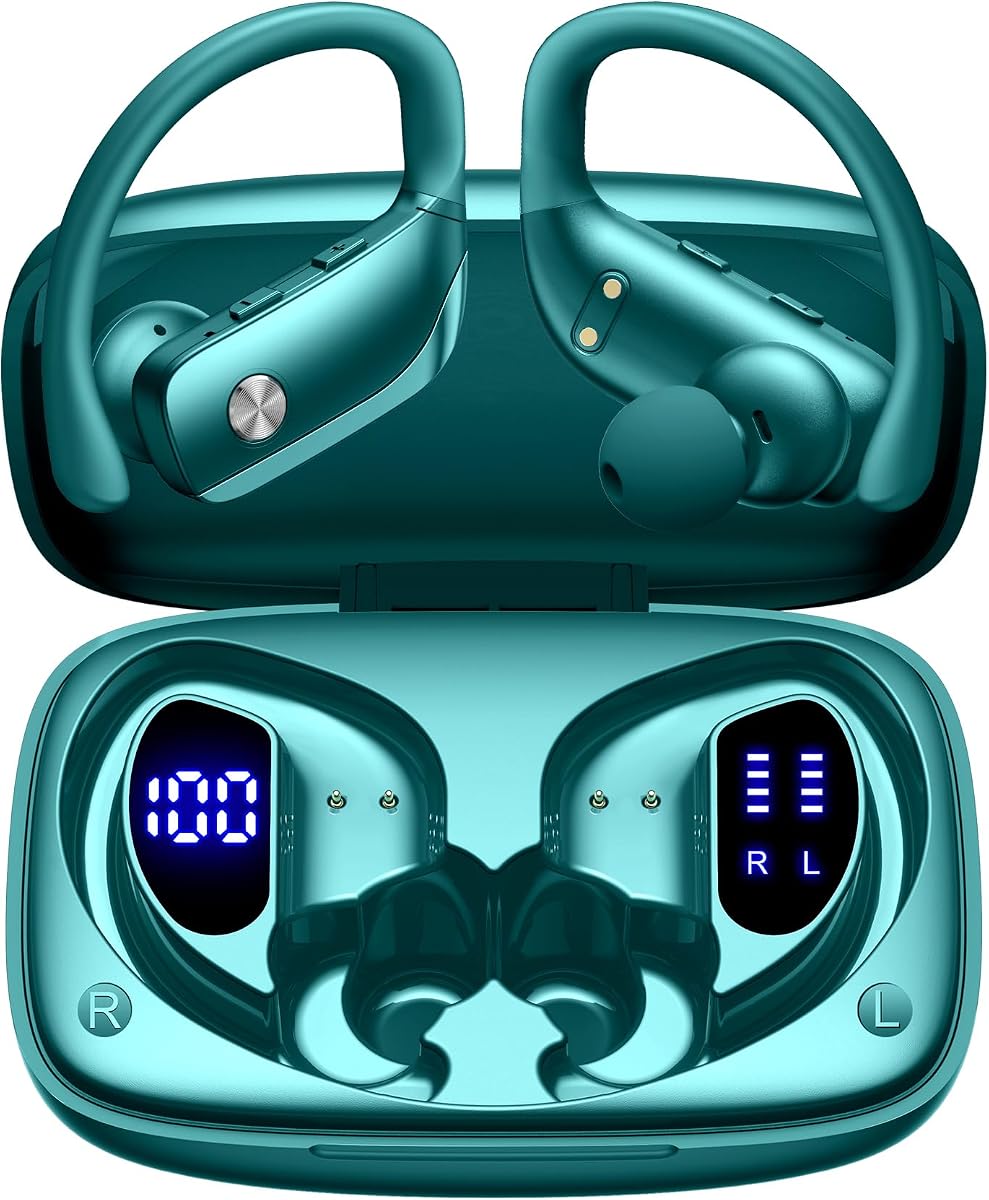
The Wireless Sports Earbuds with Secure Earhooks take a straightforward approach to fit. Flexible silicone hooks are designed to follow the wearer's ear contour and distribute pressure instead of concentrating it in a conventional in-ear tip. The product carries a 4.4 rating, tying several established models in the group while offering a useful feature set for running.
We may earn a commission when you buy through this link, at no additional cost to you.
The earhook geometry is presented as especially helpful for smaller ear canals and people who wear glasses. Thirteen-millimeter drivers provide punchy bass, while integrated ENC microphones focus on isolating the wearer's voice during calls in busy indoor or outdoor environments. A dual LED display gives separate numerical readouts for the case and individual earbuds, making battery management unusually transparent.
The earbuds offer up to eight hours of playback per charge and up to 48 hours with the case. A 1.5-hour USB-C charge supplies up to eight hours, while Bluetooth 5.3 supports stable connections and low latency. The trade-off is that the IPX7 rating is intended for sweat, rain, and humidity, not swimming or prolonged underwater use. The generic branding may also make comparison and support less reassuring.
This pair is most appropriate for runners who struggle with small conventional earbuds, wear glasses, or prefer a hook that spreads pressure across the outer ear. It also fits buyers who value a clear battery display and straightforward physical touch controls more than a broad ecosystem of premium features.
The flexible hook and pressure-distributing structure are intended to reduce fatigue during extended wear. This makes the model particularly relevant to runners with less conventional ear shapes or those whose glasses arms compete for space around the earbud.
A numeric display for both the case and earbuds removes the guesswork associated with small indicator lights. Runners can check remaining power before a long outing without opening the case or relying on a phone application.
We may earn a commission when you buy through this link, at no additional cost to you.
The bmani Ear Buds use adjustable over-ear hooks intended to remain secure during running, cycling, and intensive gym work. Their 4.3 rating reflects a reliable combination of hook-based retention, physical controls, and extensive battery life. They are a practical option for athletes who want extended playback without constantly recharging the case.
We may earn a commission when you buy through this link, at no additional cost to you.
Each earbud provides up to eight hours of playtime, while the portable charging case expands total use to 80 hours. The case uses a split display to show remaining case power and individual earbud charging status. Ten-millimeter dynamic drivers and dual microphones are included, and the hooks adapt to different ear shapes to reduce slippage. Separate main and volume buttons are easier to operate blindly during a run than many touch panels.
The main limitation is that eight hours of uninterrupted earbud playback is modest compared with the case's headline figure. The provided information also does not state a formal numerical water-resistance rating, instead describing the construction as sweat resistant and dust resistant. The hook may feel more substantial than a lightweight in-ear wing, particularly during long sessions.
The bmani model is well suited to runners who train frequently, take long hikes, or cycle in changing weather and need a case that can sustain repeated use. Physical buttons and automatic reconnection add convenience, while the broad Bluetooth compatibility makes it easy to move between a phone, tablet, and laptop.
The over-ear hooks follow the outer ear and are positioned to reduce slippage during repetitive vertical movement. Their adjustability allows the user to refine the angle rather than relying on a fixed tip size.
The 80-hour case runtime is particularly useful for athletes who do not recharge their earbuds every night. The per-earbud runtime is more limited, so runners planning very long sessions may still need a case charge.
We may earn a commission when you buy through this link, at no additional cost to you.
The Wireless Earbuds 75H are built around elastic TPU earhooks intended to stop the earbuds from falling during a run. The hooks are described as comfortable and anti-allergic, while the overall form is aimed at jogging, gym work, yoga, and other active uses. A 4.3 rating suggests a well-received product within the sport-earbud category.
We may earn a commission when you buy through this link, at no additional cost to you.
The TPU material provides enough flexibility to adapt to the outer ear, while the earbuds offer 14.2mm drivers for a comparatively large sound chamber. Built-in microphones support calls in noisy settings, and physical buttons cover playback, track changes, volume, calls, and voice assistance. Bluetooth 5.4 supports common profiles, quick pairing, and a stated connection distance of up to 33 feet.
Battery life reaches up to 15 hours from the earbuds and up to 75 hours with the case, based on five to six case recharges. IPX7 protection is designed to resist sweat, raindrops, and splash damage. As with the other hook-style models, the trade-off is physical bulk, and the product information does not highlight a companion app, active noise cancellation, or heart-rate sensing.
This is a fitting option for runners who have experienced repeated slipping with lightweight earbuds and want a flexible hook, long runtime, and tactile controls. It is less suited to buyers who require advanced training metrics or a nearly invisible open-ear profile.
Flexible TPU is a practical material for an exercise earhook because it can bend with the ear rather than forcing the earbud to move independently. The design aims to keep the two sides together through repeated foot strikes.
The 14.2mm drivers and up to 75-hour case runtime make this a strong combination for music-focused runners. The charging case includes a dual display for case power and earbud charging progress.
We may earn a commission when you buy through this link, at no additional cost to you.
The GNMN Active Noise Cancelling earbuds combine in-ear tips with soft earhooks, offering both a seal and mechanical stability. Their 4.4 rating reflects a versatile feature set that includes active noise cancellation, transparent mode, wireless charging via USB-C, and one of the longest stated case runtimes in this comparison.
We may earn a commission when you buy through this link, at no additional cost to you.
Noise cancellation is specified at up to 45dB, which can reduce distracting noise in busy gyms and other environments. Transparent mode allows surrounding sound to enter without removing the earbuds, useful when crossing streets or speaking to someone nearby. Sixteen-millimeter drivers provide clear highs, richer midrange, and deeper bass, while the ear tips and hooks are designed to limit leakage and maintain a snug fit.
The earbuds last up to eight hours per charge, and the case raises total playback to as much as 96 hours. IPX7 protection covers sweat and rain exposure, and a dual LED display shows case and earbud levels. The trade-off is that an in-ear seal can create pressure for long-distance runners, while large hooks may interfere with glasses. This model also has no stated heart-rate tracking or premium call platform.
The GNMN earbuds are a strong fit for runners who want active noise reduction, adjustable tips, and dependable battery availability. They are especially useful in noisy gyms and urban routes where transparent mode provides a convenient way to preserve awareness without interrupting a workout.
Active Noise Cancelling can reduce the persistent low-frequency rumble of gyms, traffic, and air conditioning. Transparent mode restores environmental sound, making it easier to hear warnings or conduct a brief conversation without removing the earbuds.
A stated 96-hour total runtime reduces charging interruptions. The dual display is also more informative than simple status LEDs because it shows the power remaining in both the earbuds and the case.
We may earn a commission when you buy through this link, at no additional cost to you.
The Beats Powerbeats Pro 2 combines a flexible nickel-titanium alloy earhook with five ear-tip sizes to create a secure and personalized fit. The stated testing across athletes, ear shapes, and intensity levels supports its running credentials. Its 4.1 rating is modest compared with some alternatives, but the earhook, workout sensors, and battery system make this the most feature-oriented premium model here.
We may earn a commission when you buy through this link, at no additional cost to you.
Built-in sensors pulse more than 100 times per second to provide real-time heart-rate tracking without a separate chest strap or watch. Active Noise Cancelling is designed for training environments, and Transparency mode lets outside sound through when needed. The earhook is 20% lighter than the previous generation, while the supplied tips allow the acoustic seal to be adjusted for different ears.
The charging case provides up to 45 hours of total playback, and Fast Fuel adds 1.5 hours from a five-minute charge. The case supports wireless Qi charging, although a USB-C to USB-C cable is sold separately. Adaptive EQ, Personalized Spatial Audio with head tracking on Apple devices, six microphones, physical buttons, and automatic device switching round out the feature set. IPX4 covers sweat and water resistance, but the lower rating than IP67 or IP68 models means it is less suited to heavy rain and immersion.
Powerbeats Pro 2 is the premium recommendation for runners who want a rock-solid hook, integrated heart-rate data, excellent call handling, and flexible controls. Its main drawbacks are the premium purchase level, the need for a separate charging cable, and less aggressive water protection than the most rugged alternatives.
Real-time heart-rate tracking is the standout premium feature. The sensors sample the wearer's pulse repeatedly, providing workout data without requiring a separate connected device during the run.
Five-minute Fast Fuel charging is useful when a runner needs a quick top-up between sessions. The wireless Qi-compatible case adds convenience at a desk, while on-ear buttons and tactile volume rockers remain easy to operate mid-stride.
We may earn a commission when you buy through this link, at no additional cost to you.
The Soundcore C50i uses a clip-on design that rests over the ear without entering the ear canal. Its 4.2 rating reflects a compact, awareness-focused alternative to hook and in-ear sport models. The memory titanium FlexiClip is designed to adapt to different ear shapes, making this a potentially comfortable option for runners who dislike conventional earbuds.
We may earn a commission when you buy through this link, at no additional cost to you.
The open format preserves awareness of the runner's surroundings and avoids the pressure of a deep ear seal. Custom 12mm drivers provide bass and a stated maximum output of 86dB, which should be more substantial than many lightweight bone-conduction alternatives. AI processing filters background noise for calls made during outdoor running, gym workouts, or commutes.
The earbuds provide up to eight hours per charge and up to 28 hours with the case, which is shorter than many competing sport models. IP55 protection covers sweat and rain exposure, and Bluetooth 6.0 supports stable connectivity. The primary trade-offs are limited isolation, potential sound leakage, and less bass than a sealed in-ear design.
The C50i is an excellent choice for runners who want awareness, low-profile comfort, and a design that does not compete with eyeglass arms. It works particularly well for road running, walking, and group workouts where hearing the surroundings matters more than blocking out ambient noise.
Because the ear canal remains open, the C50i lets runners hear approaching vehicles, training partners, and music in the surrounding area. That awareness can be more valuable than noise isolation during outdoor sessions.
The memory titanium FlexiClip is intended to retain its shape while adapting to the wearer's ear. The product information also identifies the design as lightweight and stable during intense running and gym activity.
We may earn a commission when you buy through this link, at no additional cost to you.
The Bose SoundSport was designed specifically for running and sports, using Bose Stay Hear Plus tips to keep the earbuds comfortably in place during workouts. Its 4.4 rating places it among the highest-rated products in this guide, and the original swept shape remains an established approach to balancing retention with in-ear sound quality.
We may earn a commission when you buy through this link, at no additional cost to you.
The angled earpieces and Stay Hear Plus tips are intended to create a stable fit without relying on a large external hook. Bose active EQ keeps the audio consistently balanced as volume changes, which can make podcasts, music, and navigation prompts remain easier to hear across different settings. The stated sweatproof construction targets the demands of active use, while Bluetooth and NFC pairing are assisted by voice prompts.
The product information does not provide a numerical battery specification, active noise cancellation, multipoint connectivity, or modern sports sensors. It also warns that incorrect tip size or improper placement can reduce sound quality and call performance. Those limitations make it less advanced than newer hook-equipped models, but not necessarily less effective for its central purpose.
The Bose SoundSport is recommended for runners who value a simple, purpose-built running shape, balanced sound, and a comfortable in-ear seal. It is a particularly sensible choice for those who have had success with Bose's traditional Stay Hear fit and do not need extensive app-based workout controls.
The earbuds follow the angle of the ear rather than sitting as a straight vertical cylinder. Combined with Stay Hear Plus tips, this shape helps preserve the acoustic seal while reducing the likelihood of movement during running.
Bose active EQ adjusts the sound as the volume changes, supporting clearer perception of music, speech, and navigation prompts. Proper tip selection remains essential for achieving the intended sound and call performance.
We may earn a commission when you buy through this link, at no additional cost to you.
The most important consideration is not simply whether an earbud includes a hook, but whether its complete fit system matches your ear shape, movement pattern, and tolerance for in-ear pressure. Audio, protection, power, awareness, and controls should then be evaluated according to the kind of running you do.
In-ear wings press against the outer ear to resist vertical movement, large silicone hooks wrap around the ear, and open clips rest above or around the canal without sealing it. Each approach has different benefits. Wings tend to create stronger bass and isolation, hooks provide exceptional mechanical stability, and clips minimize pressure while preserving environmental awareness. The correct design is the one that remains comfortable through a long run rather than the one that simply feels secure during a brief shake-down.
Choose retention based on fit and use. Prioritize wings or hooks for intense movement, and consider clips or open-ear models for comfort and awareness.
A secure earbud should not require constant readjustment, but it also should not create pain around the concha or deep in the ear canal. Compare ear-tip sizes, observe whether the hook or wing creates a concentrated pressure point, and consider whether glasses interfere with the retention mechanism. Smaller ear canals may benefit from shallow-fit tips or a hook design, while sensitive ears may prefer an open format.
A good fit should stay put without feeling invasive. Use different tip sizes and positions before committing to long-distance use.
An IP rating is more useful than a generic claim of sweat resistance because it provides a standardized level of ingress protection. IPX7 models are designed to resist sweat and rain exposure, while IP55 and IPX4 offer more limited protection. IP68 and IP68-rated combinations indicate stronger resistance to water, dust, and demanding conditions. Remember that earbud ratings do not necessarily apply to the charging case, and always dry the earbuds before charging them.
For frequent outdoor running, IPX7 or stronger is preferable. Check case limitations and dry every wet earbud before charging.
Sealed in-ear models can provide stronger bass and reduce distracting gym noise, but they may also limit awareness of traffic, other runners, and unexpected obstacles. Open-ear and clip-on designs let more outside sound through and usually feel less invasive. Active Noise Cancelling can add isolation without requiring a perfect seal, while transparency or ambient modes offer a quick way to restore awareness. Road runners may prioritize environmental sound, while gym users may value stronger isolation.
Choose sealed models for noise control and open designs for awareness. Ambient modes offer useful flexibility between the two.
Compare both per-earbud playback and total case runtime. A long case rating does not compensate for an earbud that gives out during a marathon, so runners with regular long-distance sessions should prioritize at least a full workout from each bud. Noise cancellation, volume, and workout mode can also affect real-world runtime. Fast charging is useful for quick preparation, while a numeric case display helps identify remaining power without opening the case.
Prioritize per-charge runtime for long runs, then consider case capacity, fast charging, and a clear battery display.
Running earbuds must provide enough clarity for music, podcasts, and navigation prompts without harshness that becomes tiring over time. Driver size alone does not determine sound quality, so look for useful EQ controls, spatial audio options, and a balance between bass and vocal intelligibility. For runners who take calls outdoors, beamforming microphones, wind protection, and AI noise processing are important because footfalls and wind can easily overwhelm a basic microphone.
Prioritize balanced sound, accessible EQ, and noise-reducing microphones. Test spoken clarity rather than judging only by bass.
Sport modes can adjust sound or noise control to match different workout intensities, while heart-rate sensors may provide useful training information without a separate chest strap. Physical buttons are easier to identify by touch than small touch controls, and voice assistance can reduce the need to handle a phone. App support is helpful for EQ, firmware updates, device switching, and post-workout relaxation sounds, though it adds another piece of software to maintain.
Heart-rate sensors and sport presets add value for serious training. Physical buttons and app controls improve daily convenience.
Multipoint connection can keep the earbuds connected to two devices, allowing a runner to hear navigation from a phone while watching a workout video on a tablet. Quick-pair support is helpful for Android users, while compatibility with voice assistants and standard Bluetooth profiles improves everyday versatility. A stable low-latency connection is particularly useful for video and interactive training content, although audio and call quality still depend partly on the phone or computer.
Multipoint and fast pairing simplify daily switching. Verify compatibility with your phone, tablet, computer, and preferred assistant.
Before the first run, charge both earbuds and the case, then pair the earbuds with the Bluetooth menu on your phone or computer. For models with adjustable tips, wings, or hooks, begin with a moderate fit and make small changes rather than forcing the hardware into place. Check the manufacturer guidance for the intended tip size and installation position, since a proper seal improves both audio quality and call performance.
During a workout, check that the retention mechanism is seated correctly before heading outdoors. Use the smallest controls that will not be accidentally pressed during movement, and learn how to switch between music, calls, transparency, and sport modes before you need them under pressure. If the earbuds begin to feel unstable, stop and adjust them rather than continuing until a full dislodgement occurs.
After each session, remove the earbuds, wipe away moisture with a soft dry cloth, and inspect the tips and hooks for debris. Never immerse the earbuds unless their documentation explicitly permits it, and do not charge wet buds. Keep the contacts clear, store the earbuds in their case, and update the firmware when available so that sound, connection, and battery behavior remain current.
Sport earbuds with over-ear hooks or wings generally offer the strongest mechanical retention. Open-ear clip models can also remain stable because they do not depend on a deep ear-tip seal. The right model still depends on ear shape, so choosing the correct tip or hook position is essential. A model that feels secure during a short test should also be checked during a longer run.
Open-ear earbuds are often more comfortable because they do not block the ear canal. They also let runners hear traffic, training partners, and environmental warnings more clearly. Their trade-off is reduced isolation and the possibility of more sound leakage. In-ear sports models may therefore be preferable for gym noise control, while open designs are attractive for road running and situational awareness.
An IP rating is valuable because sweat, rain, and dust are common around active users. IPX4 provides a basic level of sweat and water resistance, while IPX7 offers stronger protection against sweat and rain exposure. IP68 models are better suited to demanding outdoor conditions. The rating applies to the earbuds, not necessarily the case, and wet earbuds should be dried before being placed inside it.
Wing tips are smaller and may feel less intrusive, but they rely on a good in-ear seal and can create pressure during long sessions. Earhooks spread their force across the outer ear and often stay in place more reliably. Glasses wearers should consider the space occupied by each hook. Trying both styles, where possible, is the best way to identify a comfortable fit.
Yes, but the quality varies by model and environment. Beamforming microphones, multiple microphones, wind protection, and AI noise processing can improve voice pickup. Open-ear designs may hear more surrounding noise than sealed in-ear models, while active noise cancelling is primarily designed for playback rather than call processing. Speak briefly and position the microphone toward a cleaner source of wind for better results.
ANC can be useful in noisy gyms because it reduces persistent background sound without requiring the same seal as passive isolation. On roads, it may reduce awareness of traffic, so transparency or ambient mode should be readily accessible. Runners who value environmental awareness may prefer to leave ANC off outdoors. Test both modes during similar conditions before settling on a preference.
The ideal runtime is at least as long as a typical run, with extra capacity for calls and navigation. Many models provide between six and twelve hours per earbud charge, while case totals can extend much further. Actual runtime varies with volume, noise cancellation, and workout modes. Fast charging is a useful backup, but it should complement rather than replace adequate per-charge endurance.
Heart-rate monitoring is useful for athletes who want convenient training data without wearing a separate chest strap. It is less essential for casual runners who already receive heart-rate information from a watch. Optical earbud readings can also be affected by fit and movement, so they should be treated as a convenient estimate rather than a replacement for a dedicated chest-strap sensor.
The Soundcore V20i offers the strongest budget-oriented balance of open-ear comfort, adjustable positioning, and substantial sound. The Bose SoundSport remains a straightforward running-focused choice with Stay Hear Plus tips and balanced active EQ, while the Beats Powerbeats Pro 2 stands apart as the premium option with a flexible earhook, heart-rate sensing, excellent controls, and substantial battery life.
Prioritize the fit system first, then choose the features that suit your environment. Road runners may favor open-ear awareness, gym users may prefer secure hooks and noise control, and long-distance athletes should examine per-charge runtime, comfort, and water protection. A secure product should remain fixed without creating pressure, and its controls should be usable without looking at a screen.
Finally, check the current price, availability, warranty, and latest product details before purchasing, since they can change over time. Also verify the return policy and ensure that the selected model works with your preferred phone, tablet, computer, and fitness apps. The right pair should make the run easier to enjoy without distracting from the rhythm of your stride.