
Ceptics CT-6 Travel Adapter
4.5Editor score
Ultra-compact Type A design
Grounded and ungrounded outlets
Three adapters included
Supports up to 10A
Our expert guide compares Power Adapter for Japan from Usa options, covering plug types, USB charging, voltage compatibility, portability, and travel convenienc
A power adapter for Japan from Usa lets American travelers connect familiar devices to Japanese Type A outlets without searching for a compatible wall plug. The right choice depends on plug configuration, grounded versus ungrounded connections, USB charging needs, supported wattage, and whether you want a compact single adapter or a multi-outlet travel hub.
This guide compares ten practical options, including simple Type A plug converters, folding travel adapters, multi-outlet models with USB ports, an extension-cord design, and a universal kit. We evaluated the stated features, port layouts, power limits, dimensions, voltage requirements, country compatibility, and travel considerations rather than claiming hands-on testing.
Each pick reveals a different balance: the Ceptics CT-6 is exceptionally compact, HANYCONY provides generous outlet and USB capacity, TESSAN offers broad device support, and the VINTAR models prioritize portability. Customer ratings and current availability can change, so compare the specifications and verify recent listings before purchasing.
4.5Editor score

4.7Editor score

4.5Editor score
The table below compares all ten adapters by format, charging capability, capacity, and portability, making it easier to identify the model that fits your trip and device mix.




The TESSAN 7-in-1 model combines a US-to-Japan Type A plug arrangement with four AC outlets and three USB charging ports. Its 4.6 customer rating reflects a generally favorable reception, while the combination of outlet access and USB connectivity makes it a strong all-purpose choice for travelers carrying several types of gear.
We may earn a commission when you buy through this link, at no additional cost to you.
The adapter's four AC outlets accept standard American plugs and are rated for a combined maximum of 1875 watts. Two USB-A ports provide up to 2.4A each, while the USB-C port supports up to 20W. This arrangement lets you charge phones, earbuds, accessories, and other USB-powered devices while reserving the AC outlets for larger electronics.
Its four-sided design is particularly useful in crowded hotel rooms because it helps prevent large charger blocks from obstructing neighboring outlets. The stated dimensions of 3.15 by 2.24 by 2.25 inches and weight of 3.46 ounces keep it reasonably portable. However, it has no surge protection, and it does not change the voltage supplied by a Japanese outlet.
This is a good choice for families or business travelers who want one unit to handle multiple everyday devices. It is less suitable for high-wattage appliances or anyone who requires surge protection. Dual-voltage electronics can use the outlet directly, while 110V-only or 125V-only devices would require a separate voltage converter.
Overall, the TESSAN earns its place as a flexible travel hub for travelers who value USB-C charging and ample AC access more than surge protection or voltage conversion. It balances several useful functions without becoming excessively large.
Four AC outlets and three USB ports create a convenient centralized charging point. That reduces the need to carry several separate wall chargers when a hotel room offers only limited wall access.
The four-sided body makes each outlet accessible even when bulky plugs are inserted. This is valuable in busy hotels, offices, and other locations where a large adapter could otherwise occupy more than one wall socket.
We may earn a commission when you buy through this link, at no additional cost to you.
This HANYCONY Type A adapter is a compact five-in-one option with two American-style AC outlets and three USB ports. Its 4.6 rating indicates strong customer satisfaction, and the small dimensions make it appealing for travelers who need more charging capacity than a simple plug converter without carrying a large power strip.
We may earn a commission when you buy through this link, at no additional cost to you.
The USB section includes two USB-C ports and one USB-A port. The listed output is up to 5V and 3.1A in total, or 15.5W maximum, with the USB-C ports supporting up to 5V/3A and the USB-A port supporting up to 5V/2.4A. Smart charging technology is stated to detect connected devices and select a more suitable charging rate.
The AC outlets have a maximum capacity of 2500 watts at up to 250V and 10A, which is useful for common travel electronics. At just 2.2 by 1.1 by 1.5 inches and 2.4 ounces, it saves room compared with larger outlet hubs. The power indicator provides a simple visual confirmation that the adapter is active.
Its main limitation is that the plug only fits partially into some outlets in Thailand and Peru because their wall sockets have different hole configurations. It also lacks surge protection and cannot convert voltage. These drawbacks matter less for a Japan-focused trip, but travelers combining several destinations should check socket compatibility first.
For visitors to Japan who want compact size, two AC outlets, and a mix of USB connectors, this model is a well-balanced recommendation. It is especially suitable for travelers carrying a phone, tablet, power bank, and one or two USB-C accessories.
At 2.4 ounces, the adapter can fit easily into a personal bag or carry-on without taking up much room. It offers enough capacity for daily travel electronics while remaining substantially smaller than many multi-outlet wall units.
The ports detect connected devices and distribute up to 15.5W across the USB section. That makes the hub most effective when charging several lower-draw accessories rather than relying on one port for maximum output.
We may earn a commission when you buy through this link, at no additional cost to you.
The HANYCONY 8-in-1 adapter is one of the strongest all-around choices in this guide. It combines four standard American outlets with four USB ports, including two USB-C connections, and carries a 4.7 rating. The two-pack configuration also gives travelers an option to place one adapter in different luggage or carry one as a backup.
We may earn a commission when you buy through this link, at no additional cost to you.
AC outlets are rated for a combined maximum of 2500 watts at up to 250V and 10A. The two USB-C ports support up to 5V/3A, while USB-A ports support up to 5V/2.4A, with total USB output stated at 5V/3.1A and 15.5W maximum. Device detection is included to improve charging efficiency across connected accessories.
Despite its broad feature set, the adapter measures 2.75 by 2.2 by 1.5 inches and weighs 2.4 ounces. That compact footprint makes it practical for international travel. Its listed compatibility covers Japan and many countries using Type A-style connections, including the Philippines, Canada, Mexico, China, and Thailand.
As with most travel plug adapters in this roundup, there is no surge protection, and the unit does not transform voltage. You should also treat the USB output as a shared budget rather than expecting every port to deliver its maximum rate simultaneously. Dual-voltage hair tools and other devices can operate, but single-voltage appliances need a separate converter.
This HANYCONY is a strong choice for people who want multiple AC outlets, modern USB-C charging, and two adapters in one set. It balances capacity, compactness, and customer rating particularly well, making it suitable for families, shared accommodations, and long work trips.
Four AC outlets and four USB ports give travelers many ways to organize their charging setup. You can connect larger powered devices while retaining space for phone, tablet, earbud, and power-bank chargers.
Including two adapters is useful for trips involving multiple pieces of luggage or shared accommodation. It also provides a spare without requiring a separate purchase.
We may earn a commission when you buy through this link, at no additional cost to you.
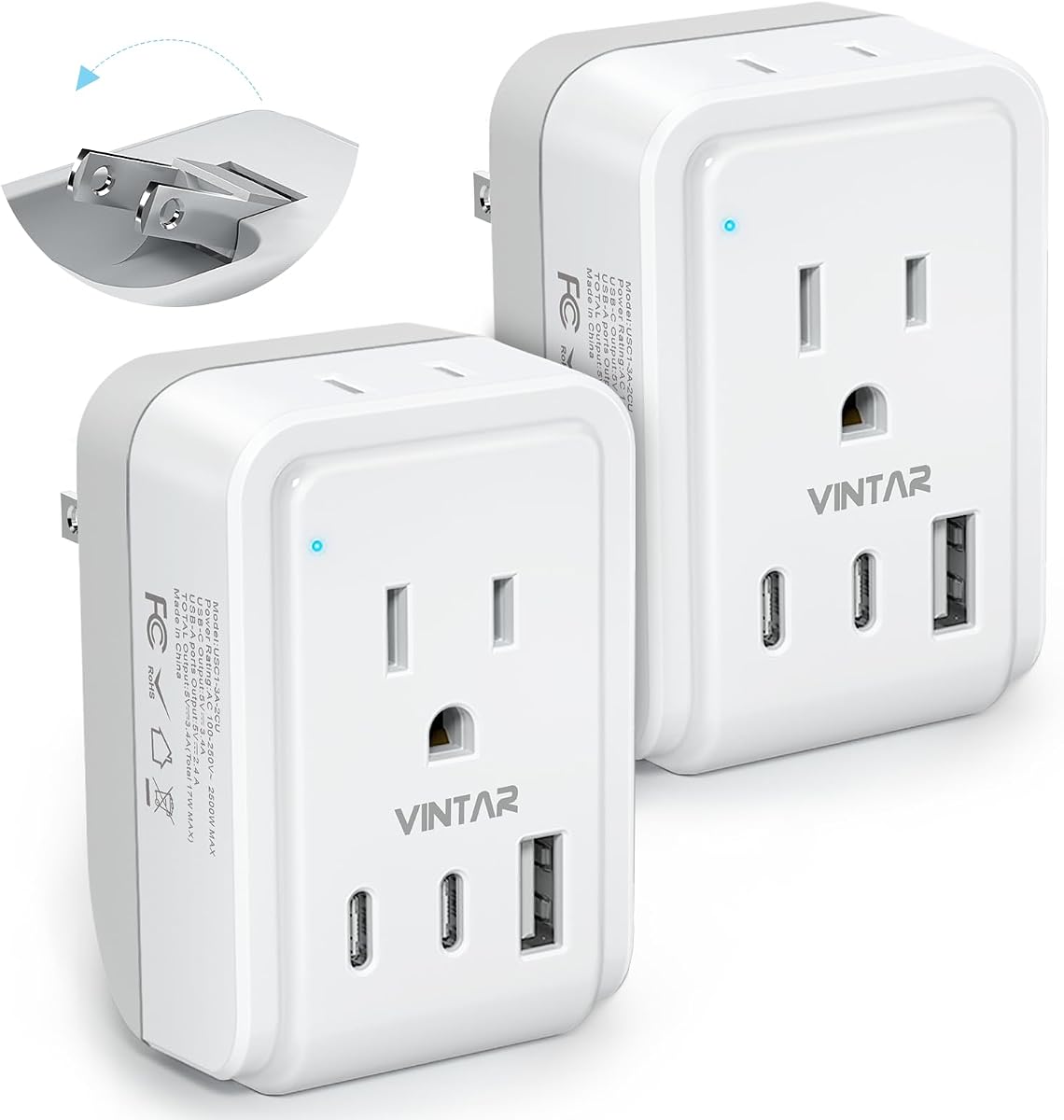
The VINTAR folding adapter combines three American-style outlets with two USB-C ports and one USB-A port. Its 4.7 rating places it among the most well-reviewed products here, while the folding-plug design gives it a distinct advantage for travelers who want to protect the pins inside a luggage pocket.
We may earn a commission when you buy through this link, at no additional cost to you.
The prongs fold through 90 degrees, helping prevent bending or snagging during transport. The adapter measures 2.9 by 1.9 by 1.7 inches and includes no attached cord, which makes it practical for hotels, offices, and homes. The stated USB-C output reaches 17W maximum, and the USB section includes two USB-C connections plus one USB-A connection.
Its listed compatibility includes Japan and numerous other regions with Type A-style sockets. The shell is described as flame retardant, and the product carries CE and FCC certification. A 12-month warranty is also stated. The two-pack format provides a backup or lets travelers keep one adapter in each bag.
The charging limitation is worth noting: the USB-C ports do not support Quick Charge 3.0 and do not handle devices requiring 9V to 22V. The adapter also has no surge protection and cannot convert 100V to 220V. These are meaningful restrictions for laptops or specialized high-voltage chargers.
VINTAR is a good match for travelers who want modern USB-C ports and a foldable, cordless design. It is less attractive if your charging setup depends on USB Power Delivery protocols or needs multiple grounded American plugs.
The rotating plug design keeps the pins closer to the body when the adapter is not in use. This reduces accidental contact with objects in a suitcase and helps the adapter settle flat in crowded luggage.
Three AC outlets and three USB ports cover common phone, tablet, camera, and laptop charging needs. The 17W maximum USB-C output is useful for compatible phones and accessories but does not replace a full laptop charger.
We may earn a commission when you buy through this link, at no additional cost to you.
The Ceptics CT-6 is the simplest and most compact adapter in the comparison. It is a three-pack of Type A converters for Japan, the Philippines, and North America, and it has a 4.5 rating. Each unit provides one grounded three-prong American outlet and one ungrounded two-prong outlet.
We may earn a commission when you buy through this link, at no additional cost to you.
What distinguishes this model is its extremely small footprint of 1.6 by 1.6 by 1.9 inches and weight of 1.07 ounces. It can support two devices at once and accepts polarized plugs as well as compatible two-prong plugs. The NEMA 1-15 standard is rated for up to 10A and 250V.
This design is ideal for travelers who already carry USB wall chargers and only need a physical way to connect them to a Japanese outlet. The lack of built-in USB ports keeps the adapter simple and avoids carrying a bulky charging hub. Three units provide convenient placement options in different rooms or bags.
Neither of the two outlets is independently rated for the full 10A limit; the shared adapter is limited to 10A. It also has no surge protection, and users must confirm that connected electronics support the relevant worldwide voltage range. Devices limited to North American 120V should not be treated as automatically safe abroad.
The CT-6 is a strong recommendation for anyone seeking the smallest Type A solution rather than a multi-port travel hub. It is less useful for travelers who want to charge several devices directly from USB or who need a single adapter with independent outlet capacity.
At only 1.07 ounces per adapter, the CT-6 is easy to carry in a purse, day bag, or carry-on. Three units add very little bulk while providing useful placement flexibility.
The three-prong outlet gives compatible grounded chargers a ground connection, while the two-prong side accommodates smaller charger blocks. Check the charger and device requirements before use.
We may earn a commission when you buy through this link, at no additional cost to you.
This second TESSAN option provides four American-style AC outlets, two USB-C ports, and one USB-A port in a two-pack. It holds a 4.6 rating and is especially interesting to travelers whose devices increasingly use USB-C but who still need to support an older USB-A accessory.
We may earn a commission when you buy through this link, at no additional cost to you.
One of the USB-C ports is listed as supporting up to 20W, while both USB-C ports support up to 3A per port and the USB-A port supports up to 2.4A. The AC outlets share a maximum capacity of 1875 watts. Together, the adapter can accommodate seven devices, making it suitable for a busy travel day or family packing list.
The four-sided design allows access to the outlets from several directions and helps avoid blocking adjacent sockets with large charger blocks. Dimensions are 3.15 by 2.24 by 2.25 inches, with a weight of 3.46 ounces. Two adapters are included, which is practical for separate travel bags or for keeping one at a destination.
There is no surge protection, and the unit is not a voltage converter. Devices must support 100V to 250V dual voltage to operate safely across Japanese and other supported outlets. Hair dryers, straighteners, and curling irons deserve particular attention because many are designed for a single voltage range.
Compared with the earlier TESSAN model, this version trades one USB-A port for a second USB-C port. It is therefore a better fit for newer phone, tablet, and accessory ecosystems, while remaining a solid general-purpose travel charging hub.
Two USB-C ports accommodate current charging cables, while the remaining USB-A port supports older accessories. The listed 20W maximum on one USB-C output is convenient for compatible phones and earbuds.
Travelers can place one adapter in each carry-on or share the set with a companion. Its broad outlet count reduces competition for wall sockets in hotels and other crowded accommodation.
We may earn a commission when you buy through this link, at no additional cost to you.
The unnamed compact 7-in-1 model combines four American-style outlets with two USB-A and two USB-C ports. Its 4.7 rating makes it one of the strongest customer-rated options in the guide, and the balanced port arrangement makes it suitable for travelers carrying a mix of older and newer accessories.
We may earn a commission when you buy through this link, at no additional cost to you.
The four USB ports share an output of 5V/3.1A. Individual USB-A ports are stated to deliver up to 5V/2.4A, while USB-C can reach up to 3A. Smart device detection is included, although the USB-C ports do not support Quick Charge 3.0 or devices that require 9V to 22V charging voltage.
The AC outlet section supports up to 1875 watts at 125V and 15A. The adapter measures 3.0 by 2.4 by 1.6 inches, has no attached cord, and includes a blue indicator that shows whether the power is on or off. The housing is described as made from 1382°F fire-resistant material.
Its lack of surge protection and voltage conversion means it should not be treated as a general-purpose surge suppressor or transformer. It is best suited to dual-voltage travel electronics, and high-draw or single-voltage appliances should be checked carefully before connection.
This adapter works well for families, shared rooms, and trips involving multiple charging cables. The main advantage over simpler Type A converters is the number of ports, while the main limitation is that its charging performance is based on shared 5V output rather than high-voltage protocols.
Two USB-A and two USB-C ports offer a balanced setup for mixed devices. It is a useful configuration for travelers carrying legacy accessories alongside newer USB-C cables.
The blue indicator confirms whether the adapter is receiving power. This quick visual check is useful in hotel rooms where an outlet may be switched off or disconnected.
We may earn a commission when you buy through this link, at no additional cost to you.
The VINTAR 2 Pack Foldable Outlet with 4 AC 3 USB combines four American outlets with two USB-C and one USB-A port. Its 4.4 rating is the lowest among the products listed, but the adapter still offers a capable feature set for travelers who need more AC connections than a compact converter provides.
We may earn a commission when you buy through this link, at no additional cost to you.
The AC side is rated for up to 2500 watts at 250V and 10A. Two USB-C ports support a combined 5V/3.4A and up to 17W maximum, while the USB-A port handles lower-power accessories. The product supports seven device connections in total, although the shared charging outputs mean that simultaneous performance should not be treated as maximum on every port.
A four-sided construction helps make the four AC outlets usable when a large charger is inserted. The plug folds 90 degrees, reducing the chance of damage or accidental contact inside luggage. Its 2.9 by 1.9 by 1.7-inch size and cordless design suit hotels, offices, and home use.
Like the other VINTAR model, it lacks surge protection and does not convert voltage. It also does not support devices that need 9V to 22V through USB-C. CE and FCC certification, a 12-month warranty, and testing before shipment are listed, but actual performance and fit should be judged against your charger requirements.
This adapter is a reasonable choice for travelers who prioritize four AC outlets, a folding design, and a generous 2500-watt maximum. Those who need the newest laptop-charging protocols or stronger customer ratings may prefer another option from the guide.
Four outlets provide room for multiple charger blocks without needing a conventional power strip. This can simplify packing and reduce the need to share a single wall socket.
The 90-degree folding mechanism protects the plug during transport. It also allows the adapter to sit closer to the wall in locations where a rigid protruding plug would be inconvenient.
We may earn a commission when you buy through this link, at no additional cost to you.
This extension-cord model differs from conventional plug converters by adding a three-foot cord and a rotating flat plug. With a 4.6 rating, it offers an interesting solution for travelers who cannot position a wall-mounted adapter close to their devices or who want to conceal a multi-outlet block behind furniture.
We may earn a commission when you buy through this link, at no additional cost to you.
The Type A section turns one socket into two American three-prong outlets and two American two-prong outlets. Five USB ports are also included, with a listed total output of 5V/3.4A and up to 17W. The wide spacing around the 2.3-inch outlet module helps reduce interference when multiple charger plugs are used.
The rotating plug is intended for locations where a standard projecting plug does not fit, such as behind a dresser, couch, wardrobe, or bookshelf. The stated dimensions are 4.6 by 1.7 by 1.1 inches, and the total weight is 9 ounces, making it larger than direct plug adapters but still manageable in luggage.
Cruise-ship rules vary. Some operators permit non-surge-protector travel adapters, while others restrict power strips and extension cords, so travelers must check their cruise line's current policy before packing it. It also lacks surge protection and does not convert voltage; connected devices must be compatible with 100V to 250V.
This product is best for travelers who value reach and placement flexibility more than the smallest possible footprint. It may also be useful at home or in dorm rooms, but its cord makes it less convenient for minimalist international travel.
The three-foot cord allows the outlet module to reach a desk, nightstand, or other device location while keeping the wall plug in place. It can make a cramped outlet arrangement more practical.
The rotating wall plug can be turned to fit against furniture or a wall where a fixed protruding plug would not. That flexibility is especially useful behind beds and dressers.
We may earn a commission when you buy through this link, at no additional cost to you.
The Ceptics 35W Universal Travel Adapter Kit is the broadest international option in the guide. It combines two USA outlets, USB-A, two USB-C connections, a 35W USB-C power-delivery port, and a USB-C cable. Its 4.5 rating reflects a balanced feature set designed for trips beyond Japan.
We may earn a commission when you buy through this link, at no additional cost to you.
The kit includes plug attachments for Europe, the United Kingdom, the United States, Australia and China, Germany and France, and Japan. A travel pouch is included, and the adapter measures 2.7 by 1.4 by 3.7 inches while weighing less than 5 ounces. It is therefore more specialized than a simple Type A converter but remains portable.
One of its strongest distinctions is the 35W USB-C power-delivery output, which is more capable than the standard 5V outputs offered by many competing travel hubs. Built-in surge protection and voltage indicators are also included. These features make it useful for compatible laptops, phones, tablets, and cameras during international travel.
The unit remains a plug adapter rather than a voltage converter. Electronics must support the worldwide 100V to 240V AC range, and certain 110V-only hair clippers, dryers, and curling irons are incompatible. Always check the label on an appliance before plugging it in, particularly if it is a high-draw or heating device.
This kit is the most useful option for a traveler visiting Japan and several other countries. Travelers taking a Japan-only trip may find a simpler Type A adapter more economical and less complicated, but the Ceptics earns its place for multi-destination travel and stronger USB-C charging.
The six included plug attachments cover many common international socket formats. This avoids buying a separate country-specific adapter for each destination and keeps related equipment together.
The dedicated 35W USB-C power-delivery port can charge compatible laptops and other higher-power devices more effectively than a basic 5V USB port. The included cable makes that function immediately useful.
We may earn a commission when you buy through this link, at no additional cost to you.
Choose by matching the adapter's physical configuration, outlet capacity, charging protocols, voltage behavior, and destination needs to the devices and locations you will actually use.
Japan generally uses Type A-style wall sockets, while many American plugs are Type B with an additional grounding pin or Type A with two flat pins. A suitable US-to-Japan adapter therefore needs the correct male plug configuration and female outlets that accept the charger plugs you carry. Products described as 3-prong-to-2-prong or 2-prong-to-3-prong adapters solve this physical mismatch, but the labeling can be confusing because the adapter's own grounding arrangement is not always explained in the same way.
Choose based on the charger rather than the device alone. Many modern phone and laptop chargers use detachable two-prong plugs, while desktop equipment may require a grounded three-prong cord. The Ceptics CT-6 is useful for both grounded and ungrounded American plugs, whereas some travel hubs offer only specific outlet formats.
AC outlet count matters when multiple people or multiple large charger blocks need power at the same time. Compact adapters with two outlets work well for a single traveler, while four-outlet hubs are more convenient for families, shared hotel rooms, and workspaces. A broad face with outlets on several sides can also prevent one oversized charger from blocking the others.
Check the maximum wattage and amperage rather than assuming every outlet can deliver the headline rating independently. Listed limits range from 1875W to 2500W for most multi-outlet models, while the extension-cord model states a 3750W maximum at 100V and 1875W at 125V. High-wattage appliances may also have special requirements, so use the lower shared limit as a guide.
A plug adapter changes the physical connection, not the electricity. None of the Japan-focused products in this guide is a true voltage converter. Dual-voltage devices with a 100V to 250V or 100V to 240V rating can usually work across Japanese and American outlets, but single-voltage devices may run too slowly, heat up, or become unsafe.
Hair dryers, straighteners, curling irons, electric shavers, and some electric toothbrushes deserve particular attention. Look for a dual-voltage label rather than assuming the product works because its plug fits. If an appliance accepts only 110V or 125V, use a suitable voltage converter as well as the travel plug adapter.
USB ports can reduce the number of wall chargers you carry, but the number of ports alone does not reveal charging speed. Several models offer standard 5V USB-A and USB-C outputs, while the VINTAR adapters advertise up to 17W and one TESSAN configuration includes a 20W USB-C output. The Ceptics universal kit goes further with a dedicated 35W USB-C power-delivery port.
Check both the per-port and shared output because several multi-port adapters divide a stated total across connected devices. Fast-charge protocols such as Quick Charge 3.0 and high-voltage laptop charging are not universal. If your device needs USB Power Delivery or a particular voltage protocol, confirm that the adapter explicitly supports it.
The smallest useful option should still fit comfortably and offer the outlet configuration you need. The Ceptics CT-6 is exceptionally small at 1.07 ounces, while several multi-outlet hubs remain lightweight enough for a carry-on. Folding prongs add protection against damage and can make the adapter easier to position near a wall.
Avoid choosing solely by the number of functions. A larger universal kit earns its size when traveling to several countries, while a simple Type A adapter is easier to explain and use for a short Japan trip. A corded model takes more luggage space but may provide better reach in a cramped room.
Surge protection is an important differentiator because most compact Japan plug adapters in this guide do not include it. The Ceptics 35W universal kit is the clear exception with stated built-in surge protection. If you are protecting expensive electronics in unfamiliar outlets, that feature can justify a larger or more specialized product.
Cruise-ship policies also matter. Several adapters are described as suitable for cruise ships because they have no surge protector, but operators can still restrict extension cords, power strips, or particular wattages. The three-foot extension-cord model should be checked against the cruise line's policy before departure. Always follow the stricter rule when policies conflict.
Even a product labeled for Japan may advertise compatibility with a long list of countries, and those claims are not always equally strong. Type A outlets are found in several parts of Asia and the Americas, but sockets can vary by country. The HANYCONY 5-in-1 model, for example, only fits partially in outlets in Thailand and Peru because those sockets use different hole patterns.
Use the adapter primarily for the destination you have verified. For a multi-country trip, a universal kit with separate regional attachments may be more dependable than relying on a broad compatibility claim. Look for the exact countries on your itinerary, then confirm the physical shape and grounding arrangement of each outlet.
Before departure, inspect the adapter, prongs, outlets, and USB ports for damage, and read the voltage labels on every device you plan to connect. Confirm that each appliance is compatible with 100V to 250V or the appropriate worldwide range. Keep the adapter dry, and do not use it if the housing is cracked, discolored, or excessively hot.
At the destination, plug the adapter firmly into the wall outlet and connect devices one at a time when practical. Do not exceed the combined wattage or amperage stated for the adapter. High-draw appliances should be connected alone, while lower-draw phone chargers can share the USB section within its stated shared output limits.
After use, disconnect devices before removing the adapter, especially when the plug is close to a bed or other combustible material. Wipe the exterior with a dry or lightly damp cloth, but do not use excessive liquid or immerse the unit. Store folding prongs or retractable parts in their protected position and keep the adapter away from moisture, heat, and bending forces.
Usually not, provided every device supports the voltage found in Japan. Most travel plug adapters in this guide only change the plug shape and do not convert 100V to 220V. Check labels for a dual-voltage or 100V to 250V rating. Single-voltage hair tools, shavers, and other appliances may require a separate voltage converter.
Type A adapters use two flat parallel pins, while Type B adapters add a round grounding pin beneath them. Japanese outlets are commonly used with Type A connections, so travelers need a Type A-compatible arrangement regardless of whether their original American charger was polarized or grounded. The Ceptics CT-6 accepts both grounded and ungrounded US plugs.
Only if the hair dryer explicitly supports 100V to 250V dual voltage. Many inexpensive or high-wattage hair dryers support only one voltage, so the plug may fit while the appliance still operates improperly. Low-voltage or 110V-only models can run slowly, overheat, or create a safety risk and should be paired with an appropriate voltage converter.
Many travel adapters provide only standard 5V USB output, and several models share that power across multiple connected ports. Your device may also require USB Power Delivery or another fast-charge protocol that the adapter does not support. Check the stated per-port output, shared output, and protocol compatibility before relying on the adapter for a laptop.
It depends on the cruise line and the specific product. Several compact adapters are described as suitable for cruise ships because they lack surge protection, but some operators prohibit extension cords, power strips, or adapters above certain limits. The corded extension model requires especially careful checking, and travelers should follow the cruise operator's published policy.
A two-pack is helpful when traveling with family, carrying separate luggage, or wanting a backup. It also allows one adapter to remain in a hotel room while another is used at an airport or café. For a solo traveler with few devices, a single simple Type A adapter may be easier to pack.
Many Type A adapters also work in the Philippines and other locations that use compatible Type A sockets. However, broad compatibility lists sometimes include partial fits or outlets with different pin spacing. Check the exact destination and socket type, especially for countries such as Thailand or Peru, where some Type A adapters may not fit fully.
The physical connection count varies from two devices on the compact Ceptics CT-6 to as many as nine positions on the extension-cord model, which includes AC and USB connections. Charging speed depends on the shared output budget and the protocols supported by each port. You also must remain within the adapter's combined AC wattage and amperage limits.
The TESSAN 7-in-1 is a versatile all-purpose hub with four AC outlets and three USB ports, while the HANYCONY 8-in-1 raises the outlet count and adds balanced USB-C and USB-A connectivity. For the simplest and smallest solution, the Ceptics CT-6 provides an excellent low-profile option. The Ceptics 35W universal kit stands apart for travelers visiting multiple countries, stronger USB-C charging, and built-in surge protection.
Prioritize the features your actual trip requires. Choose a compact converter when you carry only USB wall chargers, select a multi-outlet hub for several people or devices, and confirm USB protocols before relying on USB-C for a laptop. Most importantly, verify that every connected appliance supports dual voltage and keep total consumption within the adapter's stated limits.
Ratings, stock availability, and prices can change, so check the current listing and recent customer feedback before buying. Comparing the present specifications against your device list will help prevent an inconvenient discovery at the airport and make your Japan trip more organized.
