
Waterdrop C2SL Countertop RO
4.2Editor score
Mineral-balanced filtration
Voice-guided setup
Detachable glass pitcher
Compare the best countertop reverse osmosis systems for filtration, efficiency, convenience, taste, capacity, and everyday countertop use.
Countertop reverse osmosis systems bring multi-stage purification to homes, apartments, offices, and rental spaces without requiring a plumber or permanent faucet connection. A good model should balance contaminant reduction, taste, water efficiency, maintenance, and countertop practicality while producing water reliably for daily drinking, cooking, coffee, tea, and ice.
We compared ten countertop RO systems using the specifications and manufacturer information supplied for each product. The evaluation considers filtration stages, membrane performance, certifications, pure-to-drain ratios, reservoir and pitcher capacity, display features, installation requirements, filter replacement, and the practical differences between standard, UV-equipped, mineral-filtered, and multi-pitcher designs.
Each pick below highlights a distinct combination of strengths rather than treating one feature as the only measure of quality. Ratings reflect the supplied customer feedback, while performance claims come from the listed laboratory testing and certifications. Product prices and promotions can change, so check the current listing before deciding which system best fits your household.
4.2Editor score

4.4Editor score

4.4Editor score
This side-by-side comparison highlights the major differences in filtration technology, water efficiency, capacity, monitoring, and maintenance features across ten countertop reverse osmosis systems.




The DREO 7-in-1 Countertop RO is our all-around choice because it combines broad filtration claims with thoughtful conveniences that reduce everyday friction. Its supplied rating is 4.4, and the manufacturer states that the system removes 99.9% of possible contaminants, including PFOA, PFOS, chlorine, and fluoride, after testing by SGS against NSF/ANSI 58 standards.
We may earn a commission when you buy through this link, at no additional cost to you.
Its strongest feature is the combination of live TDS readings, filter-life reminders, an autofill sensor, and a self-cleaning function. The 3L tank and 1.1L pitcher support daily use by one or two people, while a 3:1 pure-to-drain ratio aims to limit discarded water. A claimed filter life of 265 gallons, or 1,000 liters, helps frame the maintenance commitment.
The 14.51-inch by 6.73-inch by 13.35-inch footprint is substantial but still compact enough for a kitchen, office, bedroom, or living area. It is not the smallest model here, and the system depends on electrical power and proprietary replacement cartridges. Those are reasonable compromises for users who value monitoring and automated operation over a minimalist appliance.
This DREO is a strong match for households wanting a capable countertop purifier without permanent plumbing. It is especially attractive for someone who wants water-quality visibility and hands-free dispensing. For families beyond two people, the Bluevua carafe models may offer a more familiar reservoir-and-carafe format worth comparing before purchasing.
Live TDS readings for raw and purified water make it easier to see what the system is producing, while filter reminders reduce reliance on guesswork. These visibility features are especially useful for users unfamiliar with RO cartridges.
The autofill sensor and self-cleaning tubes streamline repeated use. The included pitcher and compact tank make the appliance practical for drinking, cooking, and smaller households.
We may earn a commission when you buy through this link, at no additional cost to you.
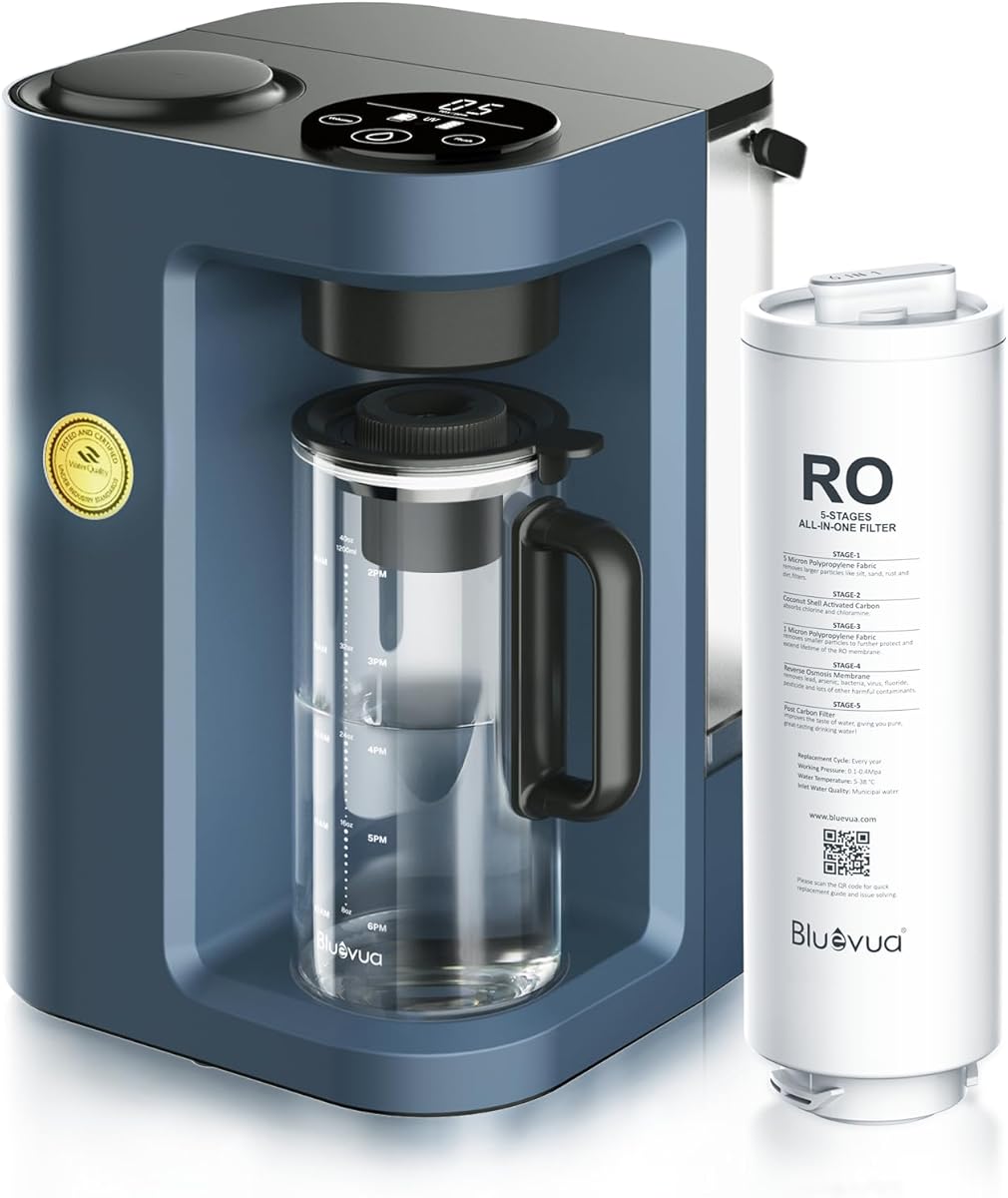
The Bluevua RO100ROPOT has the highest supplied rating in this group at 4.6, earning it a place among the premium picks. Its five-stage RO process includes a remineralization filter, with the manufacturer claiming removal of 99.9% of possible contaminants and enrichment with minerals for better taste.
We may earn a commission when you buy through this link, at no additional cost to you.
A high borosilicate glass carafe is one of the design's most persuasive details. It avoids relying on a conventional plastic collection vessel and creates a convenient way to keep purified water near the refrigerator. The display tracks filter life and water quality, while the system enters standby mode when idle and uses a 2:1 pure-to-drain ratio.
The tradeoff is water efficiency. A 2:1 ratio is less favorable than the 3:1 or 4:1 figures offered by several competitors, and the stated filter interval of 12 to 24 months means replacement planning is essential. Nonetheless, the glass vessel, five-stage process, and strong customer rating distinguish this model.
Choose the standard RO100ROPOT when a glass carafe, mineral balance, and polished countertop presentation matter most. It suits apartments, offices, and homes that value a dedicated countertop appliance. Users who place greater priority on water conservation may prefer the Waterdrop C2SL or one of the 4:1 systems instead.
The borosilicate carafe is both a storage vessel and a visible reminder of the system's purpose. It also reduces reliance on disposable single-use bottles during normal household use.
Five stages, including remineralization, support clean-tasting water, while the display simplifies cartridge timing. The result is an appliance designed for users who want fewer routine chores.
We may earn a commission when you buy through this link, at no additional cost to you.
The DREO Dual Autofill RO expands the familiar DREO concept with two autofill pitchers. It carries a 4.4 supplied rating and is built around seven-stage RO filtration, with a stated 99.9% contaminant reduction claim for substances such as PFOA, PFOS, chlorine, and fluoride following SGS testing against NSF/ANSI 58 standards.
We may earn a commission when you buy through this link, at no additional cost to you.
Two pitchers offer more flexibility than a single-vessel setup. One can remain in the refrigerator while another stays on the counter, or different containers can support a shared kitchen or office. TDS readings, filter-life tracking, self-cleaning internals, and a 3:1 ratio reinforce the convenience-focused design.
The supplied information is less detailed than it is for the first DREO model, so prospective buyers should examine the current listing for exact tank size, dimensions, and included accessories. More pitchers also mean more items to store, wash, and move around, which can offset the benefit for a very small kitchen.
This model makes the most sense for users who regularly move purified water between locations or want a spare pitcher. It is less compelling for someone who only needs one small container, but the filtration platform, monitoring, and installation-free operation make it a credible alternative to the featured DREO.
Two pitchers make it easier to keep one container in the refrigerator and another accessible at the sink or in another room. This supports households and shared spaces that use filtered water throughout the day.
Because no plumbing or permanent faucet connection is required, setup is limited to placing, filling, and powering the system. The self-cleaning function further supports consistent operation.
We may earn a commission when you buy through this link, at no additional cost to you.
The Bluevua RO100ROPOT-UV adds UV treatment to a countertop RO format built around a high borosilicate glass carafe. Its supplied rating is 4.4. The system uses six stages, including a 0.0001-micron RO membrane, UV light, and a remineralization filter, with WQA certification against NSF/ANSI/CAN 372 for lead-free materials and SGS testing.
We may earn a commission when you buy through this link, at no additional cost to you.
The manufacturer lists reductions for TDS, PFOA, PFOS, chlorine, fluoride, arsenic, lead, and other contaminants. Installation is limited to plugging the unit into a power source and filling its reservoir. A smart monitor displays service life and water quality, and the appliance automatically enters a power-saving standby state when inactive.
Its 2:1 pure-to-drain ratio is the clearest compromise. Users in areas where water conservation is a priority may get more value from a 3:1 or 4:1 system. The UV stage also distinguishes this model from the standard Bluevua, but it does not eliminate the ongoing cost or frequency of filter replacements.
Consider this version if you specifically want UV-assisted purification and a premium glass carafe. It is well suited to offices, apartments, and homes seeking a more comprehensive filtration sequence without plumbing. Those who prioritize the lowest ownership complexity may favor the non-UV Bluevua, while efficiency-focused buyers should compare the Waterdrop C2SL.
The integrated UV stage adds another treatment step beyond RO, which may appeal to buyers seeking a multi-barrier approach. It complements the membrane and remineralization stages described in the supplied data.
A glass carafe, lead-free certification, and an intelligent service-life display combine material and software considerations. These details support a polished countertop setup without permanent installation.
We may earn a commission when you buy through this link, at no additional cost to you.
The AquaTru Glass Carafe offers a comparatively direct approach to countertop RO. It has a supplied rating of 4.1 and uses four stages to address microplastics, fluoride, chromium-6, arsenic, PFOA, PFOS, and other contaminants. The stated testing and certification to NSF standards by IAPMO supports its positioning for everyday contaminant reduction.
We may earn a commission when you buy through this link, at no additional cost to you.
Its visual design centers on the removable glass carafe, which collects purified water beneath the dispenser. There is no faucet connection, drilling, or tool-based installation; users fill the tank, plug the unit in, and begin dispensing. A complete preinstalled filter set and quick-start guide are included in the box.
The filter schedule is clearly divided by component: the pre-carbon filter lasts six months or 300 gallons, the RO filter lasts one year or 600 gallons, and the VOC carbon filter lasts one year or 300 gallons. That granular guidance is useful, although a countertop system without a live filter display requires more attention to the calendar.
Choose AquaTru when simplicity, a glass vessel, and clearly stated cartridge intervals are priorities. It may appeal to buyers who do not want a complex touch interface or UV stage. The lack of detailed water-quality monitoring is its main limitation compared with more display-equipped competitors.
The removable carafe makes it easy to move filtered water to the refrigerator or a table. Its simple form avoids faucet hardware and permanent countertop plumbing.
Each cartridge has a stated gallon or time interval, helping owners plan maintenance. A written schedule is especially useful for users who prefer simple checklists over electronic reminders.
We may earn a commission when you buy through this link, at no additional cost to you.
The Waterdrop C2SL is our budget-oriented top pick because it combines a seven-stage system, mineral addition, voice guidance, and a 3:1 ratio without moving into the premium price tier. Its supplied rating is 4.2. SGS laboratory results list reductions of 99.8% for PFOA, 99.7% for PFOS, 99.96% for microplastics, 99.83% for lead, 99.51% for chlorine, and 98.45% for fluoride.
We may earn a commission when you buy through this link, at no additional cost to you.
The mineral stage adds calcium, magnesium, potassium, and sodium to improve the taste often perceived as flat after RO. The 108-ounce feed tank automatically refills a detachable 40-ounce Maxblue glass pitcher, which can move to the refrigerator. A smart display reports filter life and operating status, while voice alerts cover low water and replacement needs.
The system is designed for one or two people, with up to 528 gallons or 12 months of stated filter life. Actual life will vary with incoming water quality and use, as the manufacturer notes. Voice-guided initial rinsing and setup reduce uncertainty, although users who dislike spoken alerts may find them less appealing.
This is a compelling choice for a household wanting strong purification, improved taste, and moderate water consumption. It also suits renters because no plumbing, drilling, or faucet work is needed. If a large glass carafe and premium finish matter more than the budget position, consider one of the Bluevua models.
The dedicated mineral filter is intended to counter the flat flavor associated with reverse osmosis. That makes the C2SL a good fit for users who plan to drink the water straight rather than use it only for cooking.
Voice prompts explain initial setup and rinse steps, while the display tracks filter condition. These features make the system approachable for first-time RO owners and users who want fewer routine checks.
We may earn a commission when you buy through this link, at no additional cost to you.
The CT910 stands out for portion control, offering five volume selections that include 4, 8, 12, and 17-ounce options as well as unlimited production. It has a supplied rating of 4.2 and a seven-stage RO platform with stated certification to NSF/ANSI 372, 53, 42, and 58 standards.
We may earn a commission when you buy through this link, at no additional cost to you.
The system claims contaminant reduction of up to 99.99% for TDS, PFOA, PFOS, fluoride, lead, chromium, iron, nitrates, chlorides, and larger particles. A 3:1 pure-to-drain ratio conserves water, while the touch screen displays live TDS and filter status. The included 1.2-liter pitcher detaches for use in a kitchen, office, bedroom, RV, or other location.
The twist-and-lock cartridge design is advertised as allowing replacement in three seconds, reducing the inconvenience of routine maintenance. One caution is that the many settings can make the interface less intuitive than a single-button or carafe-led system. Buyers should also consider that actual output and efficiency depend on source-water conditions.
CT910 is best for users who frequently prepare different serving sizes or want clear visibility into TDS and cartridge status. It is also appealing to renters and travelers because it requires no installation and includes a portable pitcher. It remains a strong middle-ground option with more controls than simpler glass-carafe models.
Preset portions support quick daily dispensing for different cup and bottle sizes. The unlimited mode adds flexibility for larger tasks, although the smaller presets are more convenient for repeated use.
The LED touch screen provides real-time TDS and filter-life information. This visibility can help owners understand output and respond sooner when cartridge replacement is due.
We may earn a commission when you buy through this link, at no additional cost to you.
The Bluevua RO100ROPOT-Lite combines seven-stage UV reverse osmosis with a carafe designed for fruit-infused water. Its supplied rating is 4.2. The system includes UV treatment and remineralization, and the manufacturer states that it is WQA certified against NSF/ANSI/CAN 372 for lead-free materials and tested by SGS.
We may earn a commission when you buy through this link, at no additional cost to you.
A smart LED panel provides filter alerts, water-quality visualization, and selectable dispensing volume. The 3:1 pure-to-drain ratio improves efficiency over the 2:1 Bluevua models. A quick three-second twist installation is advertised for the filter, with replacement expected once per year according to the supplied description.
The defining accessory is a glass infuser that fits into the carafe. It adds a healthy-hydration use case beyond plain drinking water, while the timeline on the carafe can help track intake. The compact format is aimed at one or two people, which is the principal capacity limitation for larger households.
Choose this model for users who enjoy flavored water and want UV-assisted purification in a relatively compact appliance. It is less suitable for a busy family needing continuous high-volume production. Even so, the combination of infuser, smart display, and improved water ratio makes it distinctive within this category.
The fitted glass infuser turns the carafe into a hydration vessel as well as a storage container. This is especially useful for users who want fruit, citrus, or herbs without placing loose ingredients in the main reservoir.
The 3:1 ratio reduces water discarded relative to 2:1 designs. Combined with seven UV-assisted stages, it offers a practical balance for smaller kitchens and offices.
We may earn a commission when you buy through this link, at no additional cost to you.
The SimPure Y7P-BW UV emphasizes speed and water efficiency. It has a supplied rating of 4.2 and combines four RO stages using a 0.0001-micron membrane with UV purification. SGS testing against NSF/ANSI 58 is cited for the removal of 99.99% of more than 1,000 contaminants, including PFAS, PFOA, PFOS, heavy metals, chlorine, and TDS components.
We may earn a commission when you buy through this link, at no additional cost to you.
The stated output is 418 gallons per day, and a cup can be dispensed in approximately 15 seconds. Its 4:1 pure-to-drain ratio is among the most efficient figures in this comparison, while the twist-change cartridges offer a stated capacity of 528 purified gallons. The unit can be used in homes, apartments, offices, camping areas, and RVs.
The UV stage is described as chemical-free and byproduct-free, and the appliance requires no plumbing. A major limitation is that it dispenses only room-temperature water, so it cannot handle hot or cold serving preferences. Filter replacement and well-water conditions should also be considered carefully.
This SimPure is a good fit for busy users who want quick dispensing and low water waste. Its compact, install-free design suits temporary living situations and smaller workspaces. Buyers seeking chilled or heated water should look elsewhere, while those prioritizing speed will find its 418-gallon daily rate unusually useful.
The claimed 15-second cup delivery makes the system practical for repeated use. A high daily production rate also helps it serve more demanding routines than a smaller pitcher-oriented model.
A 4:1 ratio means three units of purified water for every unit sent to drain. This efficiency is a meaningful advantage for users who care about ongoing water use.
We may earn a commission when you buy through this link, at no additional cost to you.
The NU Aqua 8-Stage UV combines a relatively large internal tank with a 4:1 pure-to-drain ratio and smart controls. Its supplied rating is 4.5. The filtration sequence combines sediment and chlorine treatment, heavy-metal reduction, RO, and a built-in UV-C stage intended to address dissolved solids and improve overall purification.
We may earn a commission when you buy through this link, at no additional cost to you.
The touch panel can monitor water levels, select cup sizes, and issue automatic cartridge reminders. Tool-free filter replacement and a self-flushing feature are designed to simplify upkeep. A large internal reservoir also provides a steadier supply for family cooking, refills, and everyday drinking.
Compared with many pitcher-focused competitors, this system emphasizes continuous household availability. The tradeoff is a larger countertop footprint and less detail about independent certification in the supplied information. Buyers who prioritize verified certification may wish to examine the full listing and documentation before purchase.
NU Aqua is a strong choice for a family that wants more storage than a compact pitcher system can provide. It is also versatile enough for apartments, offices, and RVs. Those needing exceptionally detailed specifications or a smaller footprint may prefer the Waterdrop C2SL, while efficiency-conscious users will appreciate the 4:1 ratio.
The large internal tank reduces the need for frequent refilling compared with compact models. That makes the appliance more suitable for families and shared offices.
Tool-free cartridge changes, self-flushing, and automatic reminders cover several common maintenance concerns. Users can focus on the display rather than dismantling the unit by hand.
We may earn a commission when you buy through this link, at no additional cost to you.
Choosing a countertop reverse osmosis system means balancing purification capability, taste, water efficiency, capacity, maintenance, and available counter space. The following factors help translate technical specifications into practical household needs.
RO is the central purification process, but the complete system may also use sediment, carbon, mineral, and UV stages. Check the listed contaminant claims and testing organizations, such as SGS, IAPMO, WQA, or NSF-related standards. Certification details are more useful than a stage count alone because each stage may perform a different function and different products count comparable treatment steps differently.
The pure-to-drain ratio shows how much purified water is produced for each unit discharged. Models in this guide range from 2:1 to 4:1. A higher ratio can reduce water consumption during repeated filtration, which matters for households that produce several pitchers each day or live where water conservation is a concern.
Feed reservoirs, internal tanks, and removable pitchers determine how much water is ready at one time. Systems designed for one or two people may be ideal for offices, bedrooms, apartments, and couples. Families should consider a larger internal tank, carafe system, or high daily output rate to reduce repeated refilling and waiting.
RO can produce water that tastes very clean but may seem flat to some drinkers. A mineral or remineralization stage can add selected minerals and improve perceived taste. The Bluevua and Waterdrop models explicitly include this feature. If you plan to drink the water plain, taste should receive more attention than it might for a system used mainly for cooking.
A TDS display, filter-life indicator, and low-water alerts can simplify ownership, but they do not eliminate cartridge changes. Check how frequently each filter must be replaced, whether the display reports remaining life, and whether cartridges use a quick twist system. If you prefer written checklists, a clearly stated gallon and time schedule can be equally useful.
Every system reviewed operates without permanent plumbing, making the category attractive to renters and anyone avoiding faucet installation. Most require only a filled tank and a standard power source. Consider whether you will keep the unit in one kitchen, move it to an office, or take it to an RV, and verify that the footprint and pitcher size fit those locations.
Several options use high borosilicate glass carafes, while others use detachable pitchers or other containers. Glass offers a premium appearance and can reduce reliance on disposable bottles, but it is heavier and may be easier to break. Plastic pitchers may be lighter and more convenient to move, so the better choice depends on handling, storage, and personal preference.
UV-equipped models add another treatment stage, while specialty features include fruit infusers, voice guidance, multiple serving sizes, and self-cleaning routines. These additions can be useful, but they should support rather than replace sound core filtration, sound efficiency, and manageable maintenance. The most feature-rich appliance is not necessarily the easiest one for every household.
Begin by placing the system on a level, dry surface near a standard electrical outlet and away from the counter edge. Review the included quick-start guide, confirm that all filtration components are installed, and wash the removable pitcher or carafe before first use. Then fill the feed reservoir with cold tap water to the indicated level and connect the system to power.
Run the initial rinse or setup cycle specified by the manufacturer before drinking the water. Some models provide voice-guided instructions, while others use display prompts or a printed guide. After the first cycle, check the purified-water TDS reading if the system includes a display, and allow the appliance to complete any self-cleaning or flushing routine before normal operation.
For daily use, keep the reservoir at the required level, select the desired amount where volume controls are available, and use the dedicated pitcher or carafe for collected water. Replace cartridges when the filter-life indicator, TDS trend, or written service interval indicates it is time. Clean the detachable vessel regularly, wipe the exterior with a damp cloth, and never immerse the powered unit in water.
No. The systems in this guide are designed for plug-and-play countertop use. They generally require a filled feed tank and access to a standard electrical outlet, without a permanent faucet connection, drilling, or under-sink installation. This makes them convenient for renters, offices, apartments, RVs, and temporary living arrangements.
A 2:1 ratio means the system produces two units of purified water for each unit sent to drain, while a 4:1 ratio produces four units for each unit discarded. A higher ratio generally conserves water and can be valuable for frequent use. It does not change the basic RO process, and actual efficiency can depend on operating conditions and source water.
TDS measures dissolved substances in the water, providing a general indication of how much material remains after filtration. It is useful for comparing incoming and purified water and noticing a change in performance over time. It is not a complete contaminant test, so it should complement rather than replace the system's certified filtration claims and maintenance schedule.
It depends on your priorities. RO provides the main membrane-based purification, while UV adds another treatment stage within some systems. Buyers seeking a broader multi-stage treatment sequence may prefer a UV model, while others may prioritize a 3:1 or 4:1 ratio, a mineral filter, larger storage, or a lower-complexity design.
Replacement timing varies by model, cartridge, and source-water conditions. Listed guidance ranges from roughly 300 to 600 gallons for individual stages, with several systems advertising about 12 months of use and the AquaTru RO filter specified for up to 600 gallons or one year. Follow the manual and display prompts, and replace cartridges sooner if performance declines or the manufacturer advises it.
The products reviewed are primarily ambient-temperature water purification systems, and the SimPure Y7P-BW UV is explicitly room-temperature only. They are not hot-water dispensers. You can chill filtered water in a refrigerator, but chilling is separate from the purification process and requires additional storage space.
A countertop RO system generally operates as a standalone purifier and is not described as requiring a separate softener. Incoming water quality still affects membrane life, taste, and contaminant reduction, so it is wise to check the manufacturer's source-water guidance. Extremely hard or poor-quality water may warrant professional assessment before choosing an appliance.
Requirements vary from compact pitcher systems to larger appliances with internal tanks and glass carafes. The DREO 7-in-1 model measures 14.51 inches long, 6.73 inches wide, and 13.35 inches high according to the supplied data. Measure the intended area, including space for the pitcher and access to the power outlet, before purchasing.
The DREO 7-in-1 Countertop RO is the most balanced overall recommendation because it combines seven-stage filtration, TDS visibility, filter reminders, autofill operation, and a 3:1 ratio in a practical countertop format. The Waterdrop C2SL is a strong budget-oriented option with mineral addition, voice-guided setup, and a detachable glass pitcher, while the Bluevua RO100ROPOT-UV is the premium selection for shoppers who want UV-assisted filtration and a borosilicate glass carafe.
Your priorities should determine which feature earns the final place in your shortlist. Choose a 4:1 ratio when water conservation is crucial, a larger internal tank when several people drink from it, a mineral stage for better plain-water taste, and UV when you want an additional treatment layer. Carafe versus pitcher, digital monitoring versus simple controls, and cooling needs are equally important practical considerations.
Finally, review the current listing for the latest specifications, replacement-filter availability, warranty details, and price. Countertop RO systems involve an initial purchase and recurring cartridge costs, while promotions and availability can change. Confirm that the product fits your space and source-water conditions before placing an order.
