
LiNKFOR 192kHz DAC Converter
4.8Editor score
192kHz stereo PCM support
Integrated RCA output cable
Amplified low-level analog output
Explore the best Toslink to RCA Converter options, comparing inputs, outputs, channel support, sampling rates, decoding, and setup needs for home audio.
A Toslink to RCA converter bridges modern digital audio sources and traditional analog sound systems. The right adapter can connect a television, game console, Blu-ray player, or set-top box to older speakers, amplifiers, and stereo equipment while preserving a clean stereo signal.
This guide compares ten converters based on supported inputs and outputs, PCM compatibility, channel handling, maximum sampling rate, amplification, volume controls, housing, cable design, and installation requirements. It also distinguishes basic stereo converters from models designed to decode surround formats and identifies one product that performs the opposite conversion.
Each review explains the strongest use case, important limitations, and setup considerations so readers can choose according to their source, destination, and channel requirements. Product availability and pricing can change, so confirm the current specifications and terms before purchasing.
4.8Editor score
4.4Editor score

4.5Editor score
The comparison covers ten products with sharply different roles: most are digital-to-analog stereo converters, one supports 5.1-channel decoding, and one performs the reverse analog-to-digital conversion. Readers should prioritize signal direction, audio format support, outputs, power needs, and volume control over cosmetic differences.


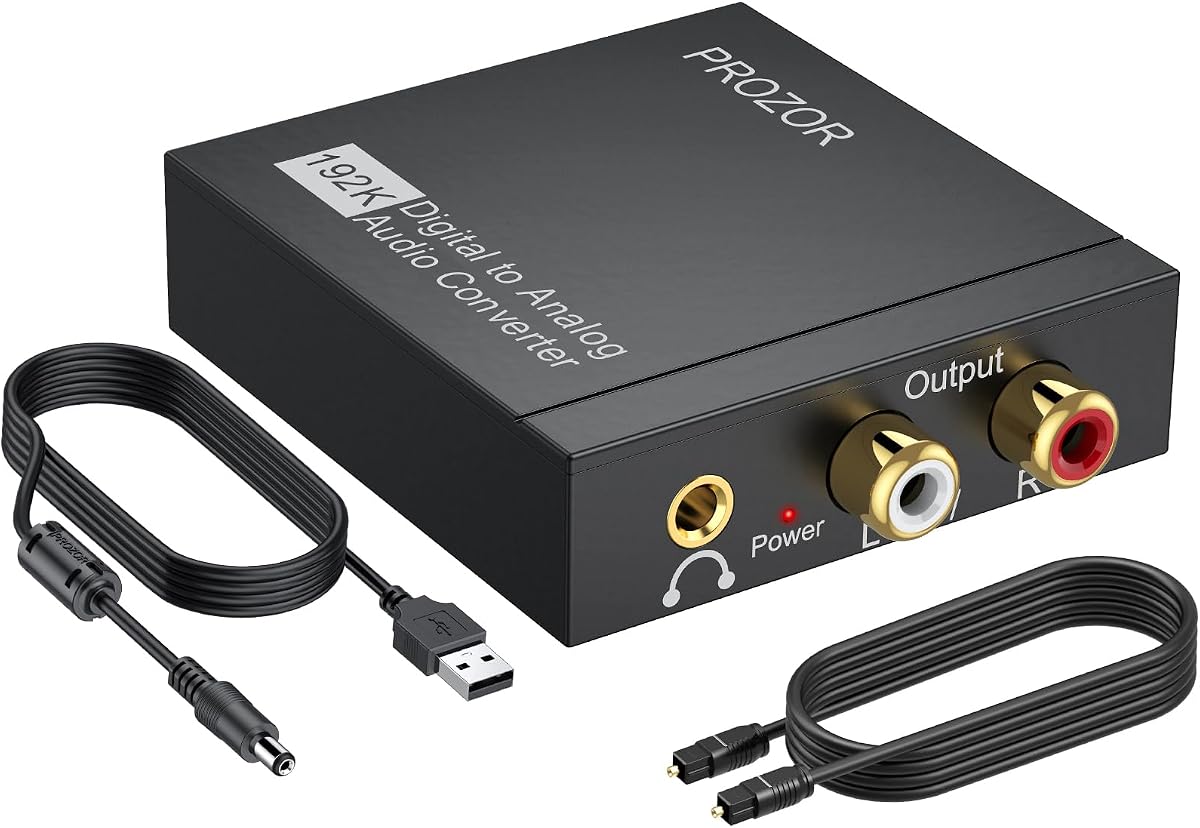


The PROZOR Aluminum DAC Converter combines broad connectivity, a practical detachable design, and high-resolution stereo support. Its 4.4 rating reflects a generally well-received product, and its standout qualities are the aluminum housing, gold-plated RCA connectors, simultaneous analog outputs, and support for sampling rates up to 192kHz. It is a converter in the digital-to-analog direction, not an analog-to-digital adapter.
We may earn a commission when you buy through this link, at no additional cost to you.
The unit accepts both optical Toslink/SPDIF and coaxial digital input, then provides left and right RCA outputs along with a 3.5mm jack. An upgraded amplifier chipset and dual-channel operational amplifier are intended to improve output level and clarity. The included 3-foot optical cable and USB power cable simplify assembly, while the detachable converter box allows users to replace a compromised RCA cable without replacing the entire device.
The main limitation is format support. It is designed for uncompressed two-channel LPCM or PCM rather than Dolby AC-3, DTS, or other 5.1-channel streams, so the source should be configured for PCM or LPCM. It also requires a 5V 1A USB power source, and the included cable is not paired with a wall adapter. A power adapter must be selected carefully because incompatible plugs may prevent operation.
This is a strong general choice for someone connecting a modern television, game console, Blu-ray player, or digital receiver to analog speakers or an amplifier. Its combination of input flexibility, replaceable cables, multiple outputs, and a metal enclosure makes it especially useful when the installation may evolve. It is the top overall pick for standard home-audio use, while buyers needing surround decoding should choose a dedicated 5.1-capable model.
Supporting both Toslink and coaxial input gives users more freedom when choosing a source. Simultaneous RCA and 3.5mm output makes it possible to feed a stereo amplifier and a pair of headphones from one digital source, subject to the source and amplifier accepting the selected output.
The aluminum housing supports heat dissipation and electromagnetic shielding, while detachable RCA connections simplify cable maintenance. Gold-plated RCA connectors and the newer amplifier chipset are useful additions for setups that previously produced weak or noisy analog output.
We may earn a commission when you buy through this link, at no additional cost to you.
The PROZOR 5.1-Channel Converter is intended for digital sources that may output Dolby AC-3, DTS, LPCM, or PCM, while the destination equipment accepts only stereo analog audio. It has a 4.4 rating and stands apart from basic converters because it accepts 5.1-channel digital signals and downmixes them to 2.0-channel RCA or 3.5mm output.
We may earn a commission when you buy through this link, at no additional cost to you.
Both optical and coaxial digital inputs are supported, and the advertised sampling rate reaches 192kHz with a 24-bit SPDIF incoming bit stream across left and right channels. The magnetic-ring power cord and adjusted amplifier chipset are designed to promote stable operation and reduce noise. A 3.5mm jack also permits direct headphone use, while RCA outputs suit conventional amplifiers and powered speakers.
The critical distinction is that this does not create true discrete 5.1-channel analog output. It accepts surround-encoded digital formats and reduces the signal to stereo, so listeners will not receive six independently reproduced channels. The converter is also not a general-purpose DAC with a physical volume control, which may limit its usefulness when the connected amplifier has limited gain.
This model is best for a television, Blu-ray player, game console, or other source that cannot be configured to output simple stereo PCM, or for users who want the converter to negotiate common surround formats automatically. It offers broader input-format support than the standard stereo models, but users seeking genuine multichannel output should choose equipment with a different output architecture.
Dolby AC-3 and DTS compatibility makes this converter useful when a source is configured for a television soundtrack or game audio. The digital surround signal is converted into a stereo analog representation rather than distributed across six analog outputs.
The magnetic-ring power cable is a meaningful feature for a device responsible for converting a digital signal into analog audio. It is designed to reduce electrical interference around the converter and support steadier operation.
We may earn a commission when you buy through this link, at no additional cost to you.
The PROZOR 7ft Integrated-Cable DAC is a compact digital-to-analog converter designed for uncomplicated television and speaker connections. Its 4.4 rating, 192kHz support, and integrated amplifier chipset make it attractive for users who want stronger RCA output without the complexity of a larger desktop unit.
We may earn a commission when you buy through this link, at no additional cost to you.
The optical Toslink input accepts sampling rates of 32, 44.1, 48, 96, and 192kHz with a 24-bit SPDIF bit stream across the left and right channels. Its built-in 1.1-meter RCA cable means most users do not need a separate analog cable. The body also includes a dual-channel operational amplifier intended to address the common problem of low output from a basic DAC.
The fixed RCA cable is the defining compromise. Because it is not detachable, a damaged cable cannot be replaced independently, and the reach may be too short or too long for a particular installation. The product also supports only uncompressed two-channel PCM or LPCM and is incompatible with Dolby AC-3 and other 5.1-channel signals, requiring the source to be set to PCM.
This converter is a good fit for a flat-screen television, set-top box, DVD or Blu-ray player, or game console positioned close to analog speakers or an amplifier. It offers an efficient one-box setup and avoids hunting for another RCA cable. For permanently installed systems, an equivalent converter with detachable leads may be easier to service.
A permanently attached 1.1-meter RCA lead reduces the number of connections required for a basic home-theater setup. The compact enclosure also sits close to the source or amplifier without occupying much room.
The built-in amplifier chipset and dual-channel operational amplifier are intended to produce a more useful signal level. This is particularly relevant when driving speakers through an amplifier with a low-gain input.
We may earn a commission when you buy through this link, at no additional cost to you.
The LiNKFOR SPDIF-to-RCA DAC is a compact converter for pairing an optical digital source with an analog stereo amplifier or powered speakers. It carries a 4.3 rating and focuses on a practical combination of high-resolution support, integrated cable design, and an amplifier chip that raises the RCA output level.
We may earn a commission when you buy through this link, at no additional cost to you.
The optical input supports 32, 44.1, 48, 96, and 192kHz sampling rates and a 24-bit SPDIF incoming bit stream for the left and right channels. A built-in 1.1-meter RCA cable eliminates the need for a separate analog lead, while USB power supplies the converter. Compatibility with HD televisions, set-top boxes, DVD and Blu-ray players, and game consoles makes its application fairly broad.
Its format limitation is significant: the converter is designed for digital PCM or LPCM stereo and is not compatible with Dolby AC-3, DTS, or other 5.1-channel signals. Users must change the source's digital output format before connecting it. The fixed RCA lead also cannot be swapped easily, which may matter more in a permanent installation than in a temporary arrangement.
This is a sensible selection for a simple television-to-old-speaker project, particularly when minimizing visible or physical cable clutter matters. The converter delivers a practical stereo path and high sampling-rate support without requiring a complicated control interface. It is less suitable for users who need surround decoding, independently adjustable outputs, or a detachable analog cable.
The small converter and integrated RCA lead are useful behind a television or beside a compact amplifier. This design reduces the number of separate pieces that need to be positioned around the room.
Support for sampling rates through 192kHz ensures compatibility with many digital source formats. The converter is still limited to two-channel PCM, so its resolution capability should not be confused with surround-channel support.
We may earn a commission when you buy through this link, at no additional cost to you.
The PROZOR Gold-Connector DAC provides one of the most flexible conventional stereo layouts in the group. It has a 4.4 rating and accepts both Toslink optical and coaxial digital audio while offering left and right RCA outputs plus a 3.5mm jack for headphones or compact powered speakers.
We may earn a commission when you buy through this link, at no additional cost to you.
Its amplifier chipset addresses low output volume, and the gold-plated RCA connectors are designed to maintain reliable signal transmission. The converter supports 32, 44.1, 48, 96, and 192kHz sampling with 24-bit incoming bit streams on the left and right channels. A USB cable with a ferrite core is included to help minimize electromagnetic and radio-frequency interference.
The product is limited to uncompressed two-channel LPCM or PCM. Dolby AC-3, DTS, and other surround formats need to be avoided or decoded elsewhere, and the source's output should be set to PCM or LPCM. A certified 5V 1A wall adapter is recommended but not included, adding one item to the purchase and installation checklist.
This converter is a strong middle ground for a home theater, television, game console, or disc player that may have either optical or coaxial digital output. It also suits users who want to compare RCA and 3.5mm connections. Its greatest limitation is that the digital format must be reduced to stereo before the converter can pass it cleanly.
Two digital inputs and simultaneous analog outputs make the unit adaptable to several source and destination combinations. This is helpful when equipment offers different ports or when a headphone connection is occasionally needed.
The ferrite-core USB power cable is intended to limit electromagnetic interference and radio-frequency noise around the conversion stage. A stable, correctly rated 5V 1A supply remains important for predictable performance.
We may earn a commission when you buy through this link, at no additional cost to you.
The YGiTK 192kHz DAC Converter is a compact option for connecting an optical source to a stereo amplifier. Its 4.5 rating is among the stronger results in this comparison, and its defining features include a built-in amplifier chipset, support for 24-bit signal depths, and sampling rates as high as 192kHz.
We may earn a commission when you buy through this link, at no additional cost to you.
The product accepts optical Toslink signals at 32, 44.1, 48, 96, and 192kHz. Its integrated audio amplification chipset raises the RCA output level, while the small enclosure keeps the installation visually simple. The listed use cases include HD televisions, set-top boxes, DVD and Blu-ray players, and game consoles, making it broadly relevant to living-room audio systems.
The converter requires the source to output PCM audio and explicitly does not support Dolby AC-3 or other 5.1-channel signals. Volume adjustment is performed on the connected output device rather than through a knob on the converter. That arrangement is simple, but it means the DAC must be paired with an amplifier or speaker system offering adequate level control.
This model is best for users who want a small, unobtrusive stereo converter and already have control over volume at the amplifier. Its strong rating and broad sampling support make it a credible everyday choice. It is not the right option when automatic surround decoding or local output-volume adjustment is required.
The miniature enclosure is useful for compact entertainment units and tightly arranged amplifier shelves. It focuses on providing a direct conversion path without a larger display or duplicated control system.
The 192kHz capability describes sample-rate support for stereo PCM, not surround decoding. Users should configure the television or disc player accordingly before expecting stable output.
We may earn a commission when you buy through this link, at no additional cost to you.
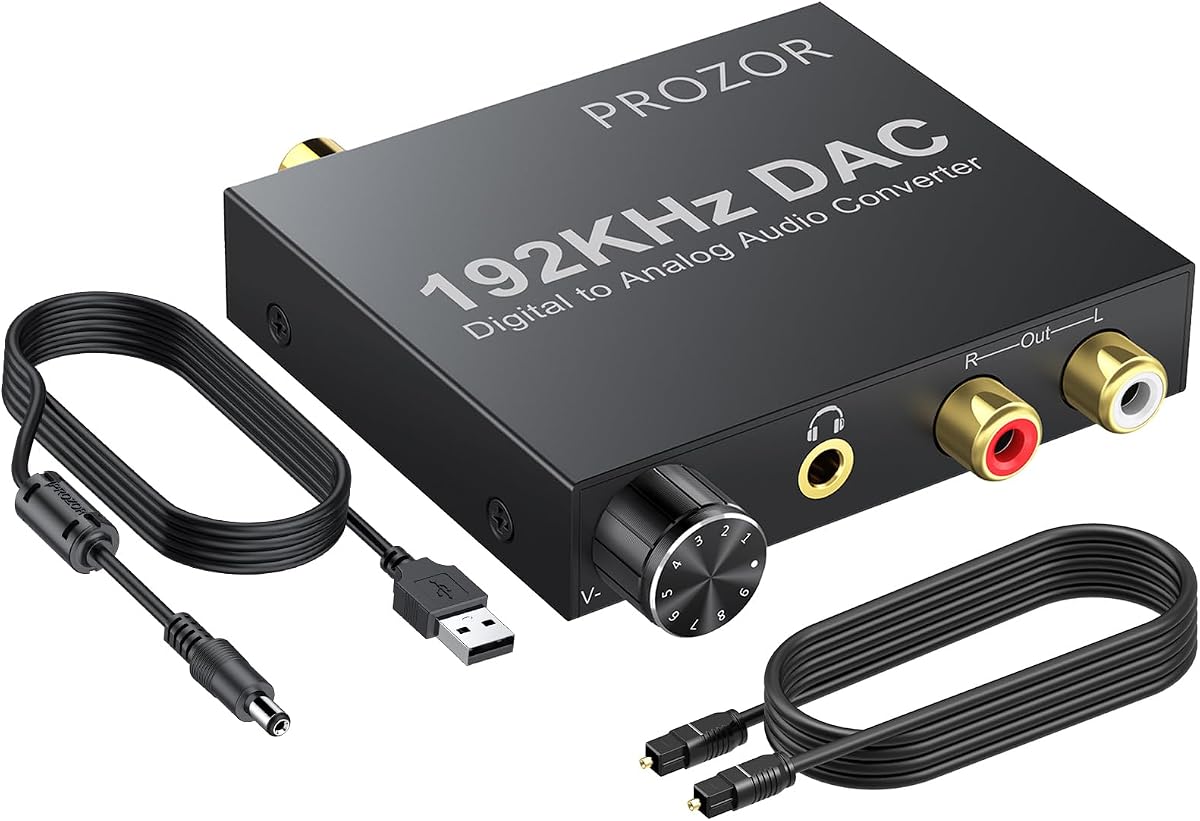
The PROZOR Volume-Adjustable DAC is the most practical choice when the converter itself needs to set the analog output level. It has a 4.4 rating and distinguishes itself through a built-in volume knob, simultaneous left and right RCA plus 3.5mm outputs, an aluminum shell, and gold-plated input and output interfaces.
We may earn a commission when you buy through this link, at no additional cost to you.
Optical Toslink and coaxial digital signals enter the device, while 2.0-channel audio exits through two RCA connectors and a 3.5mm jack. Sampling rates of 32, 44.1, 48, 96, and 192kHz are supported, with a 24-bit SPDIF incoming bit stream. The unit also includes a 1-meter optical cable. A 5.5mm USB power cable powers the DAC, although a wall adapter is not included.
The volume control is shared by the RCA and 3.5mm outputs, so it is not a separate headphone mixer with independent channel or output-level adjustment. The converter also expects digital PCM and does not provide 5.1-channel decoding. Users must use a correctly rated 5V 1A power source and should not substitute a different plug without checking the requirement.
This is the top pick for users connecting a modern source to legacy speakers through an amplifier that lacks convenient level adjustment. It is equally useful for direct headphone listening, although the shared control and stereo-only format limit more advanced mixing. The combination of durable construction, serviceable connectors, and local volume control makes it the most versatile standard stereo converter here.
The built-in knob lets users trim the converted signal before it reaches the amplifier or headphones. This is especially helpful when the source's digital output level cannot be lowered sufficiently or the connected amplifier offers only inconvenient gain control.
The aluminum casing is designed for heat resistance and longevity, while gold-plated connectors help preserve signal quality. Separate RCA and 3.5mm ports allow the same source to feed different types of analog equipment.
We may earn a commission when you buy through this link, at no additional cost to you.
The Musou RCA Analog to Digital Optical Toslink Coaxial Audio Converter Adapter serves an important but different need: upgrading an analog source so it can feed modern optical or coaxial digital equipment. Its 4.1 rating is the lowest among the listed products, but that does not diminish its relevance when the source and destination happen to run in the opposite direction.
We may earn a commission when you buy through this link, at no additional cost to you.
The converter takes left and right RCA analog input and produces both digital coaxial and optical Toslink output simultaneously. It supports uncompressed two-channel LPCM at a 48kHz output sampling rate. The included optical cable makes the common television-to-amplifier arrangement more convenient, and the product is backed by a one-year Musou warranty.
This unit cannot perform the Toslink-to-RCA conversion sought by most readers in this guide. It also cannot carry Dolby or other surround formats, because its analog input is limited to a stereo signal and its digital output is restricted to two-channel LPCM. The 48kHz rate is adequate for many standard applications but offers less resolution potential than the 192kHz-capable digital-to-analog products.
This model is worth considering for a legacy CD player, turntable with an appropriate output, cassette deck, or another stereo source that lacks a usable digital output. It should not be purchased for a modern optical source connected to old RCA speakers. For that use case, select one of the stereo DAC models or the dedicated 5.1-channel decoder.
The Musou device lets a stereo RCA source participate in a modern digital audio chain. It is particularly useful for connecting older playback equipment to a television or digital amplifier with optical input.
Providing both coaxial and optical outputs increases compatibility with different destination devices. Because only two-channel LPCM is supported, the converter cannot package a surround soundtrack from a multichannel analog source.
We may earn a commission when you buy through this link, at no additional cost to you.
The PROZOR 5.1-Channel DAC Decoder is the premium choice for users whose source can emit Dolby AC-3, DTS 5.1, or PCM but whose amplifier accepts only stereo analog audio. Its 4.5 rating and automatic conversion features distinguish it from standard stereo DACs that simply reject surround-encoded streams.
We may earn a commission when you buy through this link, at no additional cost to you.
Optical, SPDIF, and coaxial digital signals are accepted, then converted to left and right RCA and 3.5mm 2.0-channel analog output. The device can automatically process AC-3, DTS, LPCM, PCM, and RAW signals, depending on the incoming format and the capabilities of the source. Its high-resolution specification reaches 192kHz with 24-bit support across the left and right channels.
A physical knob adjusts output level for both the RCA and 3.5mm connections at the same time, so it cannot serve as an independent two-output mixer. The word decoder is also important: the product converts a surround digital signal into stereo analog audio rather than providing six separate RCA outputs for a surround amplifier. The conversion is one-way and does not offer optical output.
This is the most capable pick for televisions, computers, game consoles, and video systems where the source setting may be inconvenient to change or where automatic handling of common surround formats is valuable. It is the right option when stereo compatibility matters more than preserving discrete multichannel output. For straightforward PCM-only equipment, a simpler converter would be easier to set up.
Automatic AC-3 and DTS conversion reduces the chance that a source's default surround output will produce silence or incompatibility. It is particularly useful for entertainment setups where the audio setting is controlled by the content or device.
The shared volume knob makes it easy to balance the converted signal for either RCA speakers or 3.5mm headphones. Both outputs change together, which simplifies everyday use but removes independent level matching.
We may earn a commission when you buy through this link, at no additional cost to you.
The LiNKFOR 192kHz DAC Converter combines a strong 4.8 rating with a simple integrated-cable design. It is a direct Toslink-to-RCA solution for modern digital sources and older stereo equipment, with support for sampling rates through 192kHz and an amplifier chip designed to raise output level.
We may earn a commission when you buy through this link, at no additional cost to you.
The optical input accepts 32, 44.1, 48, 96, and 192kHz signals with a 24-bit SPDIF incoming bit stream across the left and right channels. A built-in 1.1-meter RCA cable is specified in the product description, while the product title identifies a 6-foot optical cable. USB power operates the converter, and its plug-and-play approach suits HD televisions, set-top boxes, disc players, and game consoles.
The major restriction is the absence of surround-format compatibility. Dolby AC-3, DTS, and other 5.1-channel signals are unsupported, so the source must be set to digital PCM or LPCM. The fixed RCA cable is also a practical limitation if it is damaged or does not reach the intended amplifier, although the long optical lead provides some placement flexibility.
This is the best budget choice for a basic home-audio conversion because it addresses the common problems of low analog output and complicated cabling. The high rating is encouraging, although the user experience will still depend on source format settings and the connected amplifier. Buyers seeking only a dependable stereo path can start here; users with surround sources should move up to a decoding model.
The converter supports a broad range of standard sample rates and 24-bit stereo streams without requiring physical volume controls. It is a practical bridge for source devices whose digital output is cleaner or more convenient than their analog output.
The fixed RCA lead reduces setup steps, and the included optical cable supports a direct television-to-amplifier arrangement. This makes the unit approachable for first-time converter users.
We may earn a commission when you buy through this link, at no additional cost to you.
The right converter depends first on signal direction, then on the audio format emitted by the source, the input and output sockets available on the destination, and whether you need volume or surround-decoding features. Paying attention to these details prevents common problems such as silence, unsupported codecs, weak output, and inconvenient cable placement.
A Toslink to RCA converter receives a digital optical signal and produces analog left and right audio. Most televisions, modern game consoles, disc players, and streaming boxes use optical audio for digital output, making a digital-to-analog DAC the correct device. The product name, input connector, and stated signal direction should all be checked before purchase because similarly named adapters can perform the reverse conversion.
Basic converters generally accept uncompressed two-channel PCM or LPCM and reject Dolby AC-3, DTS, and other 5.1-channel streams. The source should therefore be configured to output PCM or LPCM. If the source cannot be changed, a converter with built-in AC-3 and DTS decoding may be necessary, although its analog result will still be a stereo downmix.
Toslink is essential for the requested optical connection, but some systems also offer a coaxial digital jack. Models supporting both can provide greater flexibility and a useful backup when an optical port is occupied or unavailable. The source must expose a compatible digital audio output because a converter cannot create a digital signal from an analog-only device.
RCA left and right outputs are required for conventional stereo amplifiers and powered speakers. A 3.5mm jack is convenient for headphones, compact speakers, and other line-level equipment. Some converters provide both simultaneously, while others use a permanently attached RCA lead. Consider connector reach, cable length, and whether a damaged cable can be replaced.
A converter output may be too quiet for some amplifiers, which is why models with an audio amplification chipset are valuable. A physical volume knob provides additional control, but it usually changes the RCA and 3.5mm levels together. If the connected amplifier has reliable volume adjustment, a simpler converter may be sufficient.
A 192kHz-capable converter supports source sample rates through 192kHz, while 48kHz remains common for many standard television and disc-player outputs. Resolution alone does not determine perceived quality, and a 5.1-channel input is still delivered as stereo by a conventional two-channel analog output. Compare resolution with actual source capability and format support.
Aluminum housings can improve heat dissipation and electromagnetic shielding, while detachable RCA leads simplify replacement and cable routing. Integrated cables make the initial installation easier and reduce clutter. The best choice depends on whether the unit will remain mobile, sit behind equipment, or become part of a permanent installation.
Most of these converters require USB power, usually from a 5V 1A source. Some include a power cable but not a wall adapter, and some manufacturers recommend a certified external adapter instead of a television's USB port. Check the supplied cable, required voltage, current rating, and connector type before assembling the system.
Begin by identifying the source's digital output and the destination's analog input. Connect the source to the converter using the appropriate Toslink or coaxial cable, then connect the converter's left and right RCA outputs to the amplifier or powered speakers. If the converter has a 3.5mm output, use it only with a device designed for that analog line-level connection.
Set the television, disc player, streaming box, or game console to digital PCM or LPCM output before powering the converter. For a decoder model, surround formats may also be accepted, but the resulting analog output remains stereo. If there is no sound, check the source's audio output setting, digital output selection, cable orientation, converter power light, and correct input port.
Power the converter using a suitable 5V 1A USB supply, connect the amplifier to the desired output, and set a moderate listening level before adjusting the converter's knob. To keep the installation reliable, avoid sharply bent optical or power cables, keep the converter vents unobstructed, and do not substitute incompatible power plugs.
It depends on the available ports. If the television has an optical digital output and the speakers or amplifier accept analog RCA input, a Toslink to RCA converter is needed. A television with built-in analog speakers or a compatible analog output may not require one. Check the labels rather than assuming every old speaker system includes an amplifier.
The most common causes are an incorrect source output format, a missing ground or power connection, and a loose or incorrect cable. Set the source to PCM or LPCM, confirm the converter's power indicator is active, and verify that the optical plug is fully seated. Also ensure the amplifier is on the correct input and its volume is raised.
Most standard RCA converters output only left and right stereo, even if the digital source carries a surround-encoded signal. A model with AC-3 or DTS decoding can accept those formats but downmixes them to stereo. True discrete 5.1-channel RCA output requires different hardware and compatible surround channels.
PCM is the general digital audio format, while LPCM refers to linear PCM, an uncompressed representation of audio samples. Most optical-output devices can offer LPCM or a compatible PCM setting. Converters designed for stereo use generally rely on this format because it does not require the decoder found in a 5.1-channel model.
A 192kHz converter can accept source material sampled at that rate, but it cannot create missing detail or improve a source that outputs at a lower rate. Compatibility, correct format settings, clean power, and a suitable connection often matter more than the maximum sample-rate label. Use a high-resolution mode when the source genuinely provides it.
A volume knob is helpful when the converter output is too loud for an amplifier with limited adjustment or too quiet for connected headphones. It is less necessary when the destination offers precise level control. On models with both RCA and 3.5mm outputs, the knob commonly adjusts both at the same time rather than independently.
Some installations may work that way, but the product guidance recommends a certified 5V 1A adapter for more stable operation. A television USB port may provide insufficient current or introduce avoidable electrical noise. Check the converter's requirements and use a suitably rated supply if the result is unstable or noisy.
An attached cable can make the first setup faster and reduce cable clutter because fewer separate pieces are required. It becomes less convenient if the cable is too short, too long, or damaged and cannot be replaced. Detachable RCA connectors are generally preferable for permanent installations.
The PROZOR Aluminum DAC Converter is the best overall choice for standard home audio because it combines flexible digital inputs, simultaneous RCA and 3.5mm outputs, a durable housing, and detachable connections. The PROZOR Volume-Adjustable DAC stands out when direct level control is important, while the PROZOR 5.1-Channel DAC Decoder is the premium option for automatically handling AC-3, DTS, and PCM sources.
For a simpler installation, the LiNKFOR 192kHz DAC Converter is the best budget selection because it combines a high rating, amplified RCA output, high-resolution stereo support, and an integrated cable. Before buying any model, confirm the signal direction, configure the source to the correct digital format, and check whether the destination needs RCA, 3.5mm, local volume control, or surround decoding.
The listed products cover conventional stereo conversion, integrated-cable designs, automatic surround decoding, and one analog-to-digital alternative. Specifications and product details can be revised, and market conditions change, so verify the current listing, included accessories, power requirements, and format support before making a final purchase.