
BigBlue 21W SolarPowa 20
4.3Editor score
21W portable rated output
1.32-pound listed weight
24.7% conversion efficiency
IP68 panel water resistance
Discover the best foldable solar panels for backpacking, compared for power output, portability, charging ports, durability, efficiency, and real-world outdoor
Foldable solar panels give backpackers a renewable way to keep phones, navigation tools, lights, cameras, and small power banks ready away from an outlet. A useful panel balances usable charging power, packed weight, physical durability, weather resistance, and the number of connections available in camp.
This guide compares ten foldable solar panels using the specifications and feature details supplied for each model. The comparison covers output, efficiency, folded size, weight, charging interfaces, mounting options, water resistance, and important limitations such as panels that cannot store energy.
Each review identifies the circumstances in which that panel makes the most sense, from compact ultralight trips to higher-output setups for devices and portable power stations. Ratings and product details may change, and current prices should always be checked before making a purchase.
4.3Editor score
4.8Editor score

4.5Editor score
The table below compares all ten panels by nominal output, charging connections, portability, and outdoor protection, making it easier to identify the right balance for a backpacking trip.



The FlexSolar 40W Foldable Solar Panel Charger has a 4.4 rating and stands out as the most capable all-around option in this collection. Its stated 40-watt output, three output options, compact listed weight, and 24% conversion efficiency give backpackers more flexibility than smaller single-purpose panels.
We may earn a commission when you buy through this link, at no additional cost to you.
The charging interface is particularly useful for mixed equipment. It includes a 19-volt DC connection capable of delivering up to 40 watts, making it relevant for compatible small power stations, alongside QC3.0 USB-A and PD2.0 USB-C ports rated at up to 18 watts each. An intelligent load-distribution system favors using a single port when peak efficiency is the priority.
There are some practical limits. The panel does not contain an energy-storage battery, so it cannot provide power after sunset or maintain output when covered by shade. Its junction box is not fully waterproof, and the manufacturer advises bringing it indoors during heavy rain. The listed 1.76-pound weight is also more substantial than several lighter options.
This is a strong choice for backpackers who carry several USB devices, a camera, or a small compatible power station and want one panel to manage them. It offers the most generous output specification in the group without requiring a separate battery. For a single phone and minimal gear, a lighter 21-watt or 25-watt panel may be easier to carry.
The mix of USB-C, USB-A, and 19-volt DC output makes this panel more adaptable than models limited to basic phone charging. It can serve phones, tablets, power banks, and compatible small stations without requiring a separate adapter for each category of device.
A 40-watt rating and 24% conversion rate are attractive specifications, yet real output still depends on direct sunlight, panel angle, temperature, and device draw. The panel also works only as a direct charger, so a power bank remains useful for storing daytime energy.
We may earn a commission when you buy through this link, at no additional cost to you.
The SOLUPUP 30W Portable Foldable Solar Charger carries a 4.4 rating and offers a straightforward 30-watt option for backpackers whose priorities are USB charging, simple setup, and outdoor durability. It uses monocrystalline silicon with a stated conversion efficiency of more than 23%.
We may earn a commission when you buy through this link, at no additional cost to you.
Its two 5-volt outputs include USB-A and USB-C, each capable of 5 volts at 3 amps, with a combined maximum of 15 watts. The supplied information says two compatible devices can charge simultaneously. A built-in smart chip provides overcurrent, overvoltage, and short-circuit protection, while automatic reconnection resumes charging when sunlight returns after an interruption.
The listed weight of 2.4 pounds is the main drawback in a backpacking-specific list. It is lighter than many large camping panels but not as packable as the BigBlue 21W, FlexSolar 25W, or ultralight BigBlue 25W. The IPX5 rating also indicates good protection from dust and water without matching the stronger IP68 figures listed for several BigBlue models.
The SOLUPUP is best for campers who prioritize an uncomplicated dual-port panel, automatic recovery after changing cloud cover, and a stable adjustable stand. People watching every gram should look for a lighter option, while those needing DC output for a portable power station should choose a panel that includes it.
The USB-A and USB-C arrangement is familiar and versatile for phones, small tablets, and power banks. Its 15-watt combined output is suitable for routine trail-top-ups, although it does not match the higher USB-C ratings offered by some premium models.
Automatic reconnection can be useful on variable hiking days when a passing cloud interrupts generation. The panel still needs suitable sunlight, so this feature should be viewed as a convenience rather than a substitute for stored power.
We may earn a commission when you buy through this link, at no additional cost to you.
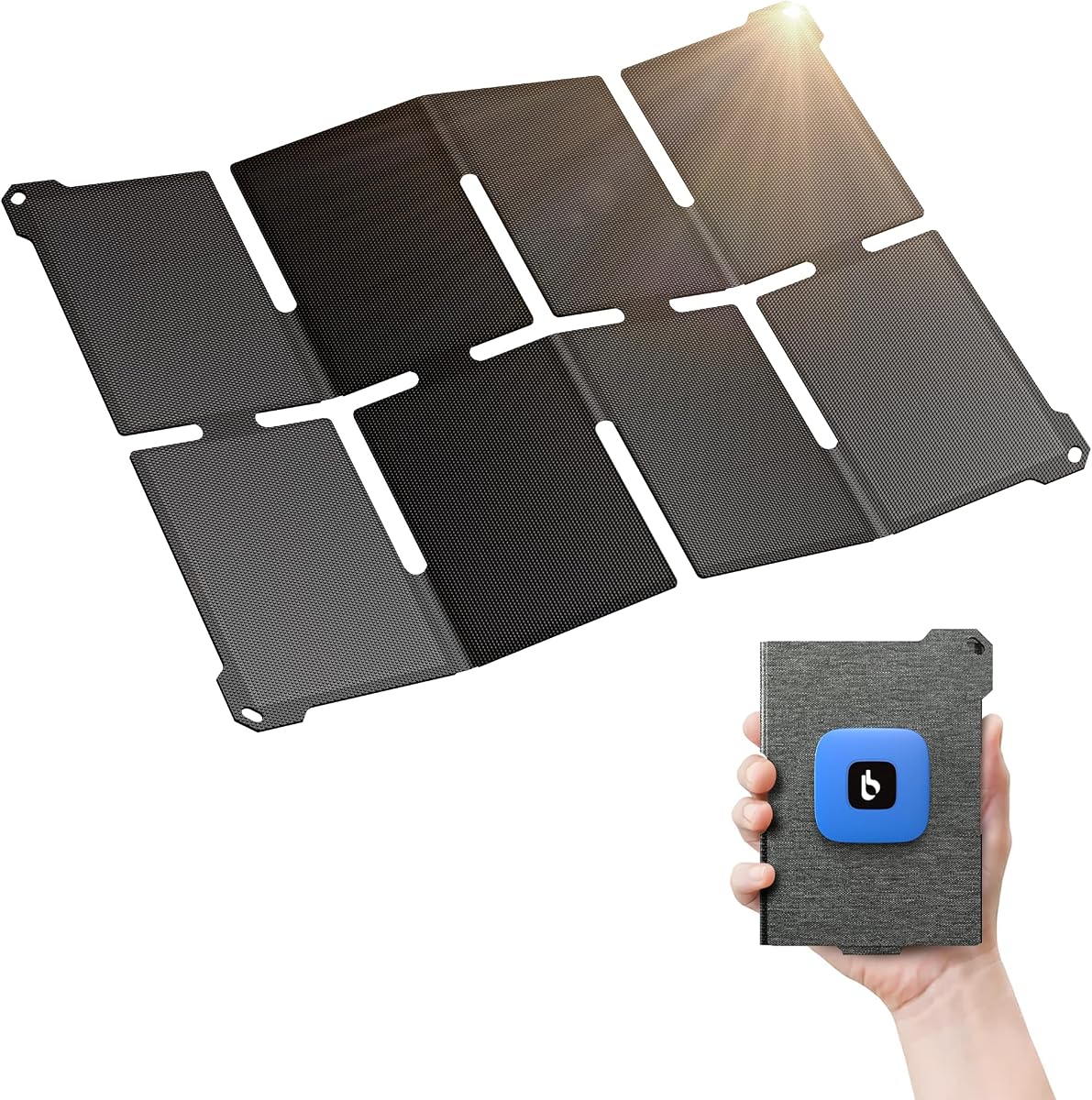
The BigBlue SolarPowa 20 has a 4.3 rating and offers a compelling combination of weight, efficiency, and weather resistance. Its 21-watt output is modest beside the 30- to 60-watt models, but that lower demand is reflected in a listed weight of only 1.32 pounds.
We may earn a commission when you buy through this link, at no additional cost to you.
The panel folds to approximately the size of a book and includes hooks for attaching it to a backpack or tent. It offers two USB outputs, each rated up to 5 volts and 3 amps, with a combined maximum of 5 volts and 4.2 amps. This configuration can power common 5-volt devices such as phones, tablets, power banks, and GPS units.
Its PVDF surface is described as more durable than conventional PET construction, while the monocrystalline cells are listed at up to 24.7% conversion efficiency and 95% light transmittance. The panel carries an IP68 rating, although the USB junction box is explicitly not waterproof and should be protected from moisture.
This is the most budget-conscious pick for hikers who mainly need to maintain a phone, GPS unit, or small power bank. It is not the best choice for powering several high-draw devices or a portable power station. For most trail users, however, the low listed weight and strong efficiency make it a practical first solar panel.
At 1.32 pounds, the SolarPowa 20 is easier to justify on a backpacking loadout than a higher-output panel. Its dual charging ports are sufficient for keeping essential small electronics operational when direct sun is available.
The PVDF surface and IP68 panel rating make this a reassuring choice for exposed campsites and changing weather. The non-waterproof junction box remains the critical detail, so the electronics should be shielded during heavy rain and not left submerged.
We may earn a commission when you buy through this link, at no additional cost to you.
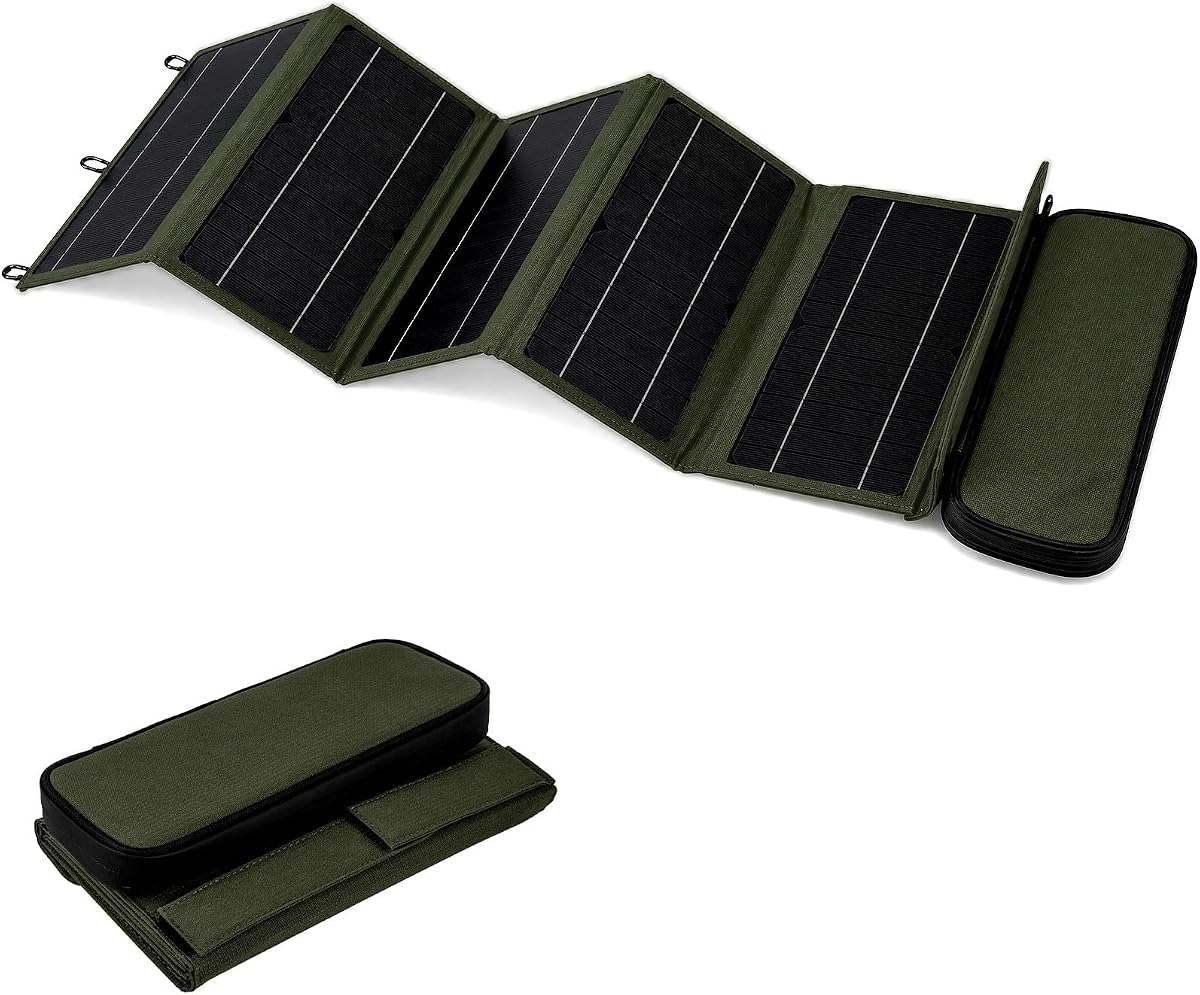
The 30W Portable Solar Panel Charger has a 4.8 rating, the highest customer rating among the products compared. Its five-panel construction, stated output of up to 30 watts, and conversion efficiency above 25% form an attractive combination for backpackers who want meaningful charging without moving to the largest category.
We may earn a commission when you buy through this link, at no additional cost to you.
USB-C and USB-A outputs support phones, camping lights, cameras, GPS devices, and other USB-powered equipment. The panel provides up to 5 volts and 6 amps in total, with 5 volts and 3 amps per port, and includes a USB-A to USB-C cable. Adjustable kickstands help maintain a favorable angle as the sun moves.
The exterior uses nylon fabric with a wear-resistant surface, while integrated hanging loops and folding straps improve handling and setup. Unlike the FlexSolar 40W and LUMOPAL 60W, it does not offer a higher-voltage DC connection, so it is less suitable for charging compatible portable power stations directly.
This model is an excellent match for hikers carrying a phone, camera, navigation device, and small lights. Its top rating and 25% efficiency are encouraging, but actual output still varies with sunlight, orientation, temperature, and cloud cover. It is best for direct USB charging rather than serving as the sole power source for a large battery system.
Five folding sections create a broader collecting area than smaller three-panel designs. The included kickstands and hanging loops give the user several ways to position the panel for better exposure while keeping the devices connected.
The pair of USB outputs is aimed at the devices most common on the trail. Phones, cameras, lights, and GPS units can draw manageable power, making this panel a strong choice for maintaining rather than rapidly recharging an entire collection of electronics.
We may earn a commission when you buy through this link, at no additional cost to you.
The FlexSolar 25W Portable Solar Panel Charger has a 4.4 rating and focuses on a compact, durable package for backpackers who want more capability than a tiny emergency charger without carrying the largest panel in the group.
We may earn a commission when you buy through this link, at no additional cost to you.
It folds to 7.7 by 5.1 inches and weighs 1.2 pounds, making it smaller and lighter than the 30-watt SOLUPUP. A built-in carabiner system allows attachment to a backpack or tent, while a reinforced elastic strap keeps the folded panel secure during transport.
USB-A and USB-C outputs can deliver 5 volts and 3 amps to two devices simultaneously. MPPT technology is included to improve energy collection, including in partial shade, and the power-management system adjusts output to guard against overcharging. The stated 23.2% photovoltaic efficiency and 2,000-plus tested fold cycles reinforce its portability focus.
IP67-rated components add useful dust and water protection, and the product description lists operation from -4 to 149 degrees Fahrenheit. It does not store electricity and has no high-voltage DC port, so it is most appropriate for directly charging small electronics. Travelers carrying a larger battery system should consider one of the DC-capable panels.
The small folded footprint and 1.2-pound listed weight make this a credible option for hikers who dislike adding a bulky panel to their pack. Integrated attachment points remove the need to carry separate clips for common mounting tasks.
The three-layer construction combines a scratch-resistant surface, UV-stabilized encapsulation, and an impact-absorbing baseplate. Hidden busbar cells are also intended to reduce the micro-crack problems that can affect frequently folded portable arrays.
We may earn a commission when you buy through this link, at no additional cost to you.
The BigBlue 35W Solar Charger has a 4.4 rating and targets users who need fast, flexible charging from a relatively light package. Its 35-watt rating, 1.54-pound listed weight, and 25.4% conversion efficiency place it between the compact 21- and 25-watt choices and the heavier high-output models.
We may earn a commission when you buy through this link, at no additional cost to you.
The connection layout includes two USB-C ports and one USB-A port. USB-A supports QC at up to 18 watts, while one USB-C port supports PD at up to 25 watts with PPS. The manufacturer specifically notes that Type-C1 does not support Apple devices, an important compatibility detail for iPhone users to check before buying.
A dual parallel circuit design is intended to keep one section operating if another section is shaded. That feature is valuable in real outdoor use, where a backpack, tent wall, or tree may block part of the panel. The panel itself carries IP68 protection, but the USB junction box is not waterproof.
This is a strong option for backpackers carrying USB-C laptops accessories, tablets, cameras, GPS units, and power banks. It does not store energy, and devices should be kept in the shade because heat can trigger thermal protection and interrupt charging. The higher output and multiple ports make it a powerful trail companion for users who genuinely need them.
Two USB-C ports and one USB-A port allow several devices to be connected without carrying a separate collection of adapters. Fast-charge protocols are especially relevant for compatible Android devices and USB-C equipment.
The parallel circuit arrangement helps preserve output when one portion of the panel is blocked. It cannot eliminate the effects of heavy cloud cover or a poorly positioned panel, but it is a thoughtful response to common camping obstructions.
We may earn a commission when you buy through this link, at no additional cost to you.
The BigBlue 28W High-Efficiency Solar Panel Charger has a 4.3 rating and offers three USB connections, solid efficiency, and a manageable listed weight. It is a versatile option for backpackers who want more than basic phone charging but do not need a high-voltage DC connection.
We may earn a commission when you buy through this link, at no additional cost to you.
Two USB-C ports and one USB-A port can each deliver up to 5 volts and 3 amps, with a collective maximum of 5 volts and 4.8 amps. Its N-type cells are described as improving low-light performance, while the absence of front-facing metal lines is intended to reduce shading and heat across the collecting surface.
At 1.5 pounds, the panel is lighter than many 30-watt alternatives, and its 11 by 6 by 1.4-inch folded size fits into a backpack. It also includes carabiners, a USB-C cable, and a blue LED that glows when charging correctly. The panel has an IP44 rating, while the junction box is not waterproof.
The main limitation is that its output is not intended for laptops or large power stations. It is best suited to phones, small tablets, GPS devices, flashlights, and power banks. Users who require stronger water protection should favor a model with an IP68 panel rating, while those wanting fewer cables may prefer a dual-port design.
The mix of two USB-C connections and one USB-A connection reduces the chance of arriving at camp without the right cable. It can support simultaneous charging for compatible small electronics, provided sunlight and the combined output limits are adequate.
N-type cells and a shadow-free front surface are intended to improve collection and low-light operation. These features can be useful near sunrise, sunset, or under thin cloud, although the panel will never approach its stated output without sufficient illumination.
We may earn a commission when you buy through this link, at no additional cost to you.
The BigBlue Ultra-Light Portable 25W Solar Panel Charger has a 4.3 rating and is the lightest model listed here, with a stated weight of 0.84 pounds. It measures 4.65 by 6.42 by 1.38 inches folded, giving ultralight hikers a practical way to carry renewable charging capability.
We may earn a commission when you buy through this link, at no additional cost to you.
USB-A is rated at 5 volts and 2.4 amps, while USB-C is rated at 5 volts and 3 amps, allowing two devices to charge simultaneously. The N-type cells are listed at up to 25.4% conversion efficiency. A metal-free front surface is designed to improve light capture and keep the cells cooler.
Construction combines ETFE coating, UV-resistant EVA, high-efficiency cells, and a solid baseplate for resistance to hidden cracks. The panel is rated IP68 for water and dust resistance, and the included carabiners and elastic strap support attachment and secure transport. As with other foldable panels, it does not retain energy after the sun goes down.
This is the strongest choice for hikers who count every gram but only need to keep a phone, small power bank, or camping light topped up. Its output is lower than the 35-, 40-, and 60-watt alternatives, and it lacks a DC port for portable power stations. For minimal loads, the low weight makes those limitations easier to accept.
The sub-one-pound listed weight is the defining advantage. It allows a backpacker to add a renewable charging option without accepting the substantially greater weight of high-output panels designed for tablets, cameras, and power stations.
N-type cells, the absence of front metal lines, and a layered ETFE and EVA build are intended to improve light collection and durability. These are meaningful construction details for a flexible panel that will be folded, repositioned, and exposed to changing outdoor conditions.
We may earn a commission when you buy through this link, at no additional cost to you.
The LUMOPAL 60W Foldable Solar Panel has a 4.3 rating and offers the most ambitious output specification in the group. It is intended for backpackers carrying tablets, cameras, laptops, portable power stations, or several other devices that benefit from more than a standard phone-charging connection.
We may earn a commission when you buy through this link, at no additional cost to you.
Its ports include one PD USB-C output with a 60-watt maximum and two QC3.0 USB-A outputs with a 22-watt maximum. An 18-to-20-volt DC output uses a 5.5 by 2.1-millimeter connection, giving the panel broader relevance to compatible portable power stations. A smart chip is described as identifying devices and applying suitable charging settings.
The panel uses monocrystalline silicon with up to 23.5% conversion efficiency. It is laminated with ETFT, while the foldable unit is listed as able to withstand pressure of up to 176 pounds. Its IP65 rating applies to the panel and fabric construction, but the junction ports themselves are not waterproof.
At 3.42 pounds and 6.7 by 9.5 inches folded, this is not a lightweight choice for a fast-and-light hiker. It is better suited to expedition-style trips, stationary camp days, or users with a substantial electronics load. Its broad output selection may reduce the need to carry several separate charging cables and adapters.
A 60-watt USB-C path, QC3.0 USB-A outputs, and a barrel-style DC connection provide more ways to serve different equipment. This makes the panel especially relevant to travelers carrying a compatible power station alongside smaller devices.
Compression resistance and weather-resistant construction suit a panel that is repeatedly packed and set up. The listed 3.42-pound weight is a deliberate tradeoff for the greater collecting area and flexible charging electronics.
We may earn a commission when you buy through this link, at no additional cost to you.
The ELECOM NESTOUT Portable Solar Panel has a 4.5 rating and brings a distinctive four-panel design to a category crowded with similar black fabric arrays. Its 28-watt output, dual USB-A ports, adjustable stands, and organized ripstop-nylon bag make it a polished option for campers who value usability alongside charging capability.
We may earn a commission when you buy through this link, at no additional cost to you.
The panel uses SunPower MAXEON cells, which the manufacturer says deliver up to a 24% efficiency increase compared with traditional solar cells. A current-check LED display provides a clear indication of power entering the USB ports. Two built-in adjustable stands help position the panel for better sun exposure during the day.
The exterior bag uses water-resistant ripstop nylon and includes two mesh pockets for cables or small items such as carabiners. Three exterior loops provide hanging points for trees, tents, or cables. Unlike several competing models, however, it offers only USB-A outputs and no stated IP dust-and-water protection rating.
This panel is best for a backpacker who prefers an integrated storage system and wants the established design pedigree associated with the NESTOUT Outdoor Series. It is less flexible for modern USB-C-only devices and travelers who require a high-voltage DC connection. Its adjustable stands and loop system make camp setup notably convenient.
Two mesh pockets keep cables and small hardware together instead of loose in a pack. The exterior hanging loops and adjustable stands create several setup options, reducing the need for separate gear at a campsite.
SunPower MAXEON cells and the absence of front-side metal lines focus on light capture and usable output. The current-check display adds practical feedback, although the two USB-A ports limit compatibility compared with modern USB-C-heavy designs.
We may earn a commission when you buy through this link, at no additional cost to you.
The right backpacking solar panel depends on what you need to charge, how much weight you can carry, and whether direct sunlight will be available when you need power. These factors help narrow the field before comparing individual models.
Nominal wattage provides a useful starting point, but it is not the same as the power available at every moment. A phone can often be maintained with a smaller panel, while tablets, cameras, portable power stations, and laptops require substantially more collection area and compatible output. Compare both the panel rating and the maximum output of each charging port, because a 40-watt panel with lower-rated USB connections may not be better for a particular phone than a 25-watt model supporting fast charging.
Choose enough output for your typical devices, not merely the largest number printed on the package. If most charging will occur during a lunch break in direct sun, a moderate panel may be sufficient. If the panel must charge a larger battery during short breaks, favor a higher-output model with USB-C power delivery or a DC connection.
Backpackers pay for every unnecessary gram, and a panel that is easy to carry may be used more often than a marginally more capable model. The listed weights in this guide range from 0.84 pounds for the BigBlue 25W Ultra-Light to 3.42 pounds for the LUMOPAL 60W. Folded dimensions matter too, particularly for trips with limited pack volume, but the stated sizes do not always use a consistent measurement format.
Balance rated output against carrying weight and the space needed for the panel in your pack. A sub-one-pound option is attractive for a phone-and-navigation kit, while a three-pound panel can make sense for a heavier electronics load. Also consider whether the packed shape fits easily in an exterior pocket without snagging on straps.
USB-A remains useful for older accessories, power banks, lights, and many GPS units, while USB-C is increasingly important for phones, tablets, cameras, and newer batteries. Fast-charge protocols such as QC and PD can reduce charging time, but they only work when the connected device and cable support the same standard. Some panels also offer DC barrel output, which is valuable for compatible portable power stations.
Check the device list and port limitations before buying. For example, the BigBlue 35W has two USB-C ports and one USB-A port, but the manufacturer states that one USB-C port does not support Apple devices. The ELECOM NESTOUT has two USB-A ports, so USB-C users may need to carry an appropriate adapter or cable.
A folding solar panel is exposed to rain, dust, changing temperatures, abrasion, and repeated bending. Water-resistance ratings provide a useful comparison, with IP68 indicating stronger dust and water protection than IP65, IPX5, or IP44. Yet a panel rating does not automatically cover the junction box, ports, cables, and attached devices, several of which are explicitly described as non-waterproof in this product group.
Prioritize panels with durable surface laminates and reinforced fabrics, but treat the electronics as vulnerable. Keep the junction box elevated and dry, avoid submerging the panel, and bring it indoors during heavy rain. After exposure, dry the surface before folding it into its protective case.
Conversion efficiency describes how effectively the cells convert available sunlight into electrical power, but the headline figure does not guarantee a specific charging speed. Panel angle, clouds, temperature, shadows, and the connected device all influence the result. N-type cells and designs without front-side metal lines may perform well in lower light or reduce localized shading, though actual performance still depends on conditions.
Look for a credible efficiency specification and sensible construction features rather than assuming the highest percentage is always decisive. If your route includes frequent cloud, forests, or early and late starts, prioritize broad light capture, good low-light behavior, and the ability to reconnect after interruptions.
A panel that cannot be aimed toward the sun may never reach its potential output. Adjustable kickstands, built-in stands, hanging loops, carabiners, and exterior hooks make it easier to position a panel on open ground, against a tent, or from a backpack. Since direct sunlight is essential, a backpack-mounted panel is only worthwhile if its small solar sections remain unobstructed.
Select the mounting options that suit where you normally camp. Freestanding stands are useful during long lunch stops, while loops and carabiners are more convenient when changing locations frequently. Keep the panel oriented toward direct sun and place connected devices in the shade to reduce heat-related charging interruptions.
Every panel in this list is a solar generator rather than a conventional portable power station. Most explicitly do not store electricity, meaning they cannot charge a phone at night or continue supplying power when the sun disappears. Direct charging is useful while the panel is exposed to adequate sunlight, but a compatible power bank can store energy collected during the day for later use.
If your schedule includes overnight charging or long stretches of poor light, plan to carry a power bank or portable power station. Choose the panel based on whether it can charge that battery efficiently through USB-C or DC. The LUMOPAL 60W is the clearest choice here for a higher-voltage DC connection, while the 25- and 30-watt USB options suit smaller batteries.
Cables, carabiners, straps, and hanging hardware determine how easily a panel can be deployed after a long day on the trail. The supplied accessories vary considerably: some models include a USB-C cable, others provide a USB-A to USB-C cable, and several add carabiners or fixed straps. A panel that includes the right attachment points can be set up with less clutter.
Inspect the panel and cable before departure, and carry a spare cable if your trip is remote. Do not assume a waterproof panel includes waterproof connectors. A small repair kit and a way to keep moisture away from the junction box can be more valuable than a minor increase in nominal solar wattage.
Set up the panel in direct sunlight as early as practical, with the solar surface facing the sun and no backpack, clothing, foliage, or tent fabric blocking it. Use the included stands, kickstands, hooks, or loops to hold the correct angle, and connect your device or power bank with a compatible cable. Keep the device itself in the shade, because direct heat can trigger thermal protection and slow or interrupt charging.
Treat the panel as a direct charging source rather than a battery. If output drops during a cloudy period, do not assume the unit is defective; move the panel into brighter light or wait for the sun to return. Some models automatically reconnect after sunlight resumes. For dependable overnight power, collect energy during the day with a compatible power bank and charge the device from that stored source later.
After use, disconnect the cable, wipe away dirt and moisture, and let the panel dry fully before folding. Keep the junction box and ports protected from standing water, and do not immerse the unit. Store it loosely in a dry bag or the supplied pouch, avoid placing heavy objects on folded cells, and inspect the surface and cable for damage before every trip.
Only if the panel includes an internal battery, and none of the products in this guide is described as a stored-energy system. These panels generate electricity from sunlight and generally stop supplying usable power when the sun sets. A phone needing power at night should be charged from a power bank that was recharged during the day.
For a phone, GPS device, and small light, a compact 21-watt to 25-watt panel is often sufficient. A 30- to 40-watt panel offers more flexibility for several devices or a small compatible power station. The 60-watt LUMOPAL is better suited to equipment-heavy trips, but its 3.42-pound listed weight makes it less attractive for fast-and-light travel.
It can provide a meaningful advantage over a smaller panel when sunlight is strong, the angle is correct, and the connected device accepts the available power. Real charging speed still depends on clouds, temperature, shadows, the device's input limit, and the panel's port rating. A phone may also draw less power than the panel can generate.
No. An IP68 rating generally describes the panel's resistance to dust and water under specified conditions, but it does not necessarily cover the junction box or charging ports. Several products in this guide explicitly warn that their USB junction boxes are not waterproof, so those components should remain dry and be protected during heavy rain.
Direct outdoor sunlight produces the best results, while fabric and glass can substantially reduce useful output. The BigBlue 28W description specifically advises against use inside a window or windscreen. If setup must occur under cover, place the panel outside in an unshaded position and keep the cable entry and electronics protected from moisture.
No. It is better to keep the phone, tablet, or power bank in the shade and expose only the panel to sunlight. High temperatures can cause a device's built-in thermal protection to reduce charging speed or stop charging temporarily. A short cable or breathable position can help keep the device cooler.
That depends on the port and voltage requirements. The LUMOPAL 60W includes an 18-to-20-volt DC output specifically suited to compatible power stations, while the FlexSolar 40W also offers a 19-volt DC port. For the other models, check whether the power station accepts USB-C or USB-A solar input and whether its charging speed is appropriate.
Disconnect all cables, dry the panel fully, and use its folding straps or pouch to prevent accidental creases. Keep it away from sharp tools and do not place heavy items on the cells. Because flexible panels are vulnerable to impact and puncture, an outer pocket or padded compartment can protect them during long approaches.
The 30W five-panel charger stands out for its 4.8 rating, 25% efficiency, adjustable kickstands, and dual USB outputs, making it the most balanced choice for typical trail electronics. The BigBlue 21W SolarPowa 20 serves budget-focused hikers with a lower 1.32-pound listed weight, while the ELECOM NESTOUT 28W earns the premium distinction for its refined four-panel design, organized storage, and adjustable stands.
Match the panel to the gear rather than choosing solely by the largest wattage figure. Minimal phone-and-navigation loads may favor the BigBlue 25W Ultra-Light, mixed device users may prefer the FlexSolar 40W, and travelers carrying a compatible power station should examine the LUMOPAL 60W or FlexSolar 40W. Remember that none of these panels stores energy, so carry a power bank when power is needed outside sunlight.
Before purchasing, verify current product details, port compatibility, and the latest price on the linked listing. Technology, ratings, and availability can change, as can the balance between efficiency, capacity, and portability. A backpacking solar panel earns its space only when its weight, charging capability, and setup features match the trip you actually plan.