
Electric Oil Change Extractor Pump 12/24V 100W Fluid Transfer Pump
4.1Editor score
12V and 24V operation
1–4 L/min stated flow
Corrosion-resistant pump body
Complete organized accessory kit
Electric Oil Extractor Pump guide compares 10 top models for power, hose reach, fluid compatibility, leak control, portability, and easier DIY maintenance.
An electric oil extractor pump removes used engine oil through a dipstick tube or other compatible opening, reducing the need for drain plugs, drip pans, and awkward under-vehicle work. A worthwhile model combines dependable suction, secure fittings, suitable hose reach, straightforward power connections, and clear limits on compatible fluids.
This guide compares ten electric oil extractor pumps across motor power, voltage, stated flow rate, fluid compatibility, hose dimensions, portability, storage, and leak-control features. It includes compact DIY options, dual-voltage models, and fuller kits designed for automotive, marine, farm-equipment, and small-engine maintenance without claiming hands-on testing.
Each review explains the standout benefits, practical limitations, and most suitable user for every model. The top selections recognize the strongest balance of performance, accessories, and convenience, while prices and availability can change, so readers should verify current listing details and vehicle requirements before buying.
4.1Editor score

4.3Editor score
4.2Editor score
The table below places all ten electric oil extractor pumps side by side, emphasizing motor output, power-system flexibility, hose reach, included accessories, and intended applications. Because the models differ substantially in voltage, fluid restrictions, and kit contents, the best choice depends more on your vehicle and service routine than on wattage alone.




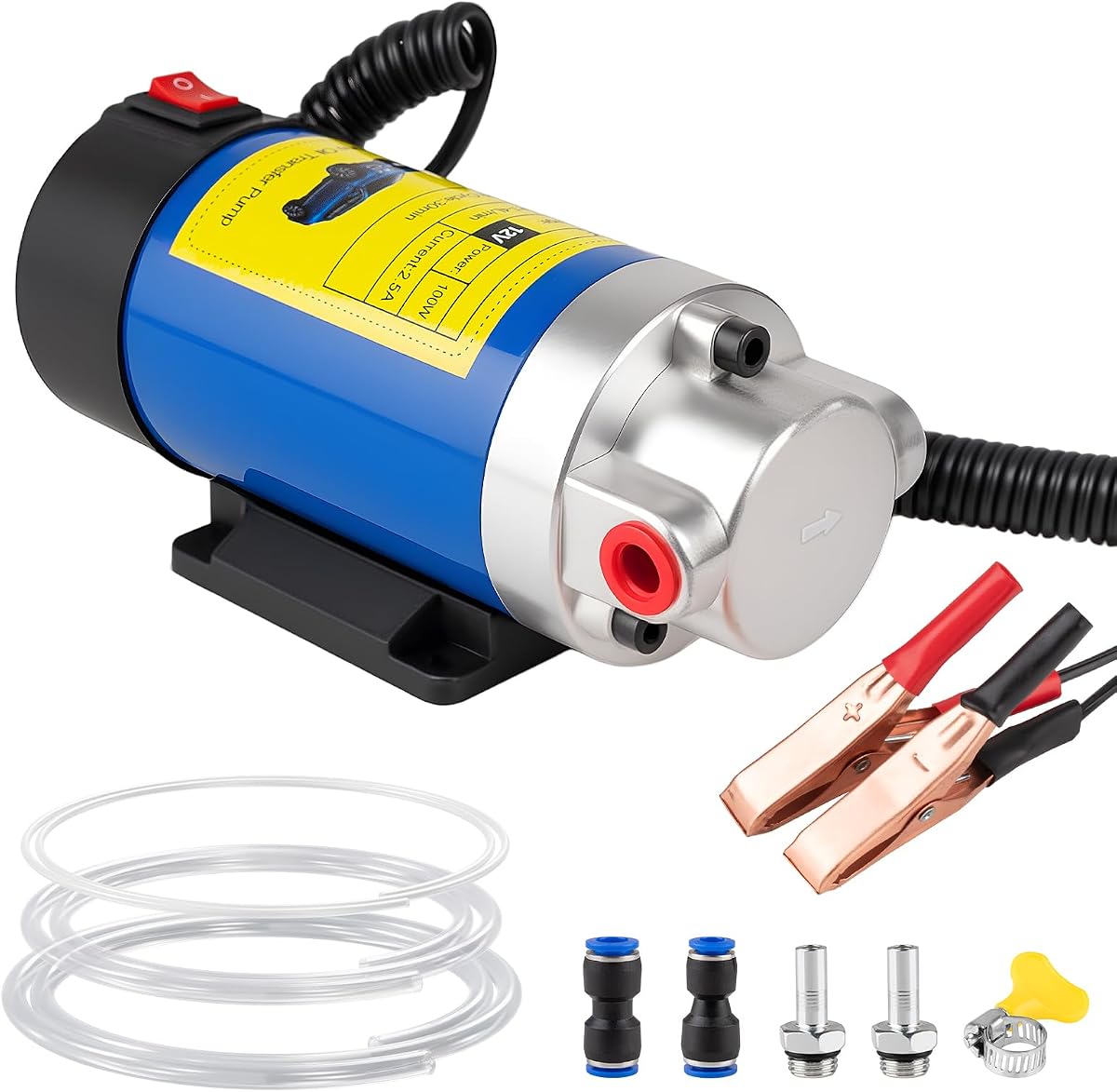
This 12V, 100W oil extractor is designed for DIY engine oil changes through the dipstick tube, offering a cleaner alternative to removing a drain plug and waiting for oil to drain. Its 3.8 rating is the lowest in this group, but the listed specifications are notable: the motor is described as pure copper, and the pump can deliver up to 4.2 quarts per minute.
We may earn a commission when you buy through this link, at no additional cost to you.
The product is positioned for synthetic oil changes and fluid maintenance in cars, motorcycles, lawn mowers, boats, and Jet Skis. It handles motor oil, gear oil, differential fluid, and transmission fluid, but explicitly excludes gasoline, diesel, and water. Warm the engine for three to five minutes before extraction because warmed oil moves more readily through the suction path.
Its principal limitation is operational endurance. The stated maximum continuous operating time is 30 minutes, so it is better viewed as a focused service pump than a tool for prolonged repeated transfers. The 3.8 rating also suggests that some buyers may have found aspects of performance or usability less satisfactory than the leading models.
Home owners and weekend mechanics who want a straightforward 12V unit with a high stated flow rate may still find this model practical. It is particularly attractive when the main goal is removing oil through the dipstick without crawling underneath the vehicle. Confirm fluid compatibility and port fit before ordering, and follow the stated warming and runtime instructions carefully.
Extracting through the dipstick opening removes much of the need for a drain pan and under-car work. The listed maximum flow makes the unit appealing for common passenger-car capacities, although real results depend on oil temperature, viscosity, hose condition, and the vehicle's oil-port geometry.
A pure copper motor is a meaningful construction detail because it supports stable suction and durability. However, the 30-minute continuous-use limit should be respected; allowing the unit to cool between extraction jobs helps reduce thermal stress.
We may earn a commission when you buy through this link, at no additional cost to you.
This electric oil change extractor combines 12V and 24V operation with a 100W motor, making it one of the more versatile kits in the group. Its 4.1 rating is solid, and the supplied components create a more organized service setup than many simpler models.
We may earn a commission when you buy through this link, at no additional cost to you.
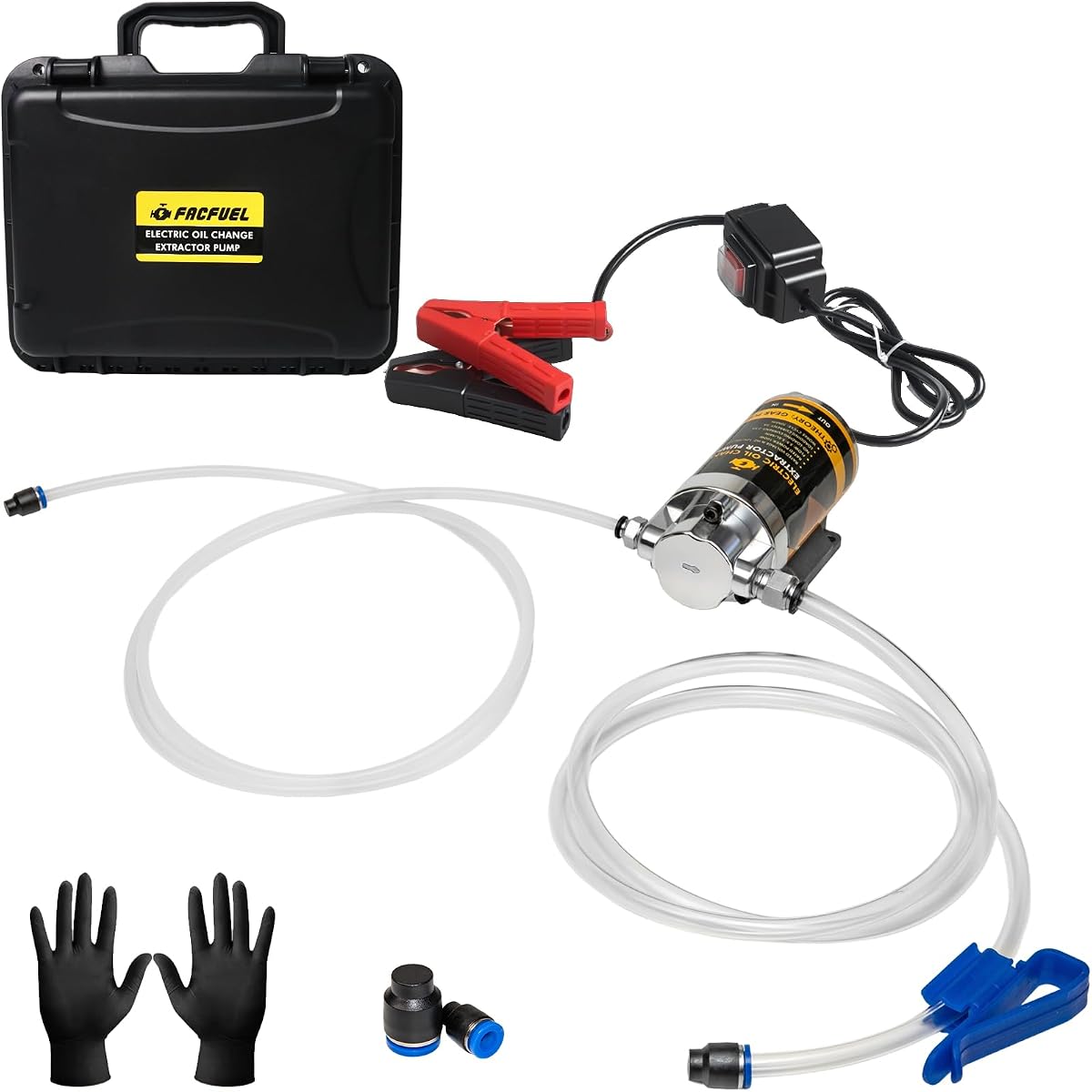
The kit includes a pump with a 1.4-meter power cord, copper-plated battery clamps, a waterproof switch, two 1.5-meter thickened hoses, two fixed clamps, two anti-leakage plugs, two anti-kink springs, an instruction manual, and a portable suitcase with additional capacity. The pump body uses an aluminum alloy construction described as corrosion-resistant, while the motor is described as pure copper.
One-person operation is a central benefit: the fixed clamp can hold a hose in place while the pump runs, and the anti-leak plug helps stop residual drainage after extraction. The trade-off is that the included equipment cannot be used with water, gasoline, petrol, fuel, or other flammable liquids, despite the broad use of the word “transfer” in the product category.
This is a strong choice for owners of 12V cars, 24V trucks, RVs, boats, or farm equipment who want one kit to cover multiple systems. It suits buyers who value dual voltage, organized storage, and hands-free hose positioning more than minimal size. Ensure the equipment oil port is at least 12 millimeters before purchase and follow the warm-oil extraction guidance.
Dual-voltage capability is the defining feature of this package. It gives garage users flexibility when moving between standard automotive batteries and 24V equipment, reducing the need to maintain separate extractors for different machine classes.
Thickened hoses, anti-kink springs, quick sealing plugs, and a fixed container clamp address several common handling problems. Together, they improve reach, routing, drainage control, and the ability to complete a service without repeatedly holding the outlet hose in place.
We may earn a commission when you buy through this link, at no additional cost to you.
The Amarine Made Oil Pump is a compact 12V, 60W extractor intended for routine fluid changes where portability matters more than maximum flow. It has a 3.8 rating, matching the lowest-rated product in the comparison, but its straightforward design and broad list of supported equipment make it a credible entry-level maintenance tool.
We may earn a commission when you buy through this link, at no additional cost to you.
The unit draws 5 amps and is stated to move 0.8 to 1.0 liter per minute while operating steadily and quietly. Its package includes a 1.5-meter outlet hose, a 1.2-meter inlet hose, two hose locks, and battery clamps. Installation follows a familiar process: connect the inlet and outlet hoses, attach the power clips to the battery, lock the hoses, and then operate the switch.
This model has tighter restrictions than several alternatives. It cannot be used with gasoline, petrol, water, gearbox oil, or other flammable liquids. Its suction capacity is also limited, and the manufacturer warns against connecting extra extension tubes. The pump should not run for more than 30 minutes continuously, with a recommended cool-down break after 10 to 20 minutes.
Choose this pump if you work on smaller quantities of engine oil and want a compact unit for cars, motorcycles, recreational equipment, or lawn machinery. It is less compelling for heavy or highly viscous fluids, extended commercial service, or jobs requiring the flow and hose diameter of a 100W system.
The 8-by-7-by-4-inch housing is easy to carry and store. That portability is useful for owners who perform maintenance away from a permanent lift or who need a small extractor that does not occupy much workshop space.
The list of prohibited liquids is unusually important with this model. Use it only for compatible engine oil, never for fuel, water, or gearbox oil, and avoid adding extension tubes that could increase suction load or reduce stability.
We may earn a commission when you buy through this link, at no additional cost to you.
Harpy Eagle’s electric oil extractor is a 12V/24V, 100W kit designed to make oil changes more approachable, particularly for first-time users. It earns a 4.0 rating and arrives fully assembled with instructions, a list of 100 car models and engine oil capacities, extended hoses, quick-release plugs, and a storage case.
We may earn a commission when you buy through this link, at no additional cost to you.
The motor is described as a rotary engine built primarily from metal, with no plastic parts, and it can pump oil at up to one quart per minute. Both hoses measure four feet, offering useful reach for larger engines in pickups, trucks, and boats. A 59-inch straight power cable provides additional working distance, while an enlarged cable cross-section and larger clamps are intended to improve connection safety.
The kit is more elaborate than a minimal pump-and-hose package, which is useful if the goal is organized, repeatable maintenance. Conversely, the case, manual, reference list, long hoses, plugs, and supporting hardware make it bulkier than compact models. The listing does not provide a numerical flow figure beyond the one-quart-per-minute claim, so buyers comparing extraction speed should recognize the less precise presentation.
This model is a good match for DIY users who value instructions, model-capacity references, and a ready-to-store package. It can also handle transfer-case, rear-axle gearbox, lawn-mower, power-washer, scooter, ATV, and generator applications as described. Confirm that the intended fluid and opening are compatible before using it on a specific vehicle.
The included manual and vehicle oil-capacity reference make preparation more systematic. Users can confirm the expected quantity, identify the relevant service point, and plan their extraction and refill process before starting the pump.
Metal motor construction and four-foot hoses favor durability and access to larger engines. The trade-off is greater bulk, making the storage case more of a workshop organizer than a truly compact travel accessory.
We may earn a commission when you buy through this link, at no additional cost to you.
The MILADO Electric Oil Change Extractor Pump Set combines a 4.1 rating with a dual-voltage system, making it a versatile organized kit for home garages and maintenance fleets. Its 100W pure copper motor is paired with an aluminum body described as corrosion-resistant and more durable than plastic-housed alternatives.
We may earn a commission when you buy through this link, at no additional cost to you.
The stated engine-oil flow rate is 1 to 4 liters per minute between 10 and 90 degrees Celsius. The package includes a storage box, pump, 1.4-meter power cord, 1.5-meter inlet hose, 1.5-meter outlet hose, a clamp, instructions, gloves, and wipes. The hoses have different stated dimensions, with a six-millimeter inlet tube and ten-millimeter outlet tube.
The pump supports engine oil, diesel oil, and transmission fluid, and is intended for cars, motorcycles, RVs, boats, lawn mowers, tractors, combines, and diesel trucks. It explicitly cannot transfer water, gasoline, petrol, fuel, or flammable liquids. A one-year warranty and customer support are also offered, although the listing's support wording is unusually brief compared with the detailed product specifications.
This is a strong candidate for users who service mixed vehicle types and appreciate the storage box, cleaning supplies, and dual-voltage capability. Its straightforward, fully assembled presentation reduces setup barriers. Confirm the hose and adapter fit for the machine being serviced, and remember that the stated flow range is tied to compatible oil temperature and operating conditions.
Operating on both 12V and 24V DC power makes this set useful for garages containing passenger vehicles, trucks, or agricultural equipment. That flexibility is more valuable than nominal wattage alone when one tool must cover several machine classes.
The larger storage box, included clamp, instructions, gloves, and wipes create a ready-to-store service package. These details are helpful for maintaining a repeatable process and keeping fluid transfer components together after use.
We may earn a commission when you buy through this link, at no additional cost to you.
This 12V, 100W extractor combines a 4.2 rating with a self-priming design, transparent hose, and several connection adapters. It is a capable budget-oriented option for DIY users who want more equipment than a basic 60W pump without paying for a large dual-voltage storage system.
We may earn a commission when you buy through this link, at no additional cost to you.
The pump is designed to connect through the dipstick tube, eliminating the need to crawl under the vehicle for extraction. Its 100W copper motor supports fast, stable operation, while the transparent PVC hose lets the user watch the oil move. The package includes two inlet hoses sized at six and eight millimeters, a ten-millimeter outlet hose, five installation adapters, battery clamps, and an instruction manual.
The operating guidance is important. The transparent hose may become stiff below 10 degrees Celsius, though briefly warming it with hot water restores flexibility. The engine should be warmed to 104–140 degrees Fahrenheit before extraction, and the pump should not run continuously for more than 15 minutes. A ten-minute pause is recommended to prevent overheating.
Fluid limitations keep this from being a universal transfer pump. It is not compatible with diesel, gasoline, water, or waste oil, and the anti-clog filter should always be installed. It remains a strong fit for cars, motorcycles, lawn mowers, and similar machines using engine oil, gear oil, or automatic transmission fluid.
The self-priming approach is intended to reduce the setup involved in beginning suction. It is particularly useful for routine services where the pump should move oil quickly after the connections have been checked.
Five adapters and two inlet diameters increase the likelihood of matching different oil-port openings. Transparent tubing gives direct visual feedback, although the hose still needs to be handled carefully when cold.
We may earn a commission when you buy through this link, at no additional cost to you.
This 12V, 100W engine oil extractor has the highest listed rating in the group at 4.3. It combines a pure copper motor, a stated extraction rate of up to one quart per minute, a corrosion-resistant body, and a sealed motor housing in a portable package intended for convenient one-handed use.
We may earn a commission when you buy through this link, at no additional cost to you.
The listed weight is 3.8 pounds, and the housing includes an ergonomic handle. A blue clamp secures the hose to the receiving container, allowing the user to control the pump without continually holding the outlet in position. The complete kit contains the pump, a five-foot or 1.5-meter inlet hose, a five-foot or 1.5-meter outlet hose, two hose clamps, four sealing plugs, and a manual.
Quick-connect fittings are intended to prevent leakage during operation, while the sealing plugs help contain residual oil when the hoses are stored. One limitation is the lack of 24V support, making this less flexible for trucks or equipment using a 24V battery. The product is also not recommended for cold oil, gear oil, or highly viscous oil; the oil should be heated to 100 degrees Fahrenheit before pumping.
This is a strong all-around recommendation for home mechanics, road travelers, campers, and users who prioritize portability, straightforward handling, and leak control. It avoids the bulk of larger case-based kits while still providing a full hose-and-fitting set. Choose it for 12V vehicles and small engines where warmed engine oil is the intended fluid.
Locked quick-connect fittings address leaks during active extraction, and four sealing plugs help manage residual fluid afterward. This two-stage approach supports a cleaner workflow than leaving disconnected hoses unsecured near a used-oil container.
The light listed weight, molded handle, and included container clamp make the unit manageable during service. The pump is more portable than larger case-based models, which is useful for roadside or campsite maintenance.
We may earn a commission when you buy through this link, at no additional cost to you.
The Electric Oil Change Pump is a 12V/24V, 100W extractor with a 4.0 rating, a metal housing, and a package centered on convenient installation and storage. It is suited to users who want a long-hose kit capable of reaching various engine bays without assembling numerous separate accessories.
We may earn a commission when you buy through this link, at no additional cost to you.
Two 59-inch hoses provide reach and allow the oil path to be routed more freely. Transparent tubing offers real-time visibility of fluid flow, while quick-insert fittings are described as requiring no tools. A blue fixing clip holds the hose in a receiving container, and quick-release plugs are included to reduce spills during storage. The pump uses a thickened cable and a safety switch for everyday handling.
The metal housing and pure copper motor are notable construction details, and the product is advertised for low-noise operation. Oil should be warmed to around 100 degrees Fahrenheit before extraction, which improves the chance of steady flow. The listing describes a broad range of automotive, marine, pressure-washer, scooter, ATV, generator, and lawn-mower applications, though it does not provide the same detailed fluid exclusions found in some competing descriptions.
This model is a practical choice for a 12V or 24V garage that wants a compact storage box, long hoses, and secure routing. The fixed clip and transparent tubing improve workflow visibility, while the tool-free connections shorten setup. Buyers should still verify the intended fluid, hose-port fit, and warming requirements against their specific equipment.
The two 59-inch hoses are long enough to navigate around engine components and reach a suitable container. Their transparency also makes it easier to identify an interrupted or incomplete flow during a service.
A pure copper motor and metal pump housing offer a more robust appearance than plastic-bodied alternatives. The safety switch, thicker cable, and enlarged quick-insert fittings support stable operation and simpler service routines.
We may earn a commission when you buy through this link, at no additional cost to you.
This 12V, 100W oil extractor uses a self-priming design to remove used oil through the dipstick tube, with a stated flow range of one to four liters per minute. Its 4.0 rating reflects a balanced package aimed at DIY automotive, marine, and small-engine maintenance.
We may earn a commission when you buy through this link, at no additional cost to you.
The motor is intended to handle engine oil, transmission fluid, and lower-unit gear oil. The listing specifically names SAE 0W-20, 5W-20, and 5W-30 oils, while warning against heavy or highly viscous fluids that could cause the pump to stall. Warming the engine before use helps produce smooth, steady extraction.
A built-in power switch allows the operator to stop the pump immediately, reducing the chance of hose slippage, spillage, or overfilling. That controlled shutdown is particularly useful when watching a container or judging the remaining quantity. The product is also positioned for home garages, marine maintenance, and small-engine repair, although its listing gives fewer accessory and construction details than the most complete kits.
Choose this model if you regularly service vehicles using common light engine-oil grades and want a compact extractor with straightforward self-priming and instant shutoff. It may be less suitable for heavy machinery with highly viscous oil or operators who need a broad bundle of hoses, plugs, adapters, and storage components.
The inline power switch gives the operator a direct way to stop flow when the container approaches capacity or the extraction appears complete. This makes it easier to control the final portion of an oil change.
The pump is described as suitable for common motor-oil grades but not for heavy or highly viscous oils. Match the fluid's actual viscosity to the manufacturer's guidance, and warm the engine before attempting extraction.
We may earn a commission when you buy through this link, at no additional cost to you.
The 12/24V Electric Oil Change Extractor Pump is a 100W, dual-voltage unit rated at 4.1 stars. It is designed for engine, transmission, and gear-oil changes across boats, trucks, cars, RVs, lawn mowers, motorcycles, and related equipment, making it a broad option for mixed-service users.
We may earn a commission when you buy through this link, at no additional cost to you.
The pump uses an aluminum alloy body described as corrosion-resistant and a pure copper motor, with a stated engine-oil flow rate of one to four liters per minute between 10 and 90 degrees Celsius. Its kit includes a 1.4-meter power cord with copper-plated battery clamps and waterproof switch, two 1.5-meter thickened hoses, fixed clamps, anti-leakage plugs, anti-kink springs, instructions, and a portable suitcase with 20% more capacity.
The product is fully assembled and positioned for one-person operation. A fixed clamp provides hands-free hose positioning, while the sealing plug helps stop residual leakage. The main requirements are that the equipment's oil port measure at least 12 millimeters and that the fluid be compatible with the pump. Water, gasoline, petrol, fuel, and other flammable liquids are expressly excluded.
Choose this pump if your equipment mix includes both 12V and 24V systems and you want a case-based kit with all routing and sealing accessories at hand. It is less appropriate for unusual small ports, prohibited fluids, or users who need the lowest possible storage footprint.
Supporting both 12V and 24V systems broadens the range of cars, trucks, boats, and RVs that one pump can address. The high stated flow is useful for larger fluid capacities, provided the oil has been warmed to the appropriate temperature.
Anti-kink springs, thickened hoses, fixed clamps, and sealing plugs address common problems encountered during fluid transfer. Their inclusion makes this a more service-ready package than a basic pump with short hoses.
We may earn a commission when you buy through this link, at no additional cost to you.
The most useful extractor is not simply the one with the highest motor rating. Consider voltage, pump capacity, fluid restrictions, hose reach, connection security, storage, cooling limits, and the vehicles or machines you actually service.
Most full-size options in this guide use a 100W motor, while the compact Amarine Made model uses 60W. A higher rating is often associated with stronger suction and faster movement, but the stated flow range also depends on fluid temperature, viscosity, hose diameter, and the length of the suction path. Compare manufacturer-stated rates cautiously, because some listings provide liters per minute while others provide quarts or approximate one-quart claims.
Choose a pump whose capacity comfortably covers the oil volume in your equipment. For normal passenger-car service, most 100W models should be appropriate. Compact engines and smaller quantities may also suit a 60W unit, provided the fluid is warm and compatible.
A 12V pump connects directly to a standard vehicle battery and is the simplest choice for cars, motorcycles, lawn mowers, and many small engines. Dual-voltage 12V/24V models are more adaptable for trucks, RVs, agricultural equipment, and mixed fleets. They provide a broader voltage range, but buyers should still confirm battery polarity and the appropriate connection arrangement before operation.
If every machine in your care uses a standard 12V system, a 12V model keeps the setup simple. If you maintain 24V trucks or diesel equipment, dual voltage is the more useful long-term choice.
An oil extractor is not automatically a safe pump for gasoline, diesel, water, waste oil, or every transmission and gear fluid. Several products in this guide explicitly prohibit gasoline, petrol, fuel, and flammable liquids, while others restrict diesel, water, or gearbox oil. Read the exact model limitations rather than assuming it can move every fluid used in a vehicle.
Match the pump to the fluid's viscosity as well. Heavy or highly viscous oil can strain a unit, and cold oil is difficult to extract. Warm the engine according to the instructions, use only compatible fluids, and never test the pump with fuel or water.
Hose length determines whether the pump can reach the oil port and discharge hose without awkward routing. Kits in this guide range from roughly 1.2 to 1.5 meters, with some offering four-foot or 59-inch lines. Longer hoses are useful for large engines and trucks, but very long suction paths can make extraction harder. Port size is equally important: one dual-voltage model requires an oil port of at least 12 millimeters.
Measure the vehicle's oil-port diameter and the distance to your receiving container before ordering. Check whether adapters or interchangeable inlet hoses are included, and avoid relying on unapproved extension tubes.
Secure fittings, hose clamps, fixed container clips, and sealing plugs are central to a clean oil change. Lock-style fittings help prevent hose slippage during operation, while anti-kink springs can keep the suction line from folding. A fixed clamp allows the outlet hose to remain positioned over the container, and sealing plugs help contain residual oil during storage.
Prioritize these features if you work in a clean garage or want to reduce spill cleanup. Inspect fittings before each use and plug unused hose openings before putting the pump into storage.
The smallest pump is easier to move between a car, motorcycle, mower, and boat, while case-based systems keep hoses, clamps, instructions, and adapters together. The Amarine Made model is listed at 8 by 7 by 4 inches, and the 12V 100W unit associated with the top selection weighs 3.8 pounds. Other kits prioritize a roomy case and a larger organized accessory set over minimal dimensions.
Choose a compact model for roadside or field use. Choose a case-based kit if you perform frequent services, want everything in one place, and value organization over minimum storage footprint.
Runtime limits vary significantly. The rank-one 100W model supports up to 30 minutes of continuous operation, the compact 60W pump should not run for more than 30 minutes and benefits from breaks after 10 to 20 minutes, and the self-priming budget model advises no more than 15 minutes with a ten-minute pause. Continuous operation beyond these limits can increase motor heat and reduce reliability.
For most routine oil changes, these limits are ample. For large engines or repeated transfers, schedule cooling breaks and monitor the pump rather than assuming it can run continuously.
A complete kit may include battery clamps, one or two inlet hoses, an outlet hose, hose locks, sealing plugs, a fixed clamp, anti-kink springs, instructions, and a storage case. The Harpy Eagle set also includes a list of 100 car models with oil capacities and a manual written by a certified Master ASE mechanic. Accessories can reduce setup time, but they do not replace checking port fit or fluid restrictions.
Compare the bundle with what you already own. If you have suitable hoses and a reliable container clamp, a simpler kit may be sufficient; if not, the added sealing and routing hardware may be worth including.
Begin by identifying the correct service point, checking the pump's fluid restrictions, and confirming that the inlet or oil-port diameter is compatible. Warm the engine to the temperature specified by the manufacturer so the oil flows more easily, then shut the engine down before connecting the suction hose. Position the receiving container where it will remain stable and where the outlet hose cannot pull free.
Connect the hoses according to the pump's flow direction, lock all fittings, and attach the red battery clamp to the positive terminal and the black clamp to the negative terminal. Some pumps support 12V and 24V, but others are 12V only. Route the hoses without sharp bends, secure the outlet with the included fixed clamp, and remove the dipstick or cap only when the instructions direct you to do so. Start the pump and watch the transparent hose or other indicators for steady flow.
Stop the pump as soon as the expected oil quantity has been extracted or the container is close to capacity. Disconnect the battery, cap or seal both hose openings, and wipe away residual oil before storage. Follow the model's maximum run time and cooling guidance, inspect hoses and fittings for wear, and keep the motor dry. Never use gasoline, water, or another prohibited fluid, and never leave the pump running without a confirmed suction path.
Yes, many models in this guide are specifically designed to extract used engine oil through the dipstick tube. The hose and adapter must fit the opening properly, and the oil should be warm enough to flow. Some vehicles have restrictive, angled, or obstructed dipstick tubes, so check the manufacturer's compatibility information before use.
Warming the engine is strongly recommended by several manufacturers because warm oil is less viscous and moves through the suction path more easily. The listed guidance ranges from a few minutes of warming to heating the oil to around 100–140 degrees Fahrenheit. Shut the engine down before connecting the extraction hose and follow the pump-specific operating instructions.
No. Although the category includes fluid-transfer pumps, every model has fluid restrictions, and most explicitly prohibit gasoline, petrol, fuel, and flammable liquids. Some also exclude water, diesel, waste oil, or gearbox oil. Using the wrong fluid can damage the pump, create a fire hazard, or void the manufacturer's guidance.
A 100W model generally offers greater suction capacity and is better suited to larger engines or more viscous fluids, while a 60W model can be sufficient for smaller quantities of warmed engine oil. The actual result also depends on hose diameter, hose length, oil temperature, and port fit, so wattage should be considered alongside those factors.
A 12V-only pump is designed for standard 12-volt vehicle batteries and is usually simpler to operate. A 12V/24V model can work with both battery systems, making it more useful for trucks, RVs, farm equipment, and mixed maintenance fleets. Always confirm the voltage before connecting the clamps.
The limit depends on the model. Stated guidance ranges from no more than 15 minutes for one self-priming pump to as much as 30 minutes for others, with cooling breaks recommended in some cases. Follow the individual instructions, watch the motor, and stop if the unit becomes unusually hot, noisy, or loses suction.
Use the included hose clamps, quick-connect fittings, fixed container clip, and sealing plugs where provided. Keep the outlet secured over the container during operation, stop the pump before disconnecting it, and plug both hose ends immediately after service. Wiping the fittings and routing hoses without tight bends further reduces leakage risk.
They can remove oil through the dipstick tube without removing a drain plug, which is convenient and reduces under-vehicle access. However, some engines retain residual oil below the pickup or in inaccessible areas, and the correct quantity can depend on the vehicle. A drain-plug service may still be needed for a full drain or a specific manufacturer procedure.
The Oil Transfer Pump 12V 100W stands out for its 4.3 rating, portable 3.8-pound construction, one-handed hose clamp, and leak-conscious fittings. The dual-voltage 12/24V Fluid Transfer Pump is the more complete premium-style package, while the 12V 100W self-priming model offers a strong budget balance with visible flow, adapters, and a 100W motor.
Prioritize compatibility before power. Confirm the system voltage, oil-port diameter, intended fluid viscosity, hose reach, and required fittings, then consider cleanup and storage. Models with sealing plugs, secure fittings, fixed clamps, and clear instructions are usually more pleasant to use, while dual-voltage capability matters when maintaining trucks, boats, RVs, or farm machinery.
Remember that prices, availability, and listing details can change. Review the current product page, manufacturer instructions, warranty terms, and fluid warnings before purchasing. Use the pump only for specified fluids, warm the oil as directed, respect runtime limits, and store the hoses sealed and clean after every service.