
CyberPower CP1500PFCLCD
4.5Editor score
1000W sine wave capacity
Twelve NEMA outlets
Color LCD monitoring
USB-A and USB-C charging
Our 1000W UPS battery backup guide compares runtime, sine wave output, outlets, USB shutdown, and protection features to help you choose the right model today.
A 1000W UPS battery backup can keep a computer, network, or entertainment system running when utility power fails, but the best model depends on battery chemistry, outlet layout, waveform, and monitoring features. A unit that looks powerful on paper may still be a poor match for sensitive equipment or a crowded installation.
This guide compares ten products based on their stated capacity, waveform, voltage regulation, protected connections, battery technology, automatic shutdown support, and practical design. It covers traditional lead-acid units, lithium iron phosphate systems, compact towers, wall-mountable models, and business-oriented UPS systems with remote monitoring.
Each review explains the standout benefits, limitations, and best type of buyer for every product. Ratings and specifications reflect the supplied product information, while availability and prices can change, so readers should verify current details and outlet requirements before purchasing.
4.5Editor score

4.8Editor score

4.8Editor score
The comparison below highlights the differences in power capacity, battery design, waveform, outlet configuration, and monitoring support across all ten models, helping buyers narrow the field before considering runtime and installation needs.




The CyberPower CP1500PFCLCD combines 1000W of stated capacity with a pure sine wave output and a generous set of protected connections. It is designed for computers, workstations, network devices, and telecom equipment, particularly systems with active PFC or conventional power supplies. Its color LCD provides immediate visibility into battery and power conditions, while the 12-outlet layout gives it an advantage over many competitors.
We may earn a commission when you buy through this link, at no additional cost to you.
Automatic Voltage Regulation corrects minor power fluctuations without switching to battery operation, which can preserve runtime during common voltage changes. Six outlets provide surge protection only, while the other six add battery backup. Two front-facing USB ports, including one Type-A and one Type-C, allow phones and tablets to be charged without occupying an AC socket. The right-angle input plug and five-foot cord also make placement more flexible.
The main compromise is battery technology. Although the stated three-year warranty includes the battery, it does not offer the decade-scale maintenance-free positioning associated with the newer lithium systems in this guide. Buyers who also need PowerPanel Management Software must download it, and people who require native cloud monitoring may find the more business-focused APC models more suitable. The LCD can tilt up to 22 degrees, making it more readable than many fixed displays.
This is the strongest general-purpose recommendation for buyers who want a full 1000W rating, a sine wave supply, numerous outlets, and useful monitoring without moving into a lithium-focused design. It suits a home office, professional workstation, or small network installation. The included connected equipment guarantee, safety certification, and three-year coverage also make it a reassuring choice for users who want established support around a conventional UPS.
Twelve NEMA 5-15R outlets separate six battery-backed connections from six surge-only connections. That flexibility makes it easier to protect essential equipment while leaving peripherals connected to protected but non-backed outlets.
The tilting color LCD reports detailed battery and power conditions and warns of potential problems. It is particularly useful for users who want visible status without relying entirely on audible alarms or computer software.
We may earn a commission when you buy through this link, at no additional cost to you.
The GOLDENMATE White Lithium combines 1000W of backup capacity with a lithium iron phosphate battery designed for more than 10 years of use and over 3,000 charge cycles. That longevity is its defining advantage over conventional lead-acid systems. It is aimed at home and office users who want dependable protection without the prospect of frequent battery replacement.
We may earn a commission when you buy through this link, at no additional cost to you.
Pure sine wave output supports active PFC and conventional power supplies, making it suitable for computers, workstations, network equipment, and telecom hardware. The line-interactive design monitors voltage continuously, while the product information lists protection against outages, voltage drops, spikes, surges, fluctuations, and damping shocks. A communication port and included USB cable can coordinate a safe shutdown with a Windows PC, Mac, or NAS when properly configured.
Eight NEMA outlets provide both surge protection and battery backup. Two front USB charging ports supply a combined 10W through one USB-C and one USB-A connection. The smart LCD displays live power and battery information, and its inactivity controls offer clear flexibility: a brief press wakes the display, while holding the button keeps it continuously visible. A short button press temporarily mutes the alarm, and a three-second hold disables it until the unit is restarted.
The product is designed for 90–140V AC input and standard 110V household service. It also warns that generator-provided power may not meet its voltage, frequency, waveform, or grounding requirements, potentially leaving it in battery mode without recharging. With that qualification understood, it is an appealing choice for buyers prioritizing battery longevity, quiet operation, and a clean output for sensitive electronics.
The lithium iron phosphate battery is stated to offer more than 10 years of use and over 3,000 charge cycles. Its long cycle life is intended to reduce the maintenance and replacement burden associated with traditional sealed lead-acid batteries.
Separate display and mute controls make the unit easy to operate around other people. The display can sleep after 90 seconds, while the buzzer can be silenced temporarily or disabled until restart.
We may earn a commission when you buy through this link, at no additional cost to you.
The GOLDENMATE Gray Lithium is a 1500VA, 1000W line-interactive UPS built around a 51.2V, 5.8Ah lithium iron phosphate battery. Its stated cycle life exceeds 3,000 charges, and the battery is designed to operate for more than 10 years without replacement. The result is a long-life alternative to lead-acid units for computers, workstations, routers, and other connected equipment.
We may earn a commission when you buy through this link, at no additional cost to you.
Pure sine wave output gives sensitive electronics a stable supply, while Automatic Voltage Regulation addresses common voltage fluctuations without unnecessary battery use. The wider spacing between its eight NEMA outlets is a practical improvement for plugs with bulky bodies. A built-in Battery Management System and PP45 terminals support controlled operation, and the system includes surge protection alongside battery backup.
A communication port and included USB cable allow compatible Windows PCs to initiate shutdown through operating-system settings. USB-C and USB-A charging ports provide 10W of combined output for phones, tablets, and wearables. The intelligent LCD shows real-time battery and power status, while the integrated control handles muting and display operation. A safety function can halt charging and discharging if defined limits are exceeded.
This model has the same important operating caveat as other lithium systems in the guide: it accepts 90–140V AC input and is designed for standard utility power. Generator output may not be recognized correctly, potentially causing the unit to remain on battery and not recharge. It is best for users who want 1000W, a lithium battery, spacious outlets, and an LCD without needing a wall-mounted emergency light.
The outlet panel is designed with wider gaps than many competing units. That helps when several power bricks or thick cords need to be connected at the same time.
The integrated battery management system monitors operating limits and can stop charging or discharging when conditions exceed the defined range. This protection complements the lithium battery's long cycle-life design.
We may earn a commission when you buy through this link, at no additional cost to you.
The GOLDENMATE Wall-Mount is distinctive because it combines 1000W backup with an emergency LED and included mounting screws. It can be placed on a wall to preserve desk or cabinet space, making it useful in home offices, network rooms, and workspaces where floor and shelf area are limited.
We may earn a commission when you buy through this link, at no additional cost to you.
Its pure sine wave output supports active PFC and conventional power supplies, and the stated transfer time is under 10 milliseconds. The lithium iron phosphate battery is advertised for more than 10 years of use and over 3,000 charge cycles. Eight NEMA outlets supply both surge protection and battery backup, while a 10W combined USB-C and USB-A charging arrangement handles mobile devices.
The built-in emergency light activates automatically when utility power fails if its switch is set to AUTO. It provides immediate visibility for checking equipment, locating connections, and moving safely in darkness. The light turns off after utility power returns. This is more useful than a standard UPS when a home office, media area, or network closet has no nearby illumination.
A communication port and USB cable support safe shutdown coordination with a Windows PC, Mac, or NAS. The smart LCD provides battery and power information, and the alarm has temporary and persistent mute options. The unit still shares the stated 90–140V input range and generator-power limitation of the other GOLDENMATE lithium products, so standard utility service is the safer operating environment.
The automatic emergency LED helps users see the UPS and nearby connections after a blackout. Its behavior depends on the AUTO setting, and it switches off once normal power returns.
Included screws allow the unit to be mounted vertically on a wall. That installation can keep a compact office, entertainment area, or network station more orderly than a floor-standing tower.
We may earn a commission when you buy through this link, at no additional cost to you.
The ADMLi 1500VA/1000W is a compact lithium UPS aimed at gamers, professionals, and households that want more than a basic surge protector. It uses a 25.6V, 9Ah lithium iron phosphate battery rated for more than 3,000 charge cycles under laboratory conditions. The Smart Battery Management System monitors charging, discharging, and temperature to support stable operation.
We may earn a commission when you buy through this link, at no additional cost to you.
Pure sine wave output and a transfer time of no more than 10 milliseconds make it appropriate for computers and sensitive electronics. The stated load targets include gaming PCs, desktops, monitors, routers, modems, NAS systems, and security devices. Eight AC outlets, surge protection, and overload protection provide the core protection needed for a home office or network installation.
One especially useful feature is automatic restart after complete battery discharge. Once utility power returns, the UPS is stated to restart and resume output without manual operation, allowing connected equipment to come back online more easily. A built-in LCD presents important operating information, while one USB-A and one USB-C port provide convenient charging for phones, tablets, and other accessories.
The main uncertainty is runtime because the supplied information does not provide a load-based estimate. The product also does not specify a USB communication feature for coordinated shutdown, so buyers who need that functionality should verify compatibility before buying. Even so, the combination of lithium chemistry, smart management, clean output, and automatic recovery makes this a strong all-around recommendation for a modern home or office.
Pure sine wave output provides clean power for active PFC systems and conventional power supplies. This makes the UPS suitable for modern gaming computers, workstations, NAS devices, and other sensitive equipment.
After utility power returns following a complete battery discharge, the unit is designed to restart automatically. Connected devices can therefore resume receiving power without someone physically pressing the power button.
We may earn a commission when you buy through this link, at no additional cost to you.
The Everamp 1500VA/1000W stands apart with a dual-metal case, 360-degree five-side cooling vents, and a clearly stated maximum runtime of 24 minutes at a 500W load in a 25°C environment. It delivers pure sine wave power with a transfer time under 10 milliseconds, and all eight outlets provide battery backup and surge protection.
We may earn a commission when you buy through this link, at no additional cost to you.
Its 25.6V, 9Ah lithium iron phosphate battery is stated to last more than 10 years and support over 3,000 charge cycles. The smart battery management system, high-grade cells, and absence of acid leakage make it suitable for locations where long service life and lower maintenance are priorities. The enclosure is also designed for shelf, cabinet, or placement beside other equipment.
An included USB cable can connect the UPS to a PC, Mac, or NAS. Using operating-system settings, the system can send a shutdown signal during a prolonged outage, helping protect work and reduce the risk of data loss or file corruption. The one-touch silent control mutes the alarm temporarily, while a three-second long press enables complete silence until restart.
The front LCD shows real-time battery and power status, and two LED indicators provide quick operating or fault information. USB-A and USB-C ports are included for charging. The stated heavy-duty transformer and metal case make the unit heavier than similar products, but that construction is presented as a deliberate design feature. It is a premium choice for buyers who value enclosure quality, explicit runtime data, cooling, and coordinated shutdown.
The maximum 24-minute runtime is specified at a 500W load and 25°C. This gives buyers a more useful reference than a generic capacity figure when estimating performance for a network or office.
A one-touch control mutes the alarm, and a three-second long press enables persistent silent mode. This is valuable in offices, bedrooms, studios, and other spaces where an extended outage alarm would be disruptive.
We may earn a commission when you buy through this link, at no additional cost to you.
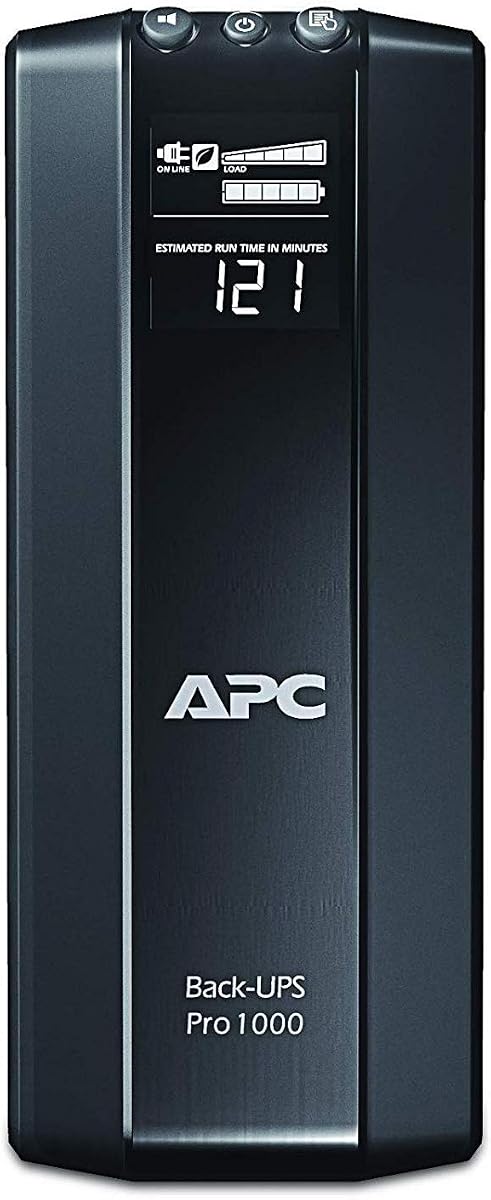
The APC Back-UPS Pro BR1000G is a 1000VA unit with 600W of supported output rather than a full 1000W. It remains relevant to the broader search because it is designed for computers, external hard drives, wireless routers, and other electronics where dependable brief runtime and surge protection are the main requirements.
We may earn a commission when you buy through this link, at no additional cost to you.
Its eight outlets divide into four with battery backup and surge protection and four with surge protection only. This configuration makes it possible to reserve limited backup capacity for a router, computer, and other essential devices while protecting less critical peripherals. Automatic Voltage Regulation maintains safer voltage conditions without drawing on the battery during minor corrections.
Intelligent battery management is intended to maximize battery performance, life, and reliability through precision charging. The tower format is familiar and unobtrusive, making it suitable for a home office, small network cabinet, or workstation area. Its emphasis is straightforward protection rather than extensive displays, lithium chemistry, or advanced remote administration.
This is not the correct choice when the connected equipment genuinely requires 1000W of active output. Nor is it ideal for many devices at once, since only four outlets receive battery power. It is most appropriate for a compact setup with a few essential electronics, particularly a router, computer, and network storage where 600W is sufficient.
Four outlets are reserved for battery operation and four for surge protection only. Buyers can use the limited backup capacity where continuity matters most instead of spreading it across every peripheral.
Automatic Voltage Regulation handles minor voltage changes without switching to battery power. This helps preserve runtime when the mains supply is uneven but still operational.
We may earn a commission when you buy through this link, at no additional cost to you.
The APC Smart-UPS SMC1000C is built for small businesses and technically equipped users who need more visibility than a basic home UPS offers. It is a 1000VA, 600W line-interactive pure sine wave tower, with applications including entry-level servers, networks, retail point-of-sale systems, business voice-over-IP setups, and desktop computers.
We may earn a commission when you buy through this link, at no additional cost to you.
Its SmartConnect Ethernet port enables cloud-based remote power monitoring, firmware upgrades, diagnostics, and proactive email notifications. That feature allows a user or administrator to check system status without physically visiting the installation, making it particularly attractive for unattended offices, retail locations, and distributed network equipment.
Automatic Voltage Regulation keeps output within user-selectable acceptable levels, supporting consistent delivery during input fluctuations. Graceful shutdown can be coordinated through serial or USB connections with PowerChute Serial Shutdown software. This is important for servers and workstations where an abrupt power loss can lead to data corruption, system crashes, or interrupted operations.
The included 16GB USB drive adds a separate storage accessory and does not increase the UPS's power capacity. As with the BR1000G, the 600W output limit makes this unsuitable for a load that truly needs 1000W. Its real distinction is remote administration and managed shutdown. It is a strong fit for small business infrastructure where visibility and controlled recovery are more valuable than a higher maximum wattage.
The SmartConnect Ethernet port supports cloud-based status checks, remote diagnostics, firmware updates, and recommended-action notifications. This is especially useful for equipment located in another room or at a separate site.
Serial and USB options work with PowerChute Serial Shutdown software. Compatible devices can shut down in an orderly manner during a prolonged outage, reducing the risk of data loss.
We may earn a commission when you buy through this link, at no additional cost to you.
The APC Smart-UPS SMT1000 provides 1000VA and up to 700W of backup power, with pure sine wave output designed for compatibility with active PFC power supplies and other sensitive electronics. All eight outlets provide battery backup and surge protection, giving it a more uniform connection layout than units that divide outlets into backed and surge-only groups.
We may earn a commission when you buy through this link, at no additional cost to you.
The LCD provides operating information, while the network-grade conditioning system protects against surges and disruptive noise. Solid-state Automatic Voltage Regulation boosts low input voltage and trims high voltage without using battery power. Network management is available through serial, USB, or an optional Ethernet connection, allowing the unit to fit into a more carefully administered small-server or office environment.
Output specifications include a nominal 120V voltage and synchronized output frequency. For a 60Hz nominal input, the stated output range is 57–63Hz, while the 50Hz nominal range is 47–53Hz. A typical recharge time of three hours means users should allow adequate charging time after the battery has been heavily used.
The 700W output ceiling is the main limitation for shoppers whose equipment is advertised around 1000W. VA and watts are not interchangeable, so buyers should add the normal operating draw of every connected device and leave suitable headroom. Within that limit, the SMT1000 is an appealing managed UPS for compatible computers, network equipment, and sensitive electronics that benefit from pure sine wave power.
All eight outlets provide surge protection and battery backup. This simplifies installation when several essential devices need continued power rather than separating a small backed group from surge-only sockets.
Serial, USB, and optional Ethernet connectivity give the SMT1000 several management paths. That makes it suitable for users who want manual control now and networked monitoring if their setup evolves.
We may earn a commission when you buy through this link, at no additional cost to you.
The APC BX1500M emphasizes runtime and broad home connectivity protection. Its 1500VA capacity supports up to 900W, and the stated runtime reaches 68 minutes at a 100W load. The product information positions it for computers, televisions, DVRs, Wi-Fi routers, modems, external drives, NAS systems, and smart home devices.
We may earn a commission when you buy through this link, at no additional cost to you.
Ten protected outlets include five with battery backup and five for surge protection only. Coaxial and Ethernet surge protection add protection for connected lines, making the unit more relevant to a home network than a model focused exclusively on AC outlets. Automatic Voltage Regulation corrects low-voltage brownouts and surges without draining the battery, and the unit is compatible with Active PFC gaming PCs.
A user-replaceable APCRBC124 battery is supported, although the replacement battery is sold separately. The LCD shows battery charge, estimated runtime, load capacity, and input voltage. ENERGY STAR certification indicates an efficiency of 92% or higher, which can reduce energy use compared with less efficient systems.
Although it falls short of a literal 1000W maximum output and the replaceable battery adds a separate ownership consideration, the BX1500M can be a compelling choice for low-to-moderate loads that need extended runtime. It is particularly attractive to users protecting routers, storage, media equipment, and several small household electronics rather than a single high-power workstation.
The stated 68-minute runtime at a 100W load demonstrates how runtime changes with demand. A network centered on small essential devices can stay online longer than one that must support a power-hungry computer.
Built-in coaxial and Ethernet surge protection broadens the unit's usefulness for home networks. These connections receive added protection in addition to the ten AC outlets.
We may earn a commission when you buy through this link, at no additional cost to you.
A useful UPS choice depends on more than its headline wattage. The battery chemistry, supported load, waveform, connection layout, monitoring options, and physical installation requirements determine whether a model will protect equipment effectively in real conditions.
Choose a model that clearly exceeds your combined connected load. If a product is listed as 1000VA but supports only 600W, it may still fit a modest network but will not run a setup that genuinely draws 1000W.
For sensitive or high-performance equipment, prioritize pure sine wave output over minor differences in outlet count. It reduces compatibility uncertainty and gives one system a better chance of serving several device categories.
Choose based on service life, maintenance willingness, and the replacement support available for the exact model. Do not assume every lithium UPS has identical battery specifications or cycle claims.
List the devices you intend to protect and their typical consumption. Use published runtime information as a guide, while keeping a generous safety margin for battery age, temperature, and power fluctuations.
Choose enough backed outlets for critical equipment and enough surge-only outlets for safe peripherals. Wide outlet spacing can be more valuable than an extra socket when using large power adapters.
Decide whether local visibility is enough or whether remote monitoring and managed shutdown are necessary. Confirm operating-system and network-device compatibility before buying a communication-based feature.
Measure the intended location and check the included mounting hardware before ordering. Ensure the unit can sit or mount securely without blocking its cooling vents or creating a trip hazard.
Prioritize broad protection for computers, network storage, routers, and security systems. Verify that the waveform and voltage regulation features match the connected equipment rather than assuming every UPS handles every disturbance identically.
Place the UPS on a stable, dry surface or mount it securely where permitted, leaving its vents unobstructed. Connect the input plug to a compatible grounded utility outlet, verify that the local voltage falls within the unit's accepted range, and allow it to establish a full charge before relying on it for an emergency. Connect only critical equipment to battery-backed outlets and keep the total load within the supported wattage.
Configure the display, alarm, and communication settings after installation. If the UPS includes a USB cable and supports shutdown coordination, connect it to the intended PC, Mac, or NAS and enable the appropriate operating-system or device settings. Test the arrangement during a normal setup period by briefly disconnecting utility power, confirming that intended devices remain on, and checking the estimated runtime and alarm behavior.
For long-term care, keep the unit ventilated, avoid exposing it to moisture or extreme heat, and follow the manufacturer's battery guidance. Test it periodically under realistic load, replace any conventional battery according to the stated service schedule, and keep software and firmware current when the model supports managed monitoring. If a lithium unit remains in battery mode after a generator outage, confirm that the generator's voltage, frequency, waveform, and grounding meet the UPS input requirements.
Not always. A product described as 1000W may provide 1000VA of apparent power, while its supported real wattage can be lower because of efficiency and power factor. In this guide, some 1000VA models are limited to 600W or 700W. Add up the normal draw of every critical device and select a UPS with a comfortable margin above that total.
Pure sine wave is the safest choice for modern PCs, gaming systems, NAS devices, and other sensitive electronics. It is especially relevant to systems using active PFC power supplies. Although some simpler UPS units can protect basic electronics, a pure sine wave model offers broader compatibility and a more consistent supply during battery operation.
Runtime depends on the connected load, battery condition, and temperature. A light setup consisting of a router and small network equipment may run much longer than a gaming computer or workstation. Published estimates are most useful when they state the load; the Everamp, for example, states a maximum of 24 minutes at 500W and 25°C. Always leave enough capacity for the devices that truly require backup.
You can connect these devices if the combined load remains within the UPS's supported wattage and the output is compatible with their power supplies. Pure sine wave models are a better match for modern electronics. Keep the system focused on essential equipment, and remember that one high-load entertainment device can shorten runtime for every other connected device.
A surge-only outlet protects connected equipment from certain voltage spikes but loses power when utility electricity fails. A battery-backed outlet continues supplying power during an outage, provided the UPS has sufficient capacity. Models such as the CyberPower CP1500PFCLCD include both types, allowing critical devices to stay online while less essential peripherals remain protected.
It is highly useful for a computer or NAS that must shut down cleanly during a long outage. A connected UPS can send a shutdown signal through supported operating-system or device settings, reducing the risk of file corruption and abrupt shutdowns. Verify compatibility before purchase, because communication features and supported systems vary among models.
Only if the generator's output satisfies the UPS input requirements for voltage, frequency, waveform, and grounding. Several GOLDENMATE lithium models explicitly warn that unsuitable generator power may not be recognized, causing the UPS to remain in battery mode without recharging. Verify all four conditions before depending on generator-assisted operation.
A lithium iron phosphate system generally offers a longer service life, more charge cycles, and less maintenance than a conventional lead-acid battery. The supplied lithium products state more than 3,000 cycles and service lives exceeding 10 years. Lead-acid units can still be a practical choice when a user wants a familiar replaceable-battery design, so the best option depends on maintenance preferences and operating needs.
The CyberPower CP1500PFCLCD is the most balanced general-purpose option because it combines 1000W, sine wave output, 12 outlets, a color LCD, USB charging, and a three-year total warranty. The ADMLi 1500VA/1000W stands out for its lithium battery, smart management, automatic recovery, and clean output, while the Everamp 1500VA/1000W offers premium construction, an explicit 500W runtime estimate, extensive cooling, and automatic shutdown support.
Prioritize the factors that affect your equipment rather than selecting on capacity alone. Confirm real wattage, waveform, battery chemistry, number of backed outlets, communication support, and installation space. If remote monitoring is important, consider the APC Smart-UPS SMC1000C; if a long battery service life is the priority, favor one of the lithium systems; and if the installation is small, the GOLDENMATE Wall-Mount adds useful emergency lighting.
Current product details, compatibility, and prices can change, so confirm the specifications and support for your connected devices before purchasing. Check the outlet configuration, local voltage, generator requirements where relevant, and the communication software needed for automatic shutdown. With those details verified, a properly sized 1000W UPS can provide valuable continuity and protection for a home office, network, or small business installation.
