
SilverStone RM4A
3.6Editor score
Up to 360mm radiator support
SSI-EEB motherboard support
Eight PCI expansion slots
Expansion-card drive mounting
Front USB Type-C connection
A 4U rackmount GPU server chassis must balance accelerator capacity, airflow, storage, expansion, power delivery, and reliable rack integration. The strongest choices in this guide range from flexible 4U enclosures for custom builds to fully integrated dual-socket GPU systems, making the list useful for workstations, rendering, AI, and data-center applications.
We compared the ten products using the supplied specifications, focusing on GPU and expansion-slot support, motherboard compatibility, cooling architecture, hot-swap storage, power options, front connectivity, security features, and included installation hardware. The guide covers both standalone chassis and complete barebone-style GPU servers so buyers can distinguish between the two.
The first three selections represent the strongest overall, budget, and premium options, while the remaining reviews explain which models suit particular storage, cooling, processor, or accelerator requirements. Ratings and configurations can change over time, and current prices, availability, and component compatibility should be confirmed before purchasing.
3.6Editor score

4.3Editor score

5.0Editor score
As an Amazon Associate we earn from qualifying purchases.
This side-by-side comparison highlights chassis and barebone models with different levels of integration, from standalone SilverStone and Rosewill enclosures to Supermicro and ASRock Rack systems designed for dense accelerator configurations.


The SilverStone RM44 earns the Editor's Choice position because it combines a flexible 4U rack enclosure with unusually broad liquid-cooling support. Its 4.3 rating reflects a favorable overall reception, while the supplied specification highlights a chassis that can accept a radiator up to 360mm and motherboards up to SSI-EEB or Extended ATX. It is a strong foundation for custom GPU workstations and compute servers where thermal headroom matters.
We may earn a commission when you buy through this link, at no additional cost to you.
The most important feature is the 360mm radiator allowance. That capacity gives builders more freedom than a limited-airflow enclosure and can help accommodate high-output accelerators when paired with an appropriate motherboard, CPU cooler, pump, and radiator arrangement. Eight PCIe or PCI expansion slots provide room for multiple graphics or accelerator cards, although the final arrangement still depends on card dimensions, slot spacing, risers, and power requirements.
The RM44 also supports large server motherboards, including SSI-EEB and Extended ATX formats. That makes it useful for workstation-class platforms that need more expansion and memory capacity than a conventional ATX board may provide. Sliding rail mounting holes are a practical installation detail, reducing friction when the chassis must be repeatedly moved or serviced inside a rack. A front USB Type-C interface adds convenient access for compatible peripherals.
This is not the most storage-dense model in the comparison, and the supplied information does not detail its power-supply format or drive arrangement. Buyers should therefore verify those requirements before committing, especially if the system needs hot-swap storage or redundant power. Even so, the RM44 stands out as a well-balanced standalone chassis for buyers who want liquid-cooling flexibility, server-board support, and multiple expansion cards in 4U.
The RM44 is a particularly good recommendation for a custom 4U GPU platform assembled by an experienced integrator. It is less suited to buyers wanting a turnkey server because the motherboard, processors, graphics cards, memory, storage, and power hardware are not represented in the supplied feature list. Within that use case, its cooling and motherboard flexibility make it the most broadly appealing enclosure in this roundup.
A 360mm radiator allowance provides meaningful room for a robust thermal loop. In a GPU-heavy server, that flexibility can help builders route cooling around dense expansion areas, although radiator placement, pump performance, fan direction, and the installed motherboard still need to be planned as one system.
Support for SSI-EEB and Extended ATX motherboards opens the chassis to larger, more capable platforms. Combined with eight expansion slots, it creates a flexible base for multi-GPU workstations, specialized accelerator systems, and processors that demand extensive memory and PCIe connectivity.
We may earn a commission when you buy through this link, at no additional cost to you.
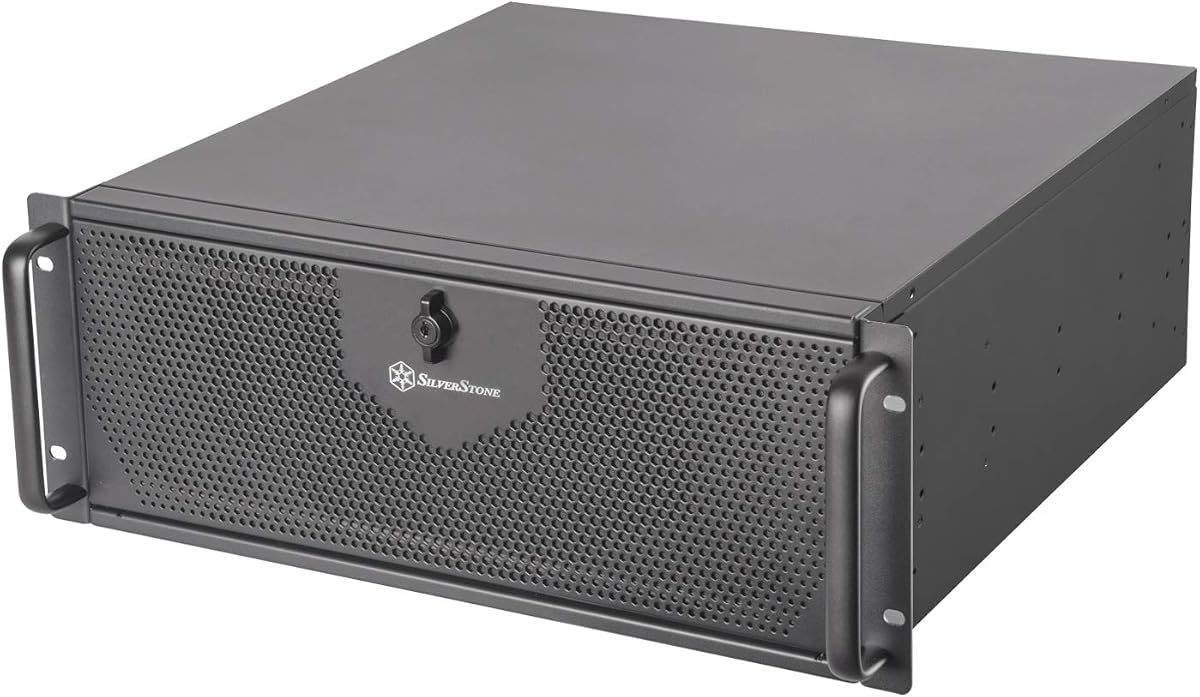
The SilverStone RM4A is the Best Budget selection, offering a practical foundation for a custom 4U GPU server without moving beyond the supplied 3.6 rating. It shares several headline features with the RM44, including support for 360mm radiators, SSI-EEB motherboards, and eight expansion positions, but it approaches the category as a more economical chassis.
We may earn a commission when you buy through this link, at no additional cost to you.
Its liquid-cooling support is especially relevant to GPU installations. The listed configuration accommodates a 360mm radiator along with two 80mm fans, giving an installer a clear starting point for the cooling loop. This makes the RM4A appealing for render nodes, compact visualization systems, and multi-GPU builds that need more thermal flexibility than a basic sealed case would offer.
Eight PCI expansion slots are available for accelerator cards and other full-size add-on hardware. Hard-drive mounting on the expansion-card retainer adds a useful storage option without requiring a separate shelf. It also includes a USB Type-C interface, providing convenient front-panel access for compatible phones, tablets, cameras, and other peripherals.
The main compromise is that the 3.6 rating is lower than those of several other products in the list. The supplied data also leaves some practical details unstated, including the supported power-supply format, included fans, and exact drive configurations. Buyers should confirm those specifications against their planned motherboard, GPU power demands, and rack arrangement.
The RM4A is best for value-conscious builders comfortable assembling and configuring the system themselves. It is particularly useful when the essential requirements are multi-GPU expansion, large-radiator support, and a 4U footprint, but advanced storage, redundant power, or an integrated server platform is not necessary. Its feature set delivers a solid budget-oriented balance for that audience.
The ability to fit a radiator up to 360mm is a meaningful advantage at this budget level. It can provide a more adaptable thermal path for high-power accelerators than a chassis limited to smaller radiators, provided the builder also selects compatible cooling hardware.
Eight PCI slots support a multi-accelerator layout, while hard-drive mounting on the expansion-card retainer offers a practical way to add storage. This combination helps the enclosure serve as a working compute platform rather than a bare rack shell.
We may earn a commission when you buy through this link, at no additional cost to you.
The ZhenLoong X412 is a storage-heavy 4U server chassis designed for buyers who need substantially more drive capacity than the other standalone cases provide. It supports 12-bay configurations, 11 full-height PCI slots, up to four GPUs, and E-ATX, ATX, MicroATX, or Mini-ITX motherboards. No customer rating was supplied, so the evaluation is based on its detailed hardware specification.
We may earn a commission when you buy through this link, at no additional cost to you.
Storage is the defining strength. The listed backplane supports three SFF-8643 Mini SAS connectors and two SFF-8654 connectors, with compatibility for U.2, SAS, and SATA devices. It can carry 12 SAS or SATA drives in 3.5-inch or 2.5-inch form factors, or a mixed arrangement of four SAS/SATA drives and eight U.2 SSDs. Tool-less caddies with orange release buttons support faster maintenance.
The chassis measures 650mm long, 438mm wide, and 177mm high, with construction from 1.0mm medium-carbon alloy steel. Eleven full-height expansion slots create room for multiple cards, while the product is marketed for four-GPU configurations. Cooling is handled by three 12038 PWM fans, an arrangement that should be considered alongside the heat generated by a fully populated expansion area.
Power redundancy is another major advantage. Two 2000W CRPS modules are included, and the power board can deliver up to 3000W while automatically switching between redundant and stacked operating states according to load. The guide rail is also included, although the listed transportation cycle of approximately 30 to 40 days is a material purchasing consideration.
The X412 is best for storage-heavy, multi-GPU server builders with clear backplane, drive, and power requirements. It is less attractive for compact workstation use because of its depth and dense drive arrangement. Buyers should also verify exact backplane controller requirements, drive keying, GPU dimensions, and the availability of compatible drives and controller cards before ordering.
The 12-bay backplane, mixed-drive capability, and tool-less caddies make this one of the most storage-focused designs in the guide. It is particularly relevant to private-cloud, virtualization, and data-processing systems where drive replacement speed and storage flexibility matter.
The included dual 2000W CRPS arrangement offers considerable capacity and redundancy for accelerator-heavy configurations. Automatic switching between redundant and stacked states adds operating flexibility, though each accelerator and motherboard still needs a careful power-budget review.
We may earn a commission when you buy through this link, at no additional cost to you.
The RackChoice 8-Bay chassis is a practical 4U server enclosure for buyers who prioritize hot-swap storage, straightforward rack installation, and support for several motherboard sizes. Its supplied 4.0 rating is solid, and the specification covers eight hot-swappable 3.5-inch SAS or SATA bays, an additional fixed 3.5-inch position, eight full-height expansion slots, and a 12Gbps MiniSAS backplane.
We may earn a commission when you buy through this link, at no additional cost to you.
The motherboard support is broad for a standalone enclosure, covering E-ATX, ATX, MicroATX, and Mini-ITX. That makes it easier to reuse components or change platforms as requirements evolve. Eight full-height slots can accommodate multiple GPUs, network cards, storage controllers, or other add-on devices, subject to their physical size, power requirements, and lane topology.
Cooling support includes three 120mm PWM ball-bearing fans, with options for additional rear cooling. The hot-swap design and two included reversed SFF-8643 male-to-four-SATA female cables help simplify deployment. Power is flexible because the chassis can accept a standard ATX supply or a redundant CRPS unit, although the exact required form factor and cable set should be confirmed before component selection.
The trade-off is that only eight bays are hot-swappable, and the ninth drive position is fixed. There is also no listed USB Type-C connection, unlike several competing cases. Buyers who need U.2 support, greater drive density, or redundant power as a standard included feature may find the X412 or one of the integrated ASRock Rack systems more appropriate.
The RackChoice model is a good choice for small business servers, virtualization hosts, and general data-center builds where hot-swappable SATA or SAS storage matters more than maximum GPU density. Its documented three-step rail process and included cabling also make it approachable for integrators, while its flexible PSU options help accommodate different build strategies.
Eight swappable drive bays reduce the disruption associated with replacing or expanding storage. The MiniSAS backplane and included breakout cables provide a clear connection path, while a separate fixed bay adds one more storage position without increasing hot-swap capacity.
Support spanning E-ATX through Mini-ITX lets the chassis adapt to different processor platforms and component budgets. ATX and redundant CRPS power options offer similar flexibility, enabling builders to align the supply with the rest of the system rather than accepting a fixed configuration.
We may earn a commission when you buy through this link, at no additional cost to you.
The Rosewill RSV-AI01 is designed around a balanced set of GPU, storage, cooling, and rack-integration features. It supports up to four GPUs, eight hot-swappable 3.5-inch or 2.5-inch SATA/SAS drives at up to 12Gbps, E-ATX motherboards, USB 3.2 Type-C, and an included rail kit. Its 3.0 rating is the lowest among the rated products, so buyers should treat it as a specification-led option rather than a universally endorsed favorite.
We may earn a commission when you buy through this link, at no additional cost to you.
The four-GPU capability gives the enclosure a clear purpose for AI, machine-learning, visualization, and render-oriented builds. Storage is similarly practical, with eight hot-swappable positions and SGPIO plus temperature-control support listed for drive management. This combination can reduce maintenance time because failed or upgraded drives can be replaced without opening the entire chassis.
Cooling includes three 12038 hot-swap PWM fans and two 8038 rear fans. Hot-swappable fan modules can be especially useful in a GPU server because cooling hardware can be serviced more quickly, although the exact air path still depends on GPU placement and the selected components. A pre-installed rail kit helps the chassis fit standard 19-inch server racks more efficiently.
Its main weakness is the 3.0 rating, which suggests that some buyers may have found aspects of the product less satisfactory. The supplied data does not specify the supported PSU format, the number of expansion slots, the maximum GPU dimensions, or the exact motherboard limits beyond E-ATX compatibility. Those omissions deserve careful investigation.
The RSV-AI01 is a reasonable choice for a builder who wants a preassembled 4U enclosure with four-GPU positioning, hot-swap drives, hot-swappable fans, and modern Type-C access. It is less appropriate for users who need detailed enterprise power redundancy, very high drive density, or a complete processor-and-memory platform already validated by the manufacturer.
A stated capacity of up to four GPUs gives the case a focused purpose in accelerator-heavy systems. Pairing that with hot-swappable storage and cooling creates a serviceable base for AI development, inference, visualization, and rendering workloads.
Three 12038 PWM hot-swap fans and two 8038 rear fans form a substantial listed cooling package. Hot-swappable fan support may reduce maintenance time, while the included rail kit simplifies initial rack deployment.
We may earn a commission when you buy through this link, at no additional cost to you.
The Supermicro CSE-747BTQ-R2K04B stands out as the Best Premium chassis in the comparison. Its supplied 5.0 rating is the highest among products with an available rating, and its specification combines eight hot-swappable 3.5-inch SAS/SATA positions, eleven full-height and full-length expansion slots, and an expansion layout optimized for four double-width GPUs.
We may earn a commission when you buy through this link, at no additional cost to you.
The 4U full-tower format supports E-ATX motherboards measuring up to 15.2 by 13.2 inches, as well as ATX and MicroATX boards. That motherboard range gives serious flexibility for professional server platforms, while the eleven slots allow additional controllers, network cards, and accelerators beyond the primary GPU arrangement.
Security and operations are important differentiators. A front hard-drive door lock and side-panel intrusion switch add physical monitoring and deterrence features that are less common in generic enclosures. The eight-bay backplane supports hot-swappable SAS or SATA drives and SES2, helping administrators manage storage status and replace drives more efficiently.
Cooling includes four middle-lower 92mm PWM fans and two rear 80mm PWM fans. That count alone does not guarantee performance for every 600W accelerator, but it provides a defined airflow foundation. Buyers should also verify thermal sensors, fan control behavior, GPU maximum dimensions, and the precise arrangement of the four double-width cards.
This Supermicro model is recommended for integrators and organizations that value a recognizable enterprise chassis, broad expansion, physical security, and a carefully stated GPU layout. It may cost more than standalone cases, but the supplied rating and feature set support its premium position. It is a strong foundation for professional visualization, compute, and storage-adjacent GPU systems.
The expansion layout is explicitly optimized for four double-width GPU solutions, making it more targeted than a generic case with many empty slots. That focus can simplify structural, power, and cooling planning for a dense accelerator configuration.
The front drive-door lock and side-panel intrusion switch add features useful in shared or managed environments. Combined with SES2-capable hot-swap storage, the chassis supports both physical protection and routine storage administration.
We may earn a commission when you buy through this link, at no additional cost to you.
The ASRock Rack 4U8G-GNR2/RF Intel configuration is built for extreme accelerator density. It supports eight full-height, full-length PCIe 5.0 x16 GPUs, 32 DDR5 DIMM slots, and a 3+1 redundant 2700W CRPS power system. No customer rating was supplied, so its appeal is based on the stated platform architecture rather than a numerical review score.
We may earn a commission when you buy through this link, at no additional cost to you.
The dual-socket platform uses the E2 LGA 4710 socket and supports Intel Xeon 6700P, 6500P, and 6700E processor families. Its 16+16 memory arrangement is listed at two DIMMs per CPU, with support for DDR5 RDIMM and MRDIMM. This provides substantial memory and processor scalability for training, inference, visualization, and general-purpose GPU compute.
GPU support is the central feature. Eight PCIe 5.0 x16 accelerator positions allow a high-density configuration, and the airflow design is specified for 600W GPUs and accelerator cards. A 3+1 80-Plus Titanium 2700W CRPS arrangement supplies redundant power, which is a meaningful advantage when several high-output accelerators are installed.
Storage can be configured with four hot-swap 2.5-inch PCIe 5.0 x4 NVMe drive bays or 24 hot-swap 2.5-inch SATA/SAS bays, with an additional RAID or HBA card required for the latter. Because this is a barebone server rather than a simple case, the buyer must add processors, memory, GPUs, storage, and any necessary controllers.
The ASRock model is a compelling choice for organizations that need the maximum number of full-length GPUs in 4U. It is less suitable for a simple custom workstation or a buyer who wants a low-effort enclosure. A detailed power, thermal, and topology review is essential because the platform is powerful, dense, and designed around professional server components.
Eight full-height, full-length PCIe 5.0 x16 GPU positions create exceptional density for a 4U system. The design targets demanding accelerator workloads where parallel compute capacity is more important than a compact, low-power desktop format.
Thirty-two DDR5 DIMM positions support large memory pools for demanding datasets and virtualized environments. The dual-socket architecture also leaves substantial platform capacity for processors, PCIe devices, and high-bandwidth accelerator configurations.
We may earn a commission when you buy through this link, at no additional cost to you.
This ASRock Rack 4U8G-GNR2/RF listing is configured as a high-power AMD platform according to its supplied details. It supports eight full-height, full-length PCIe 5.0 x16 GPUs, 24 DDR5 DIMM slots, and a 3+1 redundant 3200W CRPS power system. No customer rating was provided, and the listing title references Intel while the specification describes AMD processors, so the exact configuration should be verified before purchase.
We may earn a commission when you buy through this link, at no additional cost to you.
The detailed platform information identifies a dual-socket SP5 design using LGA 6096 and supporting AMD EPYC 9005, 9004, and 97×4 processors with AMD 3D V-Cache technology. Its 12+12 memory arrangement is listed at one DIMM per CPU, with DDR5 RDIMM and RDIMM-3DS support. The result is a high-capacity compute platform designed for demanding multi-GPU workloads.
The 3200W CRPS configuration is the standout power specification. It offers more headroom than the 2700W model in the comparison and is paired with a 3+1 redundant arrangement for operational resilience. Airflow is specified to support GPUs and accelerator cards up to 600W, although actual thermal performance still depends on the selected cards, ambient conditions, and workload.
Storage choices are also flexible. The platform supports four hot-swap 2.5-inch PCIe 5.0 x4 NVMe drive bays or 24 hot-swap 2.5-inch SATA/SAS bays, with an additional RAID or HBA card required for the larger option. These choices suit projects ranging from high-speed scratch storage to capacity-oriented data processing.
The platform is a strong candidate for advanced AI, simulation, and large-scale GPU compute. It is less suitable for buyers who cannot confirm the processor platform, because the supplied listing text is internally inconsistent. Treat the detailed AMD specifications as the relevant configuration, but verify the actual item, included components, and warranty terms directly with the seller.
A 3+1 redundant 3200W CRPS configuration provides substantial power capacity for multiple 600W-class accelerators. The stated airflow design supports those high-output cards, making this platform more ambitious than a conventional multi-GPU workstation.
The choice between four PCIe 5.0 x4 NVMe bays and 24 SATA/SAS bays allows the system to be tailored for either throughput or capacity. An appropriate RAID or HBA card is required for the larger storage configuration.
We may earn a commission when you buy through this link, at no additional cost to you.
The ASRock Rack 4U8G-TURIN2/RF is a specialized GPU server for organizations that require eight full-height, full-length dual-slot accelerators. It supports PCIe 5.0 x16 GPUs up to a listed 600W TDP, 24 DDR5 DIMM slots, and a 3+1 80-Plus Titanium 2700W CRPS power supply. No customer rating was supplied, so the platform's stated specifications are the primary basis for evaluation.
We may earn a commission when you buy through this link, at no additional cost to you.
Its dual-socket SP5 LGA 6096 architecture supports AMD EPYC 9005 and 9004 processors, including the listed 3D V-Cache families. The memory subsystem provides 12+12 DDR5 RDIMM and RDIMM-3DS positions at one DIMM per processor. This creates a balanced foundation for GPU compute, large memory pools, and virtualized accelerator workloads.
The defining design choice is support for eight dual-slot GPUs. Rather than merely offering eight physical slots, the description makes clear that the chassis is intended for substantial dual-width cards. The listed airflow supports 600W accelerators, and the redundant CRPS design provides the power resilience expected of a data-center platform.
Storage includes four hot-swap 2.5-inch PCIe 5.0 x4 NVMe bays plus 20 hot-swap 2.5-inch SATA drive bays. That combination is useful for systems needing both low-latency scratch storage and capacity-oriented drives in the same 4U enclosure. As with other barebones, processors, memory, GPUs, storage, and operating system support remain part of the build.
The TURIN2 model is a strong recommendation for a dedicated GPU cluster, high-end inference deployment, or professional render system where every slot must carry a substantial accelerator. It is less suitable for modest builds, and buyers should carefully map power, cooling, and lane allocation for all eight cards before finalizing the configuration.
Supporting eight full-length, dual-slot GPUs allows the platform to use dense accelerator hardware rather than limiting it to a smaller number of full-height cards. The stated 600W support indicates a design aimed at demanding professional accelerators.
Four PCIe 5.0 x4 NVMe positions can host high-speed system or working storage, while 20 SATA bays support larger data sets. This makes the platform useful where both throughput and capacity are part of the workload.
We may earn a commission when you buy through this link, at no additional cost to you.
The SilverStone RM42-502 combines a strong 4.7 rating with useful liquid-cooling and installation flexibility. It is a 4U rackmount server chassis supporting SSI-EEB motherboards, 240mm liquid-cooling radiators, two 5.25-inch drive bays, and a front USB Type-C interface. It can also be placed upright or horizontally, which gives installers added placement flexibility.
We may earn a commission when you buy through this link, at no additional cost to you.
The cooling provision is a major strength for a custom GPU system. A 240mm radiator has a smaller footprint than the 360mm option offered by the RM44 and RM4A, but it is still a meaningful liquid-cooling solution for a 4U enclosure. The included space and mounting options should be checked against the graphics cards, CPU cooler, reservoir, tubing, and pump selected for the build.
Two 5.25-inch drive bays can directly accept 3.5-inch or 2.5-inch drives. That is less storage than the RackChoice, Rosewill, ZhenLoong, and Supermicro models, but it may be sufficient for a compute-focused machine where an external or separate storage platform is preferred. The anti-theft lock on the front panel adds a useful physical-security measure.
Sliding rail mounting holes simplify installation, while the choice of upright or horizontal placement makes the chassis adaptable to different workflows and temporary bench configurations. Its main limitations are the smaller radiator capacity and limited listed drive count. Expansion and power details are also not supplied, so compatibility must be confirmed.
The RM42-502 is best for a compact custom GPU server with strong security needs and moderate storage requirements. It is particularly attractive when a 240mm radiator is sufficient and the builder values the option to reposition the chassis. For denser storage or larger liquid-cooling loops, the SilverStone RM44 and RM4A are more accommodating alternatives.
A 240mm radiator gives builders a practical route to liquid cooling in a 4U enclosure. It is especially suitable for a focused workstation where CPU and GPU heat needs are known and the system can be designed around that radiator size.
The front anti-theft lock adds deterrence in shared spaces, while upright or horizontal placement broadens installation options. Sliding rail mounting holes further reduce the effort required when moving the system into a rack.
We may earn a commission when you buy through this link, at no additional cost to you.
Choosing a 4U GPU server chassis requires matching accelerator capacity, thermal demands, storage, power, and expansion to a specific workload. The most important first step is to identify the cards, motherboard, memory, and drive configuration before selecting an enclosure.
GPU capacity involves more than counting expansion slots. A double-width accelerator may consume the physical space beside a slot, while a three-slot card can obstruct neighboring connectors and airflow. Some systems place a limited number of full-length cards in the primary cooling zone and route additional devices through risers. The Supermicro model is specifically optimized for four double-width GPUs, the Rosewill and ZhenLoong listings support up to four GPUs, and the two ASRock GNR2/TURIN2-style platforms are described around eight full-height dual-slot or full-length accelerators. Check the exact card thickness, maximum length, connector position, and power-cable clearance for every GPU you intend to install.
High-output accelerators generate substantial heat, so cooling should be planned before the chassis is finalized. The SilverStone RM44 and RM4A support radiators up to 360mm, the RM42-502 supports 240mm radiators, and the integrated ASRock platforms emphasize airflow for cards up to 600W. The Rosewill case includes three 12038 PWM hot-swap fans and two 8038 rear fans, while the ZhenLoong X412 lists three 12038 PWM fans. Fan count alone does not establish performance; airflow direction, intake restrictions, drive cages, cable routing, ambient temperature, and the thermal design of each GPU all matter. A liquid loop should be selected only after confirming radiator mounting points, pump placement, and tubing routes.
The enclosure must support the exact motherboard form factor and the associated processor ecosystem. The RM44, RM4A, and RM42-502 accept SSI-EEB boards, with the first two also explicitly supporting Extended ATX. The RackChoice supports E-ATX, ATX, MicroATX, and Mini-ITX. The ZhenLoong X412 lists the same broad range, while the Supermicro model supports E-ATX, ATX, and MicroATX. The ASRock barebones are complete platform designs tied to specific Intel or AMD processor families. Mixed listings can contain inconsistencies, so buyers should confirm the board size, socket, memory type, PCIe generation, and lane arrangement rather than assuming all similarly named models are interchangeable.
Storage density can determine whether a system is suitable for virtualization, data processing, or simply GPU compute. The ZhenLoong X412 leads the standalone cases with 12 listed bays and mixed SAS, SATA, and U.2 support. The RackChoice and Rosewill each provide eight hot-swappable 3.5-inch or 2.5-inch drive positions, while the Supermicro also includes an eight-bay SAS/SATA backplane. The RM42-502 has only two 5.25-inch bays, and the integrated ASRock platforms offer four NVMe or up to 24 SATA/SAS positions depending on the configuration. Confirm connector types, keying, controller requirements, backplane speed, and whether the listed cables and adapters are included.
GPU servers often need far more power than ordinary desktops, and redundancy can be essential for uptime. The RackChoice supports either a standard ATX supply or a redundant CRPS unit, while the ZhenLoong includes two 2000W CRPS modules and a power board rated for up to 3000W output. The Supermicro and ASRock platforms use redundant CRPS arrangements, with the ASRock models specified at 2700W or 3200W. The standalone SilverStone and Rosewill listings do not provide enough information to make a direct power comparison. Confirm PSU form factor, wattage, redundant versus nonredundant topology, connector availability, and the combined startup and sustained draw of processors and GPUs.
Expansion capacity affects how many add-on cards can coexist with GPUs. The Supermicro and ZhenLoong models each list 11 full-height expansion positions, while the RackChoice, RM44, and RM4A provide eight. Expansion slots may be used for GPUs, NICs, RAID or HBA cards, frame buffers, or specialty I/O rather than accelerators alone. Integrated ASRock systems place GPUs in a structured platform layout, and their full board, riser, and power topology may be less easily changed. Check slot ordering, lane sharing, bifurcation requirements, riser cable compatibility, and whether a storage controller consumes one of the positions needed by a GPU.
A chassis that is difficult to install or secure can create avoidable downtime. Sliding rail mounting holes are listed for the SilverStone RM44 and RM42-502, the Rosewill includes a pre-installed rail kit, the ZhenLoong includes a dedicated guide rail, and the RackChoice documents inner and outer rail installation. Check whether the included hardware fits the target rack, whether the system can be extended for cable management, and whether rail support will carry the final fully populated weight. The Supermicro front door lock and side-panel intrusion switch are useful for managed environments, while the RM42-502 includes an anti-theft front lock. These features matter more in shared rooms and data centers than in a private office.
A standalone chassis and a barebone server represent different purchasing models. The SilverStone, RackChoice, Rosewill, and ZhenLoong products are enclosures that leave major platform decisions to the buyer. The Supermicro product is described as a chassis, while the ASRock options are barebone platforms with processor architecture, memory support, storage layouts, and power already defined. A complete platform can reduce compatibility guesswork and simplify integration, but it may also cost more and offer fewer motherboard choices. A standalone chassis offers flexibility but requires the buyer to validate every power, cooling, storage, and lane connection independently.
Begin with a complete compatibility map before moving components into the enclosure. Record the motherboard form factor, processor socket, memory type, GPU dimensions, power requirements, drive connectors, and expansion-card order. Compare that map with the chassis specifications, then reserve slots for networking and storage controllers rather than treating every available position as available for a graphics card.
Install the chassis rails, secure the enclosure in the rack, and check its stability before adding heavy components. Route power and data cables away from fan intakes and GPU airflow paths. Follow the case documentation for rail attachment, fan orientation, radiator mounting, backplane connection, and grounding, and confirm that every panel, drive, and card latch is fully closed before operating the server.
After startup, monitor accelerator and CPU temperatures, fan speed, storage activity, power behavior, and system errors under realistic workloads. Keep intake areas unobstructed, clean dust from filters and fans on a schedule suited to the environment, and check that hot-swap components are supported by the backplane and controller. For liquid-cooled systems, inspect connections for leaks and verify pump and fan operation, while avoiding any servicing that conflicts with the platform's warranty terms.
A 4U rackmount GPU server chassis is a rack enclosure approximately four rack units tall, designed to hold servers and potentially multiple graphics or accelerator cards. It combines a 19-inch rack-mount format with internal space for motherboards, power supplies, cooling, drives, and expansion cards. Unlike a complete server, a chassis generally does not include processors, memory, GPUs, or storage unless the listing specifically says otherwise.
The number depends on card thickness, physical length, cooling, power, and the chassis layout. Products in this guide range from designs intended for four GPUs to platforms supporting eight full-height accelerator cards. Counting expansion slots alone is misleading because a double-width or triple-width GPU may occupy additional space and interfere with neighboring connectors.
Choose a standalone chassis when you want control over the motherboard and component combination, or when reusing existing hardware. Choose a barebone platform when you want a predefined processor, memory, PCIe, storage, and power architecture with fewer compatibility decisions. A barebone server still requires the major computing components and operating system to be added.
It depends on the accelerator power, density, workload, ambient temperature, and available airflow. Liquid cooling can provide useful thermal headroom, particularly with several high-output GPUs, but it adds pump, radiator, tubing, leakage, and maintenance considerations. The listed radiator size should be matched to the chassis and cooling hardware before the loop is assembled.
Check the supported PSU form factor, total wattage, redundancy, connector type, and the number of power leads required by each GPU. Include processor and memory consumption when assessing sustained load, and account for higher startup demand. For a multi-GPU system, a per-card power budget and a full chassis power map are safer than relying on a single advertised wattage figure.
No. The products reference different arrangements involving SAS, SATA, U.2, Mini SAS SFF-8643, and SFF-8654. Some include breakout cables, while larger SATA/SAS configurations may require an additional RAID or HBA card. Confirm the drive keying, backplane connector, controller support, and included cabling before ordering storage.
It can be used in any compatible 19-inch rack that provides the required depth, weight capacity, power connections, and ventilation. Some 4U GPU servers are deep, heavy, and noisy, and a small wall cabinet may not provide enough airflow or clearance. Verify rack dimensions and the chassis rail specification, especially for dense systems with several large accelerators.
Keep intake paths clear, schedule regular dust cleaning, and monitor temperatures, fan behavior, drive status, and power errors. Hot-swap drives and fans should be replaced only when the backplane, controller, and operating system support the procedure. For liquid-cooled systems, inspect fittings and check for leaks while following the platform and cooling-system manufacturers' service guidance.
The SilverStone RM44 is the strongest all-around standalone option in this guide, combining 360mm radiator support, large motherboard compatibility, eight expansion slots, and straightforward rail installation. The SilverStone RM4A delivers many of the same core features for a more budget-oriented build, while the Supermicro CSE-747BTQ-R2K04B represents the premium choice with hot-swap storage, physical security, and a stated four-double-width-GPU layout.
The right choice depends on the workload. The ZhenLoong X412 and RackChoice models suit storage-heavy custom servers, the Rosewill RSV-AI01 targets a balanced four-GPU chassis, and the ASRock Rack platforms serve buyers who need validated eight-accelerator architectures with substantial memory and redundant power. Prioritize card dimensions, thermal headroom, backplane connectors, and power topology before considering aesthetics or ease of assembly.
Ratings, stock, component availability, and prices can change, so check the current listing and seller information before ordering. Confirm the exact chassis revision, included cables and rails, PSU requirements, and compatibility with every motherboard, accelerator, drive, and controller in the planned build.