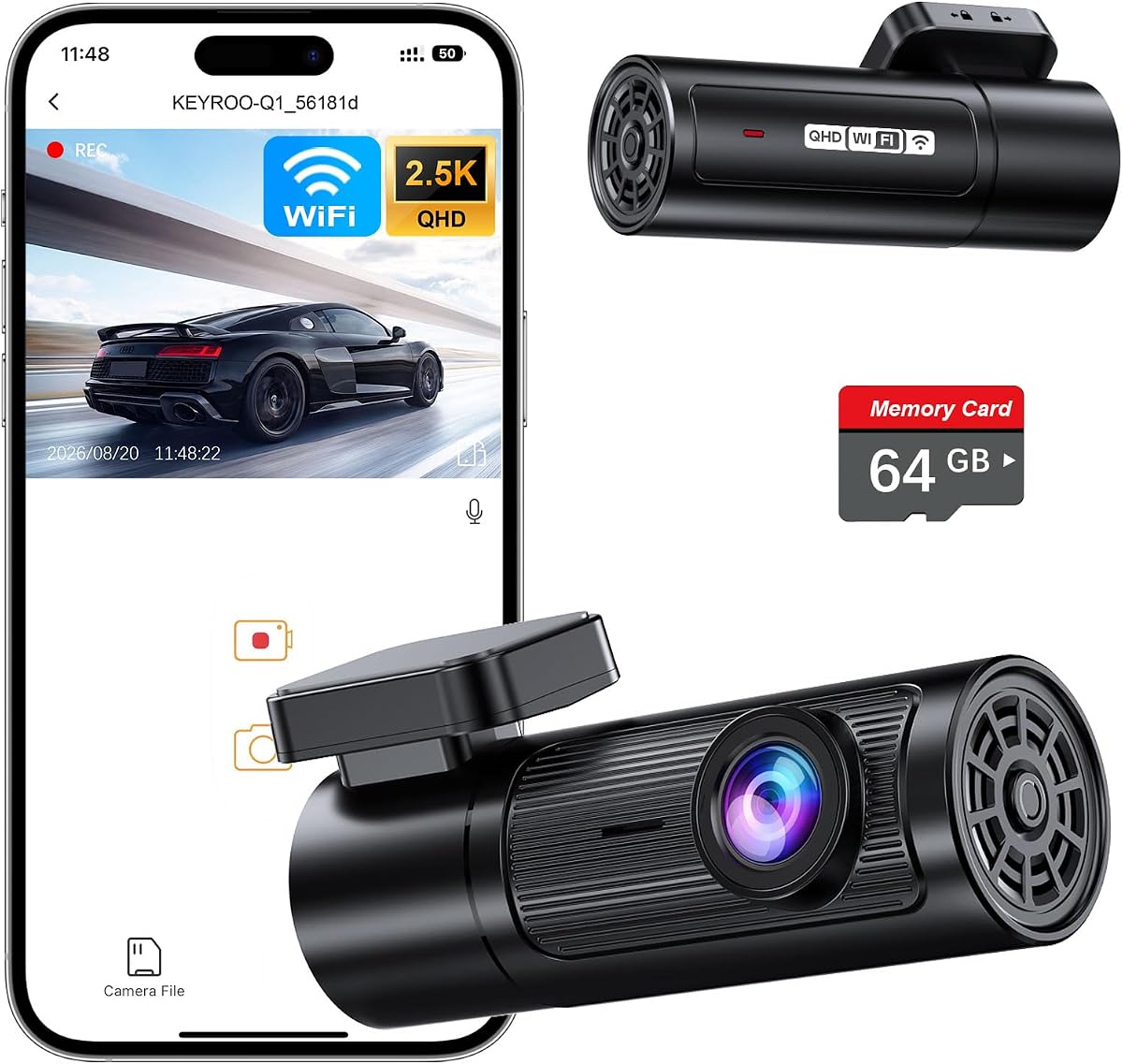
2.5K Dash Cam Front
4.7Editor score
2.5K front recording
64GB card included
Compact screen-free design
This Go Kart Dash CAM guide compares ten models for resolution, coverage, parking protection, app control, night vision, and ease of installation.
A Go Kart Dash CAM is most useful when it captures clear, wide-angle footage without distracting the driver or interfering with the vehicle. Important qualities include readable detail, broad road coverage, dependable low-light recording, secure file storage, and a power setup suited to a compact vehicle or track-day machine.
The ten products in this guide are compared using the specifications and feature information supplied by each manufacturer. The list covers front-only, front-and-rear, multi-camera, and motorcycle-oriented systems, with particular attention to resolution, viewing angle, parking mode, connectivity, and included accessories.
Each review identifies the strongest use case and the main compromises rather than treating every feature as equally important in every situation. Ratings and availability can change, product configurations may vary, and current prices should always be checked on the linked retailer page before making a purchase.
4.7Editor score

4.5Editor score

4.6Editor score
This side-by-side comparison highlights the differences in camera count, recording resolution, connectivity, and parking protection, helping readers identify the most suitable dash cam for a go kart, compact car, motorcycle, or other vehicle use case.




The ROVE R2-4K Dual combines front and rear cameras, strong connectivity, GPS metadata, and a generous selection of parking and recording features. Its 4.5 rating reflects a well-rounded system that balances image quality, compactness, and day-to-day convenience. The supplied 128GB microSD card means the core installation can begin without an immediate storage upgrade.
We may earn a commission when you buy through this link, at no additional cost to you.
Its front camera records at 2.5K and upscales the result to 4K, while the rear records at 1080p. A Sony STARVIS 2 IMX675 sensor, wide front aperture, HDR, and the ROVE app for live viewing and file transfers make this setup appealing in daylight, dusk, and low-light environments. Dual-band 5.8GHz and 2.4GHz WiFi also helps reduce waiting when downloading important clips to a phone.
The most significant qualification is that the advertised 4K front image is upscaled rather than native 4K. The hardwire kit required for 24-hour parking is also not included. These are meaningful costs for buyers who want the most advanced resolution or unattended recording, but the supplied cable, mounts, charger, card, and extensive parking options make the core package well rounded.
This is a strong all-around choice for a go kart road setup or compact vehicle that benefits from both forward and rearward evidence. It is especially suitable for drivers who want GPS speed and route data, phone-based file management, and stronger low-light capture without moving to a large multi-camera system.
Recording both directions provides context that a single front camera cannot, especially in parking-lot incidents or when another vehicle approaches from behind. Built-in GPS adds route, location, and speed information that can make the footage more useful for route documentation and incident review.
Dual-band WiFi is one of the ROVE's strongest practical features. Transfer speeds stated in the product information can be much faster than those offered by basic 2.4GHz-only dash cams, making it easier to retrieve a short clip without repeatedly removing the memory card.
We may earn a commission when you buy through this link, at no additional cost to you.
The galphi 4K Front is a compact, screen-free dash cam designed for drivers who want detailed road coverage without a large display competing for windshield space. It earns a 4.4 rating and includes a 32GB card, 5GHz WiFi, a 160-degree lens, and support for cards up to 256GB. The result is a simple single-camera package with modern transfer speeds.
We may earn a commission when you buy through this link, at no additional cost to you.
The front camera records in 4K UHD, offering a higher-resolution option than the upscaled ROVE setup. An F1.6 aperture, WDR, and the stated Super Night Vision feature help balance exposure in difficult light. The app supports up to 8MB/s downloads over 5GHz WiFi, while seamless loop recording and G-sensor event locking protect important clips from being overwritten.
Its screen-free design is a clear advantage in a go kart or small vehicle where dashboard space and visibility are limited. The trade-offs are equally clear: there is only a front camera, and continuous parking surveillance requires a separately purchased Type-C hardwire kit. A screen-free unit also offers fewer direct on-device controls, making the app more central to operation.
Choose the galphi when front-facing 4K detail, rapid wireless downloads, and a small physical footprint matter more than rear coverage. It is particularly well suited to a compact recreational vehicle used on roads where legal and safe operation permit a windshield-mounted dash cam.
The 4K UHD recording mode is useful when fine road detail is a priority, while the small screen-free housing keeps the camera from dominating the view. The 160-degree lens also covers several lanes, although the edges of such a wide image can look stretched.
Connecting a phone over 5GHz WiFi reduces download delays compared with many entry-level 2.4GHz systems. The included card and support for larger capacities also make it easier to build a practical recording setup over time.
We may earn a commission when you buy through this link, at no additional cost to you.
The KEYROO Q1 2.5K combines a high stated customer rating with a useful 64GB memory card and a compact body. Its 2560×1440 recording at 30fps, six-layer lens, and 160-degree field of view provide more detail and coverage than a basic 1080p unit. For budget-conscious buyers, the ready-to-record package is particularly attractive.
We may earn a commission when you buy through this link, at no additional cost to you.
WiFi and the companion app allow iOS and Android users to preview, download, replay, and share footage without removing the card. A rotatable lens makes it possible to adjust the view for different vehicles, while the G-sensor locks clips following sudden impacts. The product also advertises low-frame-rate time-lapse parking mode, but a compatible hardwired kit must be purchased separately.
The main limitation is its single-camera arrangement, so there is no rear or cabin perspective. Its listed resolution also sits below native 4K systems, and 2.5K files can consume more storage than 1080p recordings. Nevertheless, the included 64GB card, screen-free design, and 360-degree lens adjustment make it a balanced choice for ordinary road use.
The Q1 is a sensible recommendation for riders or drivers who want a small dash cam, app-based control, and strong everyday resolution without moving to a multi-camera or premium GPS-equipped setup. Its 4.7 rating also makes it a notable option within this comparison.
A 64GB high-endurance card is preinstalled, which is a meaningful advantage over systems that require a separate purchase. The camera also supports cards up to 256GB, giving users room to extend recording capacity as their needs change.
The rotatable lens and detachable bracket help accommodate different windshield positions and vehicle sizes. This adjustability is useful for a go kart, where the camera may need to be repositioned to capture the road, occupants, or more of the track environment.
We may earn a commission when you buy through this link, at no additional cost to you.
The CAMECHO Motorcycle Dual is the only product here designed explicitly around motorcycles, motorbikes, ATVs, UTVs, golf carts, and similar open vehicles. It records with a 1080p front camera and a 720p rear camera, displays both through a 2-inch split screen, and carries meaningful IP65 and IP67 water-resistance ratings.
We may earn a commission when you buy through this link, at no additional cost to you.
Its wired controller provides LED recording status, a one-press lock function, photo capture, recording controls, and factory reset. Loop recording and the G-sensor work together to protect collision clips, although the memory card is not included. The system can draw power through a motorcycle power line or a USB boost cable, making it more adaptable than a conventional 12-volt-only car camera.
Image specifications are less advanced than several competing products, with the rear camera limited to 720p and no WiFi or app controls listed. Nevertheless, ruggedness, simple physical operation, dual-camera coverage, and a handlebar-friendly design may matter more than maximum resolution in an exposed or vibration-prone setup. The absence of a published customer rating also means comparisons should focus on verified features rather than review history.
This is a practical candidate for an off-road-oriented go kart or motorcycle where water, dust, vibration, and glove-friendly controls are likely concerns. It is less suitable for a small windshield-mounted car setup that prioritizes high-resolution video and wireless file management.
The stated IP65 and IP67 protection ratings provide useful reassurance for rain, snow, dust, and general outdoor exposure. The sealed camera design is a stronger fit for open vehicles than a conventional adhesive-mounted car dash cam with an exposed display.
A wired controller can be easier to operate than a touchscreen or app during riding. Its recording indicator also gives immediate status feedback, while the lock button provides a straightforward way to preserve a clip.
We may earn a commission when you buy through this link, at no additional cost to you.
The Garmin Dash Cam Mini 3 is designed around compactness, straightforward operation, and polished integration with the Garmin Drive app. It records crisp 1080p footage through a wide 140-degree lens, includes a built-in polarizer to reduce windshield glare, and supports voice commands for saving clips and controlling audio.
We may earn a commission when you buy through this link, at no additional cost to you.
Its strongest selling points are practical rather than specification-heavy. The small body should be less intrusive in a compact vehicle, while automatic event saving provides a simple way to preserve incidents. Parking Guard can notify a compatible phone when an event occurs, and remote live viewing is possible when the required app, network, power, and service conditions are met.
The important qualification is that remote access and Vault features require a paid plan, active WiFi, constant power, and a compatible smartphone. The camera's maximum resolution is 1080p, so it does not match the 2.5K or 4K alternatives on paper. Some jurisdictions also regulate or prohibit dash cam use, which owners should verify before installation.
Choose this Garmin if a discreet, easy-to-control camera and reduced windshield glare matter more than native 4K detail. It is a refined front-camera option for drivers who already use the Garmin ecosystem or want a simple voice-controlled interface.
The Garmin Clarity polarizer is designed to reduce glare from the windshield, improving the readability of daytime details. It is particularly relevant when bright sunlight, reflections, or pale road surfaces otherwise obscure vehicles and signs.
Voice control lets the driver save footage without fumbling with a small button. Automatic incident saving provides a second layer of convenience by preserving relevant events without requiring manual action.
We may earn a commission when you buy through this link, at no additional cost to you.
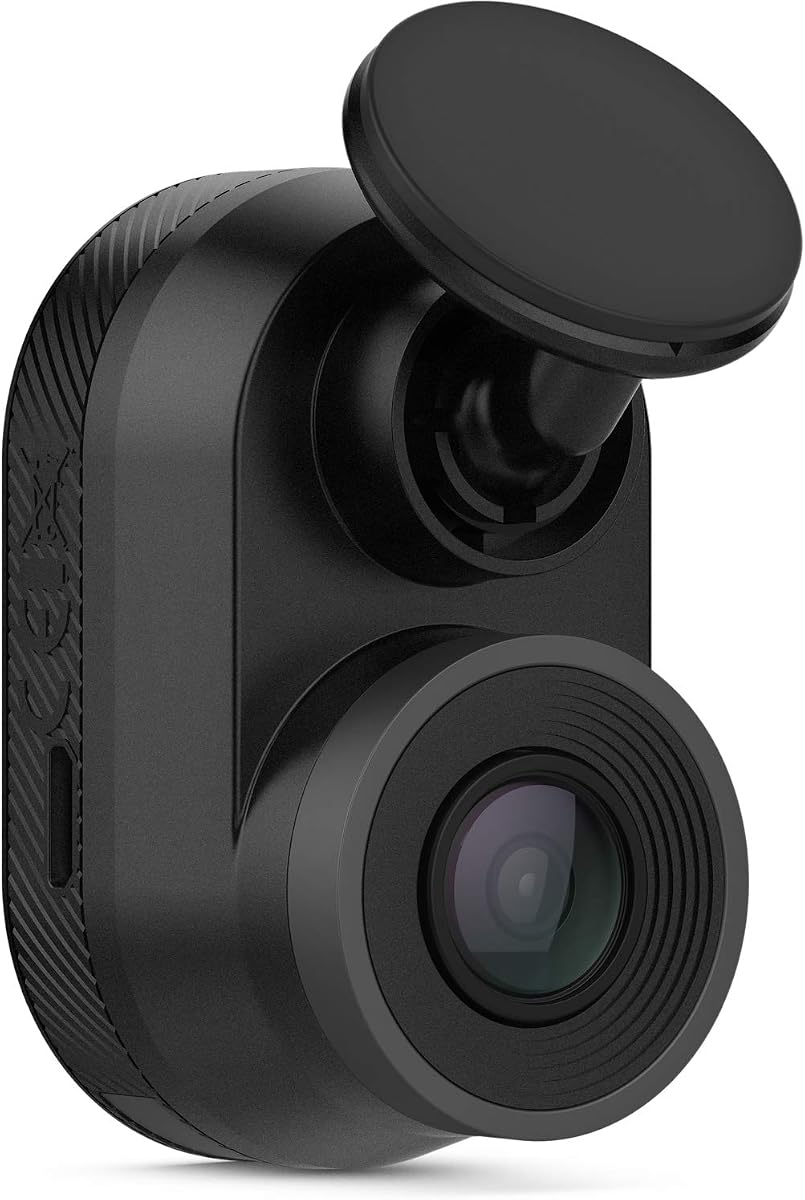
The Garmin Dash Cam Mini is a car key-sized front camera designed to remain visually unobtrusive while continuously recording. It captures 1080p HD video across a 140-degree field of view, automatically identifies and saves incidents, and carries a 4.2 rating. The low-profile adhesive mount suits vehicles where a larger housing could distract the driver.
We may earn a commission when you buy through this link, at no additional cost to you.
Built-in WiFi allows saved footage to be uploaded to a compatible smartphone through the Garmin Drive app. Its auto-sync function can also control and play back footage from up to four cameras, which provides a path to a broader multi-camera arrangement. The box includes the camera, low-profile mount, vehicle power cable, long and short USB cables, and documentation.
Compared with the newer Garmin Mini 3 models, it lacks a built-in polarizer, voice control, and described parking notifications. It also requires a separate Class 10 or faster 8GB microSD card or larger, with no card included. Its 1080p recording is adequate for basic evidence but offers less detail than modern 2.5K and 4K systems.
This Mini makes sense for a buyer who values size, dependable automatic incident capture, and established app support over maximum resolution. It is a clean front-camera solution for a go kart or compact car where every bit of mounting space and visual distraction matters.
The key-sized enclosure and low-profile mount are the defining advantages. A smaller camera is less likely to block a go kart's compact windscreen or a small vehicle's forward view, while still covering a broad portion of the road.
Although sold as a single-camera model, support for up to four cameras makes it a practical base for a larger setup. Buyers can add compatible units over time and manage their synchronized views through the same Garmin Drive app.
We may earn a commission when you buy through this link, at no additional cost to you.
This Garmin Dash Cam Mini 3 listing focuses on the compact model's connected features, combining 1080p recording, a 140-degree field of view, a Garmin Clarity polarizer, and voice control. It has a 4.0 rating and is designed for drivers who want a nearly invisible camera with a more capable app-based workflow.
We may earn a commission when you buy through this link, at no additional cost to you.
Online Vault storage can automatically preserve important clips, while the app supports live remote viewing, incident notifications, and synchronized playback from as many as four dash cams. These features extend the camera beyond simple loop recording, although remote access depends on a paid Vault subscription, an active WiFi connection, constant power, and a compatible phone.
The product shares several strengths with the other Mini 3 listing, including a glare-reducing lens, voice commands, and a body designed to withstand direct sunlight and hot vehicle interiors. The tradeoff is the 1080p ceiling and the recurring cost associated with remote cloud features. A separate storage card may also be needed depending on the package configuration.
This version is best for users who want remote incident checking and a multi-camera Garmin ecosystem. Buyers who only need local recording and automatic event saving can find similar core performance in simpler front-camera alternatives without relying on subscription-based access.
When a vehicle is parked, remote live view and event notifications can show what happened without requiring the owner to return to the car immediately. The feature is convenient for peace of mind, but its subscription and power requirements should be considered before installation.
The stated construction is designed for harsh cabin conditions, including direct sunlight and elevated temperatures. That focus is relevant for a go kart or compact vehicle that may sit outdoors in warm conditions.
We may earn a commission when you buy through this link, at no additional cost to you.
The IIWEY N5 is the most comprehensive multi-camera system in this guide, recording front, rear, sides, and interior views. It has a 4.4 rating, includes a 3-inch IPS display, and supports 2.5K front footage alongside three 1080p channels. A preinstalled 128GB card and built-in 5GHz WiFi make it ready for broad vehicle surveillance.
We may earn a commission when you buy through this link, at no additional cost to you.
The cameras use wide fields of view, including 170-degree front and rear lenses and 150-degree side lenses. An app available under the iiwey and viidure names supports preview, download, and sharing. The N5 also includes loop recording, G-sensor emergency locks, 24-hour time-lapse and impact parking modes, and a supercapacitor rated for extreme temperatures.
Its complexity is the primary drawback. The rear camera must be wired to the front unit, the system cannot be powered through a USB or Type-C cable, and the original cigarette-lighter charger is required. A compatible hardwire kit is needed for parking mode and is sold separately. The N5 also does not include GPS, so route and speed metadata are unavailable.
This system is ideal for a street-going vehicle where blind spots, cabin activity, and rear traffic deserve equal attention. It is less suitable for a minimalist go kart installation because of the wiring and power complexity, but it offers the broadest documentation among the products reviewed.
Front, rear, side, and cabin recordings can reconstruct an incident more completely than a single forward view. The 2.5K primary channel preserves extra detail while the additional cameras broaden situational awareness.
The supercapacitor is designed to tolerate extreme temperatures better than a conventional lithium battery. The stated operating range also makes the system more suitable for prolonged parking use, provided the correct hardwire kit is installed.
We may earn a commission when you buy through this link, at no additional cost to you.
The GKU D600 Pro Max stands out with native 4K front recording, a 1080p rear camera, a STARVIS 2 sensor, built-in GPS, and WiFi 6 transfers. Its 4.6 rating and 64GB preinstalled card support it as one of the strongest premium systems for a road-going go kart or compact vehicle.
We may earn a commission when you buy through this link, at no additional cost to you.
Its 170-degree front and 150-degree rear coverage reduce blind spots, while WDR, Super Night Vision, and glare reduction support clearer recordings in changing light. The GKU GO app provides wireless preview and downloading, and the stated WiFi 6 speed of up to 20MB/s is useful for transferring clips. GPS records route, speed, and location data that can be reviewed with the free GKU GPS Player.
Parking protection includes time-lapse, collision detection, and pre-recording, with the system capable of retaining context before and after an incident. However, the required hardwire kit is not included. The included car charger supports installation, but the optional USB route requires a compatible cable that is not part of the package. Voice control and a supercapacitor add convenience and heat resistance.
Choose the GKU for high-resolution front detail, rear coverage, GPS data, and strong parking features. It is a premium all-rounder for drivers who want a visually small system without giving up the metadata and incident tools associated with more elaborate dash cam platforms.
The STARVIS 2 sensor and native 4K mode give this camera a stronger detail proposition than upscaled systems. WDR and Super Night Vision further help balance dark areas and bright headlights in difficult scenes.
Pre-recording can retain footage before a detected collision, while the stated 30-to-60-second incident window helps provide more complete evidence. These are valuable features for a vehicle regularly parked near traffic or in shared parking areas.
We may earn a commission when you buy through this link, at no additional cost to you.
The Veement V300 is a straightforward front-camera option with resolution above standard 1080p, a very wide 170-degree lens, and built-in WiFi. It earns a 4.1 rating and targets drivers who want a simple mini dash cam with app control without moving to a more complex front-and-rear installation.
We may earn a commission when you buy through this link, at no additional cost to you.
The camera records at 2304×1296, and its F1.7 aperture and six-layer glass lens are intended to improve visibility in nighttime and other low-light conditions. The VeeCar app supports live preview, playback, downloads, editing, and sharing through a local WiFi connection. Seamless loop recording and support for up to 256GB cards provide standard continuous-recording functionality.
A memory card must be purchased separately, which adds a step to setup and increases the total cost of ownership. The WiFi connection is local rather than internet-based, and continuous USB-C power is required. Its stated 24/7 parking mode is also constrained by the need for an appropriate power arrangement. Eliminating the traditional lithium battery is a meaningful heat-safety benefit.
The V300 is a sensible entry-level choice for a simple go kart or compact vehicle that needs front-facing evidence and phone-based retrieval. It should not be chosen for rear coverage, GPS metadata, native 4K detail, or a fully featured parking system.
The 1296p recording mode provides additional vertical detail compared with a standard 1080p dash cam. Combined with the broad lens, it can capture multiple lanes and roadside information in a compact front-camera package.
Removing the lithium battery reduces the number of heat-sensitive components inside the unit. The trade-off is that the camera cannot operate without a continuous USB-C power supply, making installation planning more important.
We may earn a commission when you buy through this link, at no additional cost to you.
The right dash cam depends on the vehicle, recording environment, available power, and desired level of evidence. Resolution, field of view, low-light performance, connectivity, storage, and installation complexity should be considered together rather than judged by a single headline specification.
A conventional 12-volt car dash cam may not be suitable for every go kart or recreational vehicle. Some karts have limited electrical systems, exposed handlebars, unusual windshields, or no standard accessory socket. In those situations, a USB-powered mini camera or a motorcycle-oriented system may install more cleanly. A hardwire kit can provide constant power for parking surveillance, but it must match the vehicle's electrical system and the dash cam's voltage requirements.
Choose a camera whose mounting method, power source, and field of view suit the actual vehicle. Confirm whether the unit is intended for a road, enclosed cabin, handlebars, or another location before drilling, adhering, or routing cables.
Resolution determines how much fine detail a recording can preserve, but it is only one part of image quality. A native 4K or 2.5K front camera can make license plates, signs, and lane markings more useful, especially when the video must be enlarged. A system that advertises 4K through upscaling should be understood as 2.5K-based output, which may still look sharper than 1080p but should not be compared as native 4K.
For compact vehicles and track use, prioritize a balance of resolution and storage consumption. 4K is valuable for detailed evidence, while 1080p remains adequate for many routine journeys and puts less pressure on memory-card capacity.
A front-only camera is the simplest and lightest option, but it cannot show what happened behind the vehicle. Front-and-rear systems add useful context for parking incidents, rear impacts, and traffic following the vehicle. Four-channel systems add side and interior views, which can be useful for rideshare work or comprehensive incident reconstruction but require more wiring and create more installation complexity.
Match coverage to the actual risk. A go kart used mainly for forward-facing track footage may not need four cameras, while a street-driven vehicle left in busy parking areas may benefit from a rear camera or parking mode.
Wide-angle lenses help reduce blind spots and capture several lanes or a broad section of the track. Common angles in this category range from 140 degrees to 170 degrees, with the CAMECHO motorcycle model using 120 degrees at the front and 90 degrees at the rear. Extremely wide views can introduce edge distortion, making objects near the sides appear stretched or smaller.
Look for an angle that covers the road without unnecessarily capturing excessive sky, dashboard, or neighboring lanes. Adjusting the camera after installation is just as important as the stated specification.
Low-light quality depends on the sensor, aperture, HDR or WDR processing, lens design, and software. The ROVE and GKU use STARVIS 2 sensors, while the galphi, Veement, and KEYROO list wide apertures and night-oriented processing. These features can improve the visibility of vehicles, signs, and license plates after dark, but no specification completely replaces real-world testing.
For frequent nighttime use, prioritize a model explicitly designed for night vision and a wide aperture. Make sure the camera can maintain exposure without washing out headlights or rendering the road almost black.
Continuous recording requires reliable microSD storage, and loop recording makes that storage practical by overwriting the oldest unlocked files. Some products include a card, while others require a separate Class 10 or higher card; the Veement and original Garmin Mini are examples with no card included. Check maximum supported capacity and the required speed class before making an additional purchase.
WiFi makes previewing and downloading clips convenient, but dual-band 5GHz or WiFi 6 systems generally provide faster transfers than 2.4GHz-only models. App support should also be assessed for connection stability, sharing controls, and whether remote access requires a subscription.
Parking surveillance can use time-lapse recording, motion detection, collision detection, or pre-event buffering. Almost every listed parking mode requires a separate hardwire kit, and some require constant power to maintain operation. The distinction matters because a vehicle's accessory socket may switch off with the engine, while a correctly installed hardwire kit can monitor the vehicle for a longer period.
Check parking-mode requirements, event lengths, operating temperatures, and the power-management design. Supercapacitor systems may be preferable for heat resistance, while battery-free designs eliminate one common source of thermal concern.
A compact, screen-free model is often easier to position in a go kart because it preserves visibility and reduces distraction. Adhesive mounts can be stable, while suction cups are easier to relocate and remove. Ensure the camera does not obstruct a required mirror, safety equipment, controls, or the driver's forward view. Clean the mounting surface and route power cables away from sharp edges and moving components.
Physical controls and a wired controller can be more practical than an app when the user wears gloves. Conversely, a small screen-free body is usually easier to manage if the driver does not want menus or bright displays competing for attention.
Begin by confirming that the dash cam is approved for use on public roads in the relevant jurisdiction, since some locations regulate or prohibit windshield-mounted recording devices. Choose a mounting position that provides a clear forward view without blocking visibility, and test the angle before tightening the bracket. For exposed or open vehicles, protect the cable route from steering movement, heat, water, and abrasion.
Install the appropriate memory card before the first drive, format it in the camera when that function is available, and confirm that recordings appear in the app. Adjust image exposure, resolution, and loop length according to available storage. Test the G-sensor by carefully triggering a save command or following the manufacturer's test procedure rather than intentionally causing a collision. Also verify that the timestamp, GPS information, and front or rear camera orientation are correct.
Review a short sample recording after installation, including one in daylight and, if possible, one at night. Check whether license plates, signs, and nearby vehicles are readable within the actual field of view. Clean the lens gently, inspect the power cable and mount, and review the card periodically. Preserve important incident files before loop recording replaces them, and avoid formatting the card while recordings are still needed.
You can use one if the camera's mounting, power, and field of view work safely with the go kart and local laws permit recording. Check whether the vehicle has a suitable 12-volt socket, USB power source, or hardwire option. The camera should never obstruct the driver's view, steering controls, safety equipment, or access to essential switches.
A front-and-rear system provides better context for road incidents and parking-area events. A front-only camera is easier to install, lighter, and usually less distracting. Choose two cameras when evidence from both directions is important, particularly if the go kart is used in mixed traffic or parked in a busy location.
Not always. Resolution improves potential detail, but sensor quality, lens sharpness, exposure, lighting, compression, and file retention also affect what can be identified. A native 4K model should be compared separately from an upscaled 4K system, and a well-tuned 2.5K camera may produce more useful footage than a higher-resolution camera in poor conditions.
Most of the listed systems require a compatible hardwire kit for continuous 24-hour parking surveillance. The kit is generally sold separately and must match the vehicle's electrical arrangement. Without constant power, the camera may stop recording when the engine is turned off, depending on how its parking mode is configured.
No. The ROVE, galphi, KEYROO, IIWEY, and GKU listings include memory cards, while the Veement and original Garmin Dash Cam Mini do not. CAMECHO also states that its TF card is not included. Use a card meeting the manufacturer's minimum speed and capacity requirements, and format it within the camera when possible.
They are often more suitable because they are smaller and avoid displaying menus or bright images while driving. A screen-free model is also easier to position in a compact windscreen. The tradeoff is that some controls and settings depend entirely on the companion app, so the phone should be kept out of reach while the vehicle is moving.
Local WiFi generally works while the driver is near the vehicle, but remote viewing may require additional services, constant power, and a paid cloud plan. Garmin's remote features explicitly depend on those conditions. Check the requirements before relying on a dash cam as an unattended security system.
Save or copy the file to the phone, computer, or another storage location before the loop-recording system overwrites it. Event locking can reduce the risk of automatic deletion, but it is not a permanent backup. Also make a separate copy if the footage may be needed for an insurance claim, police report, or dispute.
The ROVE R2-4K Dual is the most complete balanced system in this guide, combining front-and-rear recording, GPS, fast dual-band WiFi, and flexible parking modes. The KEYROO Q1 2.5K stands out as the budget leader with its compact design, useful app, included 64GB card, and strong 4.7 rating, while the GKU D600 Pro Max is the premium option for native 4K detail and advanced low-light capture.
Prioritize the features that match the vehicle and operating environment. Front-only cameras are simplest, rear cameras improve incident context, multi-channel systems offer the broadest coverage, and low-light sensors or apertures matter most for nighttime use. Confirm power requirements, parking-mode accessories, storage support, legal restrictions, and app conditions before installation.
Ratings, bundle contents, and product configurations can change, and current prices should be checked on the linked retailer page. For any purchase, verify the exact model, card inclusion, mounting hardware, and hardwire compatibility before checkout so the installed dash cam meets your recording needs.