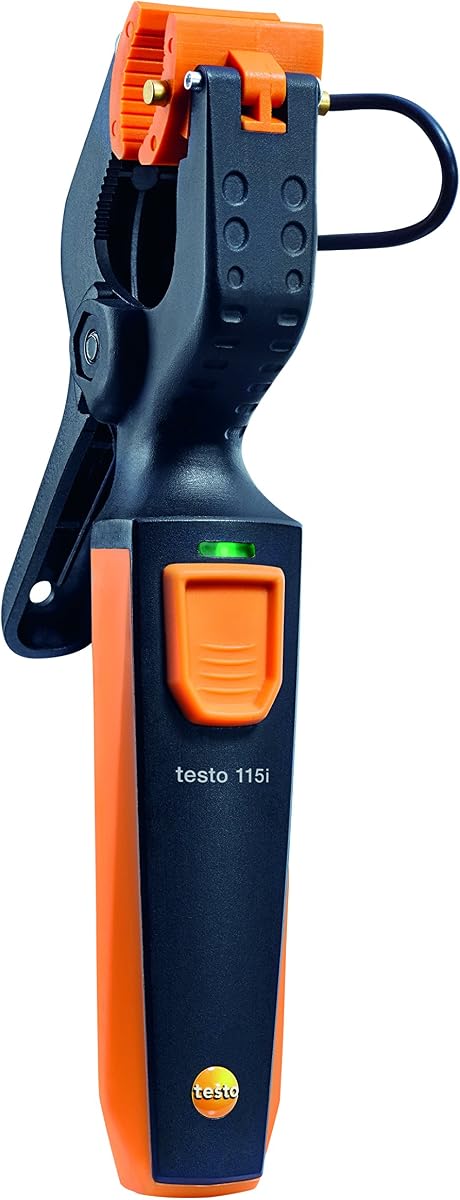
testo 115i Clamp Meter
4.6Editor score
Bluetooth app data logging
Up to 1.5-inch pipe capacity
NTC sensor measurement technology
PDF and Excel data export
Explore the best Temperature Clamp for HVAC options, comparing accuracy, pipe fit, displays, temperature ranges, features, and field usability.
A temperature clamp for HVAC gives technicians a practical way to measure pipe temperatures without inserting a probe into refrigerant lines or disconnecting equipment. A useful model should maintain steady contact, display readings clearly in demanding service environments, and provide enough range and accuracy for common diagnostic tasks.
We compared ten clamp-on thermometers and thermocouple systems using the information supplied for each product. The evaluation covers measurement range, stated accuracy, clamp size, wired or wireless operation, display features, compatibility with meters, battery convenience, and suitability for HVAC troubleshooting and maintenance.
Each pick highlights a different practical path: a straightforward all-in-one pipe thermometer, an adapter for existing meters, a dual-channel kit, or a Bluetooth instrument for connected documentation. Ratings and product details may change over time, and current prices should be checked before purchasing.
4.6Editor score

4.4Editor score

5.0Editor score
The comparison below places the ten options side by side, focusing on sensor type, pipe-contact method, measurement range, display capabilities, and how each tool connects to the rest of a technician's equipment.


This all-in-one digital pipe thermometer earns the leading position because it combines a broad measurement range, a stable spring-loaded grip, and a highly readable display without requiring a separate multimeter. Its 4.4 rating reflects a solid balance of features for HVACR diagnostics, automotive air-conditioning work, pipe monitoring, and general maintenance. For technicians who want one clamp to handle many routine jobs, its practical design is especially compelling.
We may earn a commission when you buy through this link, at no additional cost to you.
The stated accuracy of plus or minus 0.3 Celsius across minus 50 to 150 Celsius gives the instrument a useful combination of resolution and operating range. A spring-loaded jaw holds pipes of varying diameters securely, which helps preserve contact while the reading settles. The 180-degree display rotation is useful when the pipe is mounted overhead, behind equipment, or in a narrow mechanical space, while the intelligent backlight improves visibility in plant rooms, attics, and engine bays.
Its main limitation is that it functions as a single-purpose temperature instrument rather than a connected diagnostic system. It does not provide the two-channel comparison, adjustable alarms, or downloadable trend data found in some dual-channel meters. The 4.4 rating is not the highest in this list, although that does not diminish its usefulness for straightforward pipe-temperature readings where immediate portability and simplicity matter more than digital recordkeeping.
The product is best suited to service technicians, facilities maintenance teams, and serious do-it-yourself users who want dependable pipe readings without assembling a thermocouple system. It is particularly appropriate for superheat, subcooling, and surface-temperature troubleshooting when a compact standalone tool is preferred. For these users, it offers the strongest general-purpose balance in the group and serves as our top overall recommendation.
The spring-loaded clamp attaches quickly and holds the sensing surface against the pipe without requiring the user to keep a hand on the instrument. That hands-free stability is valuable when a technician must watch the display while operating controls elsewhere in the system.
The rotating screen and short-press backlight solve two common field problems: viewing glare caused by an upside-down display and poor visibility inside dark cabinets. Easy Celsius-Fahrenheit switching also reduces delays when moving between measurements and system specifications.
We may earn a commission when you buy through this link, at no additional cost to you.
The WISSCOOL Wireless Temperature Probe is a compact standalone option for technicians who want to check pipe temperature without managing a probe lead. Its 4.2 rating places it among the stronger choices in the list, and the supplied information emphasizes quick attachment, wireless operation, and a backlit display. It is especially useful where a conventional wired adapter would be cumbersome or where the technician wants to move between the clamp and other tasks.
We may earn a commission when you buy through this link, at no additional cost to you.
Its stated range extends from minus 58 to 302 Fahrenheit, covering common refrigeration and air-conditioning pipe temperatures. The spring clamp secures the sensor to a pipe, eliminating the need to hold the thermometer in place continuously. A backlit LCD makes the reading easier to inspect in equipment rooms, basements, attics, and other poorly illuminated service areas, while the compact body should be easier to carry than a full meter with attached leads.
The main uncertainty is the lack of a specific accuracy figure in the product information. A wide range and stable clamp are useful, but they do not fully describe how precisely the probe captures surface temperature. There is also no stated app connection, charting, or file-export capability, so users should not assume that the word wireless implies smartphone-based documentation. Those limitations keep it behind the more transparent standalone model in the top position.
This probe makes the most sense for routine HVAC and refrigeration checks, maintenance visits, and situations where quick cordless placement is more important than detailed records. It may also appeal to technicians who dislike trailing thermocouple wires. For users seeking a simple, compact pipe thermometer with a broad range and illuminated display, it is a credible choice, provided the available meter accuracy aligns with the diagnostic precision they require.
Wireless operation can make it easier to monitor a pipe and then move the instrument for another check. The compact form may also be attractive for service vehicles where space is limited and every loose accessory adds clutter.
The illumination and compact clamp are suited to equipment rooms, attics, basements, and other service locations. These practical details matter because a thermometer is only useful when its display can be read where the work is performed.
We may earn a commission when you buy through this link, at no additional cost to you.
This Type-K temperature clamp is a practical adapter for technicians who already own a compatible digital multimeter or clamp meter. Its 4.4 rating indicates a well-received product, and the supplied information highlights a 40-inch cable, a 1.8-inch jaw, and compatibility with K-type inputs. Rather than duplicating a meter's controls and display, it extends an existing instrument to pipe-temperature work.
We may earn a commission when you buy through this link, at no additional cost to you.
The 40-inch flexible lead gives the sensor considerable freedom when the measured pipe is inside a cabinet, behind a unit, or otherwise separated from the meter. The clamp opening can accommodate a useful range of pipe sizes, and a banana plug adapter is included for direct connection to suitable meters. Its minus 40 to 392 Fahrenheit range also makes it relevant to industrial heating, ventilation, air-conditioning, and plumbing tasks.
The chief tradeoff is that the accessory is not a complete measuring system. The product information explicitly states that accuracy depends on the precision of the meter being used, so a buyer should verify input type, connector arrangement, and supported measurement range before ordering. It also lacks a dedicated display, alarms, memory, and wireless logging of its own. Those omissions are acceptable when the goal is to expand an existing meter economically.
The product is best for HVAC technicians, maintenance workers, and plumbers who already carry a compatible meter and want a second temperature input. It is less suitable for someone buying a first pipe thermometer or needing a self-contained unit with a clear screen. For those who value flexibility and compatibility, it offers a straightforward way to add clamp-on temperature measurements without carrying another full display device.
The included banana plug adapter allows the clamp to be used with compatible meters, reducing equipment duplication. It can also be paired with a suitable K-type thermocouple thermometer, giving technicians flexibility in how they organize their diagnostic kit.
A 40-inch lead can bridge the distance between a pipe and a meter resting on a service surface. This is particularly helpful around compact condensers, confined mechanical rooms, and components that are difficult to reach from the operator's position.
We may earn a commission when you buy through this link, at no additional cost to you.
The UEi ATTPC3 is built for technicians who want a durable pipe-temperature adapter for a compatible K-type clamp meter. Its 4.3 rating and established product positioning make it a credible field accessory, especially for boiler and air-conditioning line readings. Rather than providing a standalone display, it brings the familiar clamp-meter workflow to surface-temperature measurements.
We may earn a commission when you buy through this link, at no additional cost to you.
The jaws fit pipes from one-quarter inch to one-and-a-half inches, giving the adapter flexibility across common HVAC and boiler installations. A 5.5-foot cable provides ample reach into equipment areas, while metal reinforcement at both ends helps protect the connection from strain. The supplied information also emphasizes wide thermocouple contacts for consistent readings and plug-and-play compatibility with K-type jacks and several compatible UEi clamp meters.
This is not a complete thermometer, and its minus 40 to 250 Fahrenheit range is less expansive than several Type-K clamp options in the comparison. It also requires the user to own a suitable meter and confirm connection compatibility. As an adapter, though, those limitations are understandable. The reinforced construction and broad jaw range make it more attractive for repeated field use than a minimally built generic clamp.
The ATTPC3 is best for HVAC contractors, boiler service technicians, and maintenance professionals with compatible UEi equipment. It is a particularly sensible choice for users who want a reliable pipe accessory that can remain in a professional kit. Those shopping for a first all-in-one temperature instrument should choose a standalone digital model instead, while established UEi users can consider this a focused and durable expansion to their meter setup.
Metal-reinforced cable ends add protection at the points most exposed to pulling and flexing. That construction detail is valuable for a tool expected to be routed around boilers, cabinets, and tightly packed mechanical equipment.
The adapter suits technicians who prefer keeping temperature work within the display and controls of a familiar clamp meter. Its broad contact area is also designed to encourage steady placement and repeatable readings.
We may earn a commission when you buy through this link, at no additional cost to you.
This digital dual-channel thermometer is built for technicians who need to compare two temperatures or monitor two locations with one instrument. It carries a 4.3 rating and includes two HVAC temperature clamps, two wired thermocouple probes, and a meter with an extensive listed range. The package gives users both clamp-style surface measurements and general-purpose wired probes, making it more versatile than a single-purpose pipe thermometer.
We may earn a commission when you buy through this link, at no additional cost to you.
The main unit is listed for minus 200 to 1372 Celsius, while the K-type wired probes cover minus 20 to 200 Celsius and the HVAC clamps cover minus 40 to 200 Celsius. Users can display T1, T2, and the difference between channels, a valuable capability for superheat, subcooling, and comparative diagnostics. Manually adjustable high and low thresholds cause the red backlight to flash when readings move outside the selected limits.
Adjustment compensation is another notable feature, with a stated range of minus 9 to 9 Celsius, although the process requires holding the high and low buttons together. The meter also provides maximum, minimum, average, data hold, Fahrenheit-Celsius switching, and automatic power-off that can be cancelled. These extras add functionality but also create a larger learning curve than a single-channel digital probe.
The kit is well suited to HVAC contractors, refrigeration service teams, and maintenance personnel who routinely compare readings. It is especially useful when two clamps must remain attached while a technician studies a differential value on the main display. Users who only need occasional pipe checks may find the additional controls unnecessary, but for comparative work, the included sensor variety makes this a strong all-in-one option.
Showing T1, T2, and their difference makes the meter valuable for refrigeration diagnostics where a relationship between two line temperatures is more informative than a single isolated reading. Both channels can be observed on the same screen.
The two clamps and two wired probes cover surface and inserted-temperature workflows in one package. This lets technicians choose the sensor that fits the component instead of carrying a separate meter for every measurement style.
We may earn a commission when you buy through this link, at no additional cost to you.
The Universal Dual Channel Thermometer stands out with a 4.7 rating, the highest listed rating among the ten products, and unusually broad thermocouple support. It accepts K, J, T, E, R, S, and N types while including two wired probes and two temperature clamps. This combination makes it an attractive option for HVAC technicians who also perform broader industrial or laboratory temperature work.
We may earn a commission when you buy through this link, at no additional cost to you.
Its display can present T1, T2, their difference, and maximum, minimum, and average values. The clamp range is listed from minus 40 to 392 Fahrenheit, while the main unit and wired probe ranges cover still broader applications. A large backlit LCD, Celsius-Fahrenheit switching, auto power-off, and battery operation support field use, while the dual inputs allow two different sensors or measurement points to be monitored together.
The absence of documented app connectivity means this is a capable standalone meter rather than a connected data platform. The clamp and wired probe readings also depend on the meter's ability to read the selected thermocouple type, so users should understand input compatibility before changing sensor types. Compared with the testo model, it offers less automated documentation, but it makes up for that with a broad accessory set and a lower listed customer rating of 4.7 compared with 4.6 for the premium alternative.
This thermometer is best for service professionals who want one meter to handle multiple thermocouple families and both clamp and probe measurements. It is also compelling for maintenance teams working across HVAC, engines, liquids, and industrial processes. A technician focused exclusively on Bluetooth records may prefer the testo 115i, but for versatility, channel control, and included sensors, this is one of the strongest general-purpose choices.
Compatibility with seven thermocouple families expands the instrument beyond routine HVAC work. Technicians can select appropriate sensors for different jobs while keeping a single display unit in the service kit.
The large backlit screen presents both channels and their difference, along with maximum, minimum, and average values. This reduces the need to alternate between disconnected probes when a quick comparison is required.
We may earn a commission when you buy through this link, at no additional cost to you.
This wireless pipe thermometer offers a clear combination of cordless convenience, a stated plus or minus 0.3 Celsius accuracy, and a wide minus 58 to 302 Fahrenheit range. Its 3.9 rating is the lowest in the comparison, but the listed features remain useful for HVAC, refrigeration, automotive air-conditioning, and industrial maintenance. It is aimed at users who want quick readings without a trailing probe cable.
We may earn a commission when you buy through this link, at no additional cost to you.
The clamp attaches without tools and avoids cutting into or disrupting a line, which makes it suitable for surface-temperature checks during service and maintenance. Simple controls provide power, backlight, and Celsius-Fahrenheit switching, while the directional display can be viewed from different angles. Three AAA batteries are included, and a visible battery indicator helps technicians judge whether the tool is ready for a job.
Its lower customer rating means buyers should pay particular attention to overall satisfaction and should not treat the stated specifications as a substitute for a hands-on evaluation. No remote logging function is documented, so the wireless aspect appears focused on freeing the user from a physical lead rather than transferring data to an app. It also offers only one measurement channel, limiting comparisons that can be made with a dual-channel system.
The tool is best for mobile service work where a technician needs to check several pipes quickly and the display must remain readable in confined or dark locations. DIY users and maintenance teams may also appreciate the stated accuracy and broad range. Those needing two-point comparisons or recorded trends should choose a dual-channel or Bluetooth-capable model, but for portable pipe readings this remains a practical option.
Eliminating a probe lead lets the user carry the instrument around equipment and check multiple lines without managing cables. The clamp can remain on a pipe while the unit is viewed or repositioned for another control.
Included AAA batteries and an on-screen indicator simplify job-site preparation. The backlight and directional screen support use in engine bays, crawl spaces, and mechanical rooms where conventional meters are difficult to read.
We may earn a commission when you buy through this link, at no additional cost to you.
The testo 115i is the premium selection because it combines a dedicated pipe clamp with Bluetooth documentation rather than simply providing another accessory cable. Its 4.6 rating reflects a strong reception among the ten options, and the product is specifically positioned for heating and cooling contractors and technicians. The ability to view, save, graph, and export measurements makes it especially valuable for professional service reporting.
We may earn a commission when you buy through this link, at no additional cost to you.
The NTC sensor technology is described as more accurate than thermocouples, while the clamp grips pipes up to 1.5 inches. Its minus 58 to 302 Fahrenheit range covers the low-temperature refrigeration and high-temperature discharge-line applications common in HVAC work. Bluetooth connection allows readings to be displayed on a phone or tablet, and the supplied information notes that data can be saved in PDF and Excel formats.
The main limitation is dependence on compatible mobile devices and the testo app ecosystem. A technician who only needs an immediate on-screen reading may find a standalone digital clamp more convenient, particularly in areas where a phone is not readily available. The app-driven workflow also requires some setup and discipline, so it is most valuable when documentation is part of the job rather than an optional extra.
This model is best for HVAC/R contractors, commissioning professionals, and service companies that want readings connected to their reporting workflow. Its premium positioning becomes easier to justify when repeated site visits, trending, and report creation matter as much as a single pipe reading. For those users, the testo 115i offers the most complete documentation-oriented package in the guide.
Bluetooth graphing and saved histories turn a pipe reading into a record that can be reviewed and shared. PDF and Excel export can also reduce manual transcription and support more consistent service documentation.
A dedicated clamp that fits pipes up to 1.5 inches removes the need to hold a bare thermocouple against a surface. The stated NTC technology is intended to provide fast, accurate readings for routine in-pipe work.
We may earn a commission when you buy through this link, at no additional cost to you.
The K-Type Temp Clamp Probe receives the budget recommendation because it provides a focused clamp sensor at an accessible entry point. It carries a 5.0 rating, tied for the highest listed rating in the guide, and offers a wide minus 40 to 392 Fahrenheit range. It is not a complete thermometer, but it is a useful expansion for anyone who already carries a compatible meter.
We may earn a commission when you buy through this link, at no additional cost to you.
The spring-like mechanism attaches firmly to pipes, tubes, or surfaces, and the 1.8-inch opening provides a secure connection around the sensing area. Its 32.7-inch cable gives the connected meter reasonable reach when the pipe is inside equipment or a cabinet. Compatibility with multimeters, clamp meters, and thermometers that accept Type-K probes broadens the range of instruments it can serve.
Because accuracy is determined partly by the meter and the connected measuring system, this product should not be mistaken for a self-contained digital instrument. It has no display, alarms, memory, or wireless connection of its own. Users must verify that their equipment accepts Type-K sensors and understand the paired system's measurement limitations. Those constraints are understandable for an inexpensive probe accessory.
This clamp is best for budget-conscious technicians, students, workshops, and maintenance workers who need a straightforward surface-temperature sensor. It is particularly suitable for HVAC, laboratory, and industrial pipe checks where a long lead and broad range are more important than digital records. Buyers seeking a ready-to-use display should choose a standalone model, but those with compatible test equipment can get a capable and well-located clamp from this option.
Users can add pipe-temperature capability without purchasing a complete dedicated meter. The clamp is especially attractive when a Type-K instrument is already part of the user's standard tool set.
The 1.8-inch opening and firm attachment mechanism support consistent sensor placement. A 32.7-inch lead provides enough separation between the pipe and a meter positioned on a nearby work surface.
We may earn a commission when you buy through this link, at no additional cost to you.
This dual-channel thermocouple thermometer offers a broad selection of measurement functions in one package. Its 4.0 rating places it in the middle of the group, but the inclusion of two wired probes and two pipe clamps gives buyers a versatile kit for HVAC, food service, laboratories, manufacturing, and general temperature checks. It is a practical option for users who want more than a simple adapter without paying for a connected premium platform.
We may earn a commission when you buy through this link, at no additional cost to you.
The main unit is listed from minus 200 to 1372 Celsius, which accommodates demanding process and industrial applications in addition to standard HVAC work. The two channels can show differential values, and adjustment compensation provides a way to apply a correction to the displayed readings. High and low alarms, automatic power-off, data hold, Celsius-Fahrenheit switching, and maximum, minimum, and average functions add further control.
The product does not document smartphone connectivity or report export, so technicians who need automatic records must transfer and organize readings themselves. The included text also notes that adjustment compensation is available, but users should follow the device's own operating instructions when setting it. Its 4.0 rating is lower than the 4.3 to 4.7 ratings of several alternatives, so buyers who prioritize customer feedback may want to compare features carefully before committing.
The kit is best for technicians and maintenance users who want two temperature channels and both clamp and wired-probe options in a single purchase. It may also serve well in workshops, kitchens, kilns, and laboratories where the stated main-unit range exceeds ordinary HVAC requirements. For connected service reporting, choose a Bluetooth model; for broad standalone functionality and included accessories, this thermometer is a capable value-oriented bundle.
Manually configured high and low thresholds help flag readings that move outside a desired interval. This is useful when a technician must monitor a process while attending to other equipment in the same area.
The broad main-unit range and interchangeable sensor bundle extend beyond HVAC into food service, laboratories, and manufacturing. The dual inputs make the meter useful when a task requires simultaneous or comparative measurements.
We may earn a commission when you buy through this link, at no additional cost to you.
Choosing an HVAC temperature clamp requires balancing measurement needs, instrument compatibility, pipe size, portability, and documentation. The most useful tool is the one that fits both the diagnostic task and the equipment already carried on the job.
A standalone pipe thermometer includes its own display, controls, and power source, making it convenient for users who do not already own a compatible meter. Clamp adapters are often more economical and can be lighter to carry, but they require a separate digital multimeter, clamp meter, or thermocouple thermometer. When buying an adapter, verify the connector type, supported sensor family, input range, and the accuracy of the meter that will be used. A K-type clamp with banana plugs, for example, is not necessarily interchangeable with every Type-K input.
The listed range should comfortably cover the temperatures encountered in the intended work. Refrigeration, low-temperature air conditioning, boiler work, and industrial processes can require very different limits. Most HVAC pipe clamps in this guide cover a substantial portion of the common HVAC range, while multi-function meters may advertise a much wider main-unit range. Distinguish the clamp's sensor range from the meter's overall range, since the sensor is the limiting component in a pipe measurement.
Accuracy specifications help indicate how closely a reading may correspond to the actual pipe temperature, but they do not describe every source of error. Surface contact, insulation, pipe finish, sensor response time, and the paired meter can all affect the result. Standalone products such as the leading pick state plus or minus 0.3 Celsius accuracy across their range, while adapter products may depend on the precision of the connected instrument. For refrigerant calculations, use appropriate instruments consistently and follow the procedures required for the system.
A clamp must fit securely without sliding or pinching the pipe. Products with a 1.8-inch opening are common in this category, while the UEi model is specified for pipes from one-quarter inch to one-and-a-half inches and the testo 115i accommodates pipes up to 1.5 inches. Beyond diameter, consider the sensor geometry: a broad contact area can improve consistency, while a spring mechanism helps maintain pressure around different pipe sizes. The clamp should also be easy to position in crowded equipment compartments.
Wireless operation removes cable management and can make it easier to move between pipes, but it does not necessarily mean data is sent to a phone. The testo 115i specifically supports Bluetooth viewing, graphing, storage, and PDF or Excel export through an app. A dual-channel wired meter may be preferable when technicians want visible alarms, differential readings, and a predictable connection. Consider how readings will be recorded as well as how they are obtained.
HVAC work often occurs in dim mechanical rooms, under equipment, in attics, and inside vehicle engine bays. A backlit display, large characters, and a rotatable screen can prevent a good measurement from being slowed down by poor visibility. Directional displays are particularly helpful when overhead pipes force the unit into an awkward orientation. Fahrenheit-Celsius switching is also useful when service targets and documentation use different unit systems.
A dual-channel thermometer can measure two points at once and often display the difference between them. That is valuable for superheat, subcooling, and other comparative diagnostics. Adjustable high and low alarms provide immediate attention when a reading crosses a chosen threshold, while maximum, minimum, average, and hold functions help during longer checks. These capabilities add value on busy jobs but also increase the number of controls and may exceed the needs of occasional users.
Battery operation is standard for cordless field tools, but users should note whether batteries are included and whether an indicator is provided. A compact body is easier to carry between service calls, while a rugged shell and strain relief matter when leads are repeatedly routed around sharp equipment edges. The leading standalone product uses three AAA batteries and has a visible indicator, while some adapters use a 40-inch cable and others a reinforced 5.5-foot lead. Choose based on how the tool will actually be carried and stored.
Before taking a reading, confirm that the unit, sensor, and connected meter are configured for the same temperature scale and thermocouple type where applicable. Inspect the clamp and cable for damage, confirm that the pipe is clean enough for reliable contact, and position the sensor on a representative section of the pipe rather than over an insulated fitting or sharp bend. Allow the reading to stabilize before recording it, and follow the relevant HVAC diagnostic procedure when comparing line temperatures.
Install the clamp so it remains secure without crushing the pipe. A spring-loaded jaw should make consistent contact on its own, but the technician should check that the display is not changing as the clamp or cable moves. For a dual-channel instrument, connect the correct sensors to T1 and T2, select the proper channel or difference function, and set any alarm thresholds before beginning the test. Avoid pulling on the cable when repositioning the instrument.
After the job, switch off the unit and remove the clamp before storing it. Wipe the sensor and contact surfaces with a clean, dry cloth, and do not immerse the display, meter, or connector. Check batteries periodically even if the device has an indicator, and replace them as a set when voltage becomes unreliable. Store cables loosely rather than tightly wrapped around the meter, and keep the contacts clean and dry. For a Bluetooth model, also maintain the compatible app and device software so recorded data and exports remain accessible.
An HVAC temperature clamp measures the surface temperature of a pipe while remaining attached to it. Technicians use these readings for diagnostics involving refrigerant lines, boilers, heating pipes, and air-conditioning equipment. A clamp is especially useful when inserting a probe or holding a handheld sensor against a pipe would be inconvenient.
No. A Type-K clamp is generally a sensor accessory that must connect to a compatible meter or thermometer. The connected instrument supplies the display, controls, and measurement processing. A standalone digital pipe thermometer includes those components in one body, making it more convenient for users who do not already own compatible test equipment.
A standard single-channel clamp measures one location at a time. To compare two temperatures, choose a dual-channel meter with two clamps or two wired probes. These instruments can display both readings and often show the difference between channels, which can be useful for superheat, subcooling, and comparative line checks.
Choose a clamp that securely accommodates the smallest and largest pipe you expect to service. The products in this guide commonly use a 1.8-inch opening, while others are specified for particular ranges such as one-quarter inch to one-and-a-half inches. A snug spring grip and stable sensor contact are more important than having a very large maximum opening.
Not necessarily. Wireless operation can simply remove the cable between the probe and its display. Only models with documented Bluetooth app connectivity, such as the testo 115i, are confirmed to support phone-based viewing, graphing, storage, and report export. Check the connection features before assuming that a wireless probe creates records.
Clean the pipe surface, position the clamp on a straight section, and avoid fittings, insulation edges, and sharp bends. Make sure the sensor maintains contact and allow the reading to stabilize before recording it. Cable movement, poor sensor placement, and an incompatible or inaccurate meter can all contribute to inconsistent results.
Look for a range that covers both cooling and heating pipe temperatures encountered in the intended work. Many HVAC clamps cover approximately minus 58 to 302 Fahrenheit, while broader thermocouple clamps can reach minus 40 to 392 Fahrenheit. The connected meter's range and the sensor's limits should both be checked before making a measurement.
An app is optional for ordinary temperature checks unless you need logged histories, trend graphs, or professional reports. A standalone digital clamp is often faster for immediate readings, while an app-connected instrument can reduce manual documentation on repeated service visits. The right choice depends on how you record and use measurements.
The leading HVAC Clamp-On Temperature Probe offers the best general-purpose balance for immediate service work, combining a wide range, stated accuracy, a stable grip, and a rotatable backlit display. The testo 115i is the premium choice for professionals who value Bluetooth measurements, trend history, and PDF or Excel documentation, while the K-Type Temp Clamp Probe provides an economical way to add pipe sensing to compatible equipment.
For occasional users, a standalone model is usually the simplest approach. For technicians with a reliable Type-K meter, a clamp adapter can reduce duplication and expand the existing tool's usefulness. Dual-channel systems deserve consideration when comparing two temperatures is central to the diagnosis, and connected models make more sense when service records are part of the job.
Before buying, verify pipe compatibility, sensor type, connector requirements, temperature range, and whether the product is a complete instrument or only an accessory. Ratings, availability, product details, and prices can change, so check the current listing and customer feedback before making a final purchase.

